
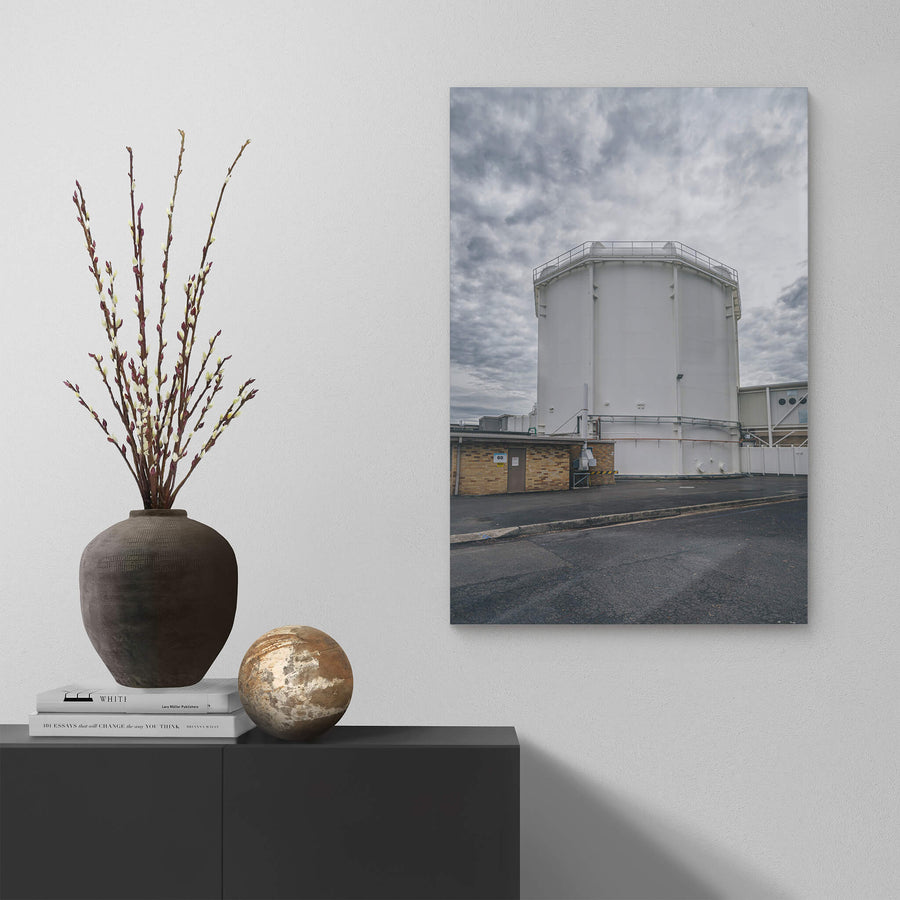
Reactor Containment Building
Provenance
- Camera
- NIKON D850
- Lens
- 14.0-24.0 mm f/2.8
- Settings
- 18mm · f/2.8 · 1/2000 · ISO 64
- Paper
- Ilford Galerie Smooth Cotton Rag 310 gsm
The white, round biological containment building. Building 68 at the front left, which was used by the Australian Federal Police for forensic analysis. The home of HIFAR, a DIDO-class reactor designed by the British.
Open edition
Printed to order, no fixed quantity. Each print is hand-signed by the photographer.
Limited edition
A fixed number of prints exist. Once sold, the edition closes permanently. Each print is individually numbered and signed.
Shipping Free shipping over $250. Ships worldwide, rates calculated at checkout.
Returns Damaged in transit? We replace it. Full policy →
Ships within 10 business days · signed & numbered
In situ


Print datasheet
- Title
- Reactor Containment Building
- Series
- ANSTO HIFAR
- Catalogue
- AHF-018
- Process
- Giclée
- Captured
- 7 October 2022
- Camera
- NIKON D850
- Lens
- 14.0-24.0 mm f/2.8
- Aperture
- f/2.8
- Shutter
- 1/2000 s
- ISO
- 64
- Focal length
- 18 mm
- Paper
- Ilford Galerie Smooth Cotton Rag 310 gsm
- Paper size
- 297 × 210 mm
- Location
- Lucas Heights, New South Wales, Australia
- Authenticity
- C2PA verified provenance →
- Recognised by
- Highly Commended in Multimedia at the 2016 National Trust of Australia (NSW) Heritage Awards
Lucas Heights, New South Wales, Australia
Map · Mapbox · OpenStreetMap
About this print
This white, round structure is the biological containment building, the ultimate shield between the reactor and the outside world. Building 68, at the front left, was used by the Australian Federal Police for forensic analysis.
Brett Patman

The series
ANSTO HIFAR
The High Flux Australian Reactor (HIFAR) was Australia's first nuclear reactor, a research reactor at the Australian Atomic Energy Commission's Lucas Heights establishment in southern Sydney, critical from 26 January 1958 and shut down on 30 January 2007. The British firm Head Wrightson Processes built it to the design of Harwell's DIDO, moderated and cooled by heavy water. Its 25 fuel elements sat in an aluminium tank beneath a round steel top plate, at first-floor level inside a white cylindrical steel containment building under a 20-ton circular crane.
Print sizes
The anatomy view shows what this finish is as a physical object: paper margin, mat band, frame depth, acrylic profile. The comparison strip shows how each size sits relative to the others at true scale. Click a size or a finish to update both.
| Type | Size | Width | Height |
|---|


