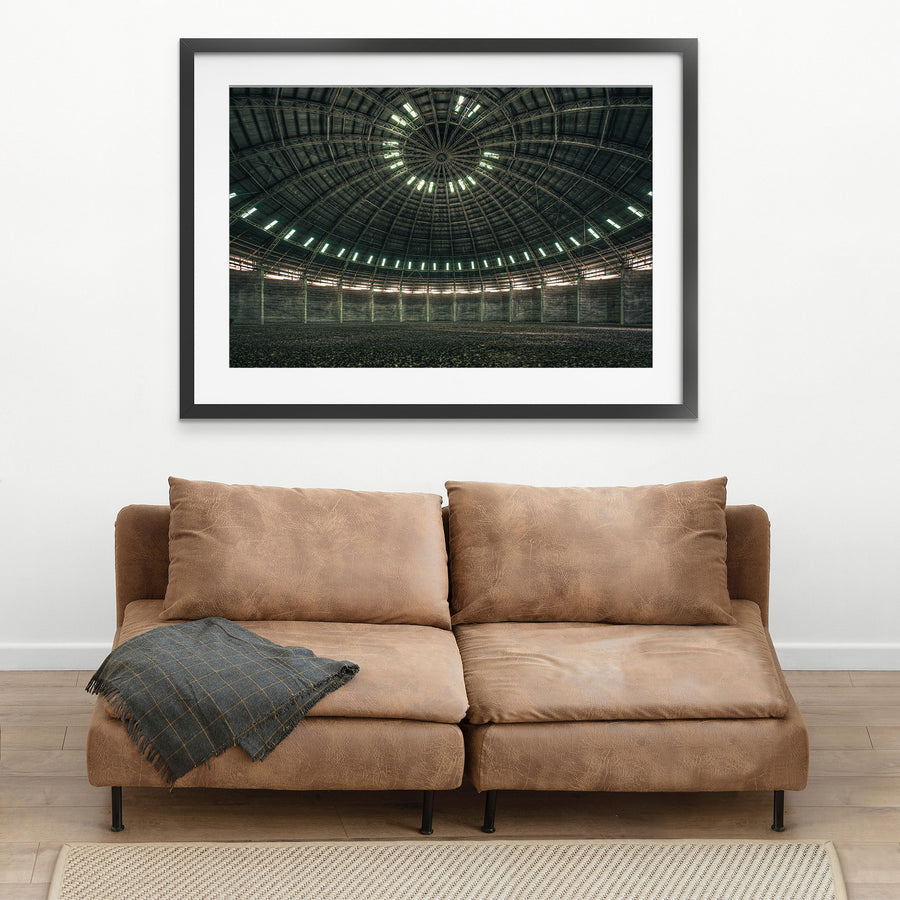
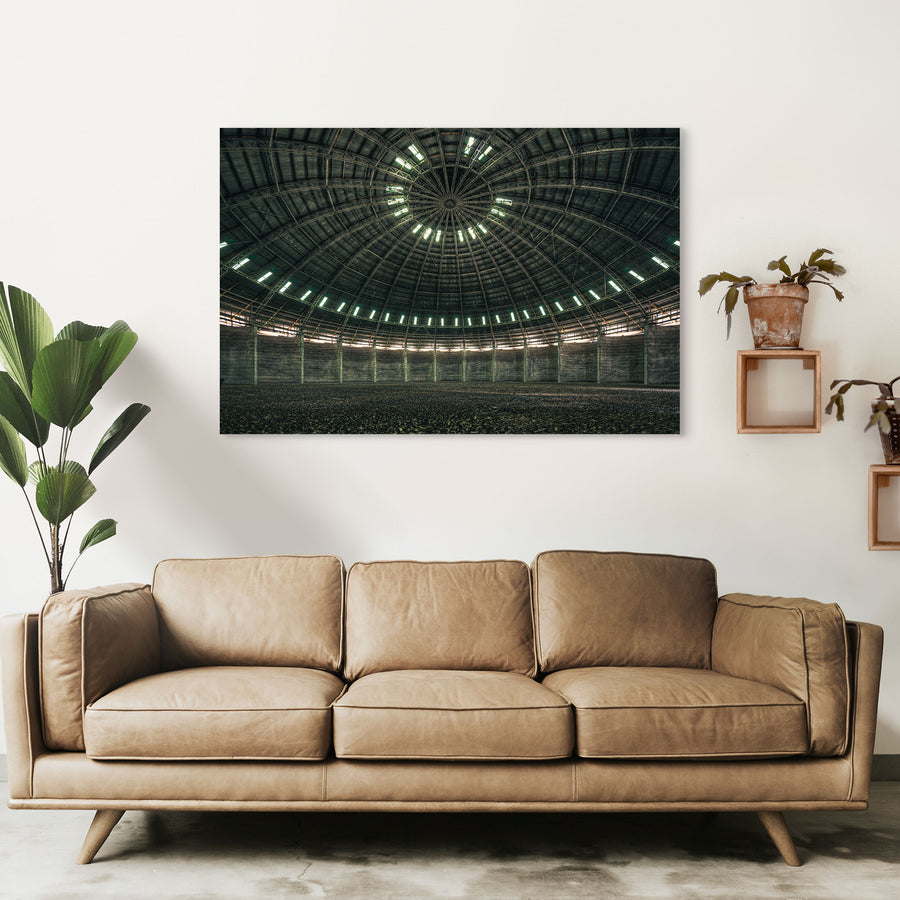
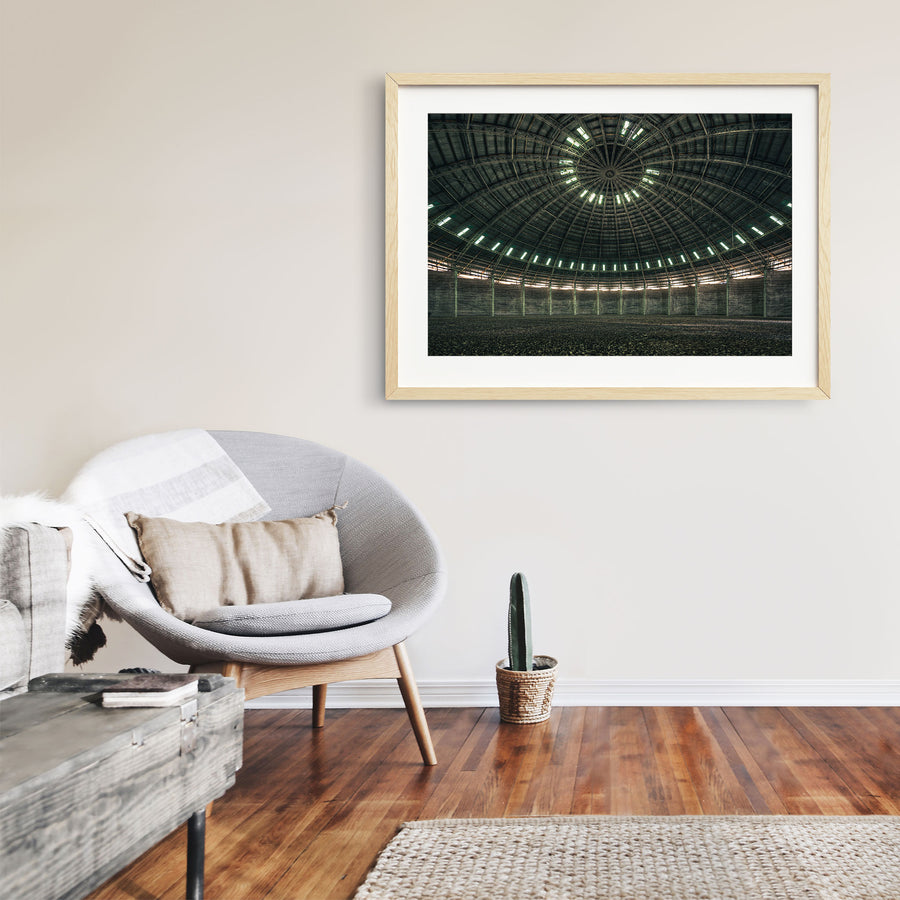
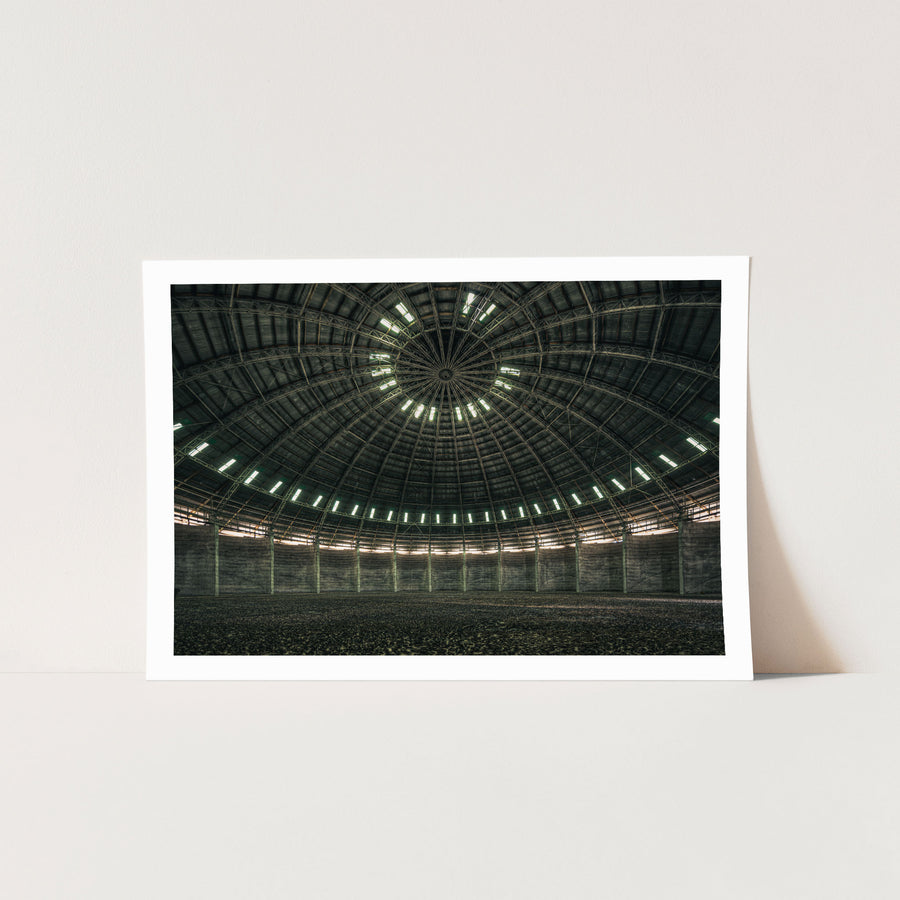
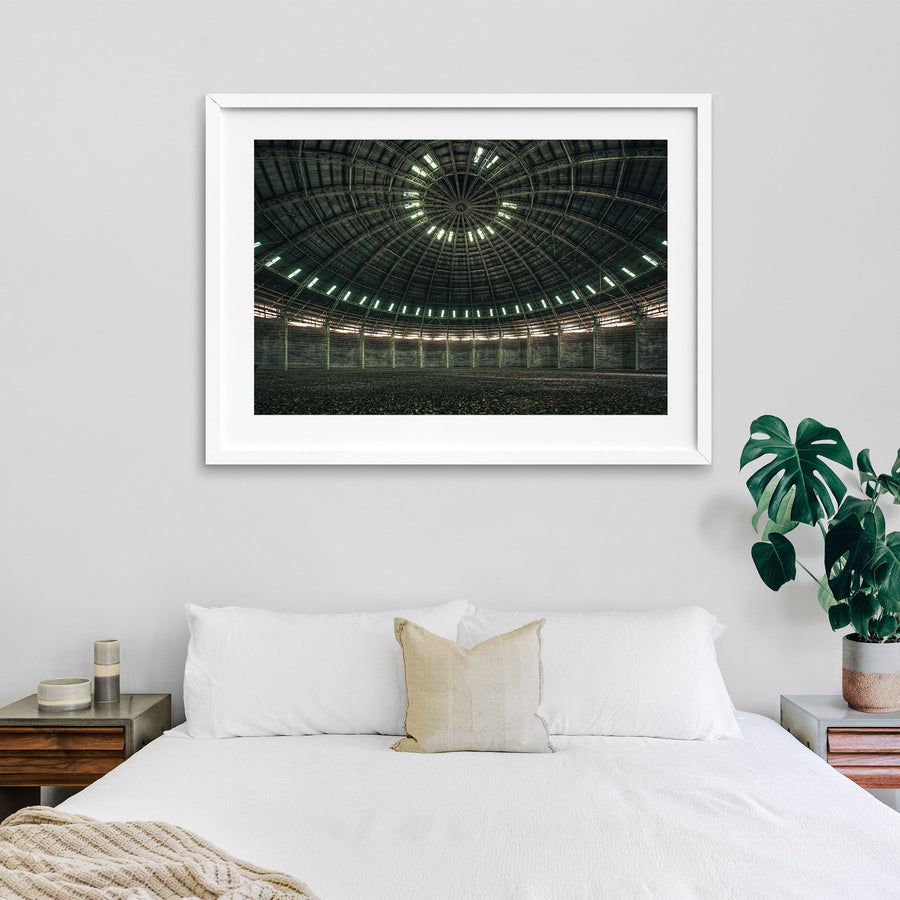
The curved underside of a large dome fills the frame. Radial steel members extend from a central hub toward a surrounding ring of concrete bays. Concentric rows of narrow openings run around the structure. Very little natural light reaches the interior. The floor below is cracked, dried mud. No equipment or fittings remain visible.
Edition
Open edition
Open edition Printed to order, no fixed quantity. Each print is hand-signed by the photographer.
Limited edition A fixed number of prints exist. Once sold, the edition closes permanently. Each print is individually numbered and signed.
$100.00 AUD
Size
Type
Colour
✓
Signed, numbered, with COA. Made to order in 5 to 10 business days (unframed). Shipped in protective packaging with edition certificate, paper-stock reference and a printed care guide.
The photograph is taken from the floor of the type A285 scalloped concrete silo at Mount Russell, looking upward into the dome. Radial steel members run from a central hub outward to the perimeter ring of concrete bays, and concentric rows of narrow openings encircle the structure at intervals. Very little natural light reaches the interior. The floor underfoot is cracked, dried mud that crunches loudly when dry and reverts to liquid mud when rain enters through the structure. The scale of the space registers in the geometry: the convergence of the steel framing at the hub above and the curve of the dome dropping away to the concrete bays at its base.
The Mount Russell site held two structures. The original, a type S041 concrete silo with a capacity of 4,100 tonnes, was constructed in 1934 by a NSW Government grain authority, a predecessor body to the later Grain Elevators Board. It was followed in 1955 by the type A285 scalloped concrete silo photographed here, which added 28,500 tonnes of capacity, approximately 1,050,000 bushels, to the site. The 1955 building became the dominant structure.
The Grain Elevators Board, formally constituted in New South Wales in 1954, assumed responsibility for the country silo network including Mount Russell. In 1992 the NSW Grain Handling Authority, successor to the GEB, was privatised with a majority of shares transferred to grain growers, forming GrainCorp. GrainCorp listed on the ASX in March 1998, and Mount Russell remained within its receival network until the facility closed in 2007.
The site had been connected to the broader grain network through the Inverell branch line. Mount Russell station opened on 10 March 1902. Passenger services on the branch ended in 1983, and the Delungra-Inverell section closed in 1987; the last train ran on 22 June 1987, with the line decommissioned on 2 December 1987. The railway sidings at the silo site fell out of use and became overgrown after that closure.
The structure has remained standing and intact since GrainCorp's 2007 closure. The photograph records the interior as it stood in early 2023, the steel framing and concrete bays undisturbed, the space otherwise empty.
04·FROM THE FIELD NOTES
The curved underside of a large dome fills the frame. Radial steel members extend from a central hub toward a surrounding ring of concrete bays.
Brett Patman
The series
Mount Russell Grain Silo
2023 · 6
photographs
Mount Russell sits among dry grass and eucalypt on the North West Slopes of New South Wales, about 25 kilometres north-west of Inverell. The original concrete cell silos were built in 1934 as part of the NSW Government's bulk-wheat programme for the northern railway network. In 1955 a large scalloped bulk store, locally known as an opera house type, was added alongside. The Inverell branch line closed in 1987, and GrainCorp shut the facility in 2007.
The anatomy view shows what this finish is as a physical object: paper margin, mat band, frame depth, acrylic profile. The comparison strip shows how each size sits relative to the others at true scale. Click a size or a finish to update both.