
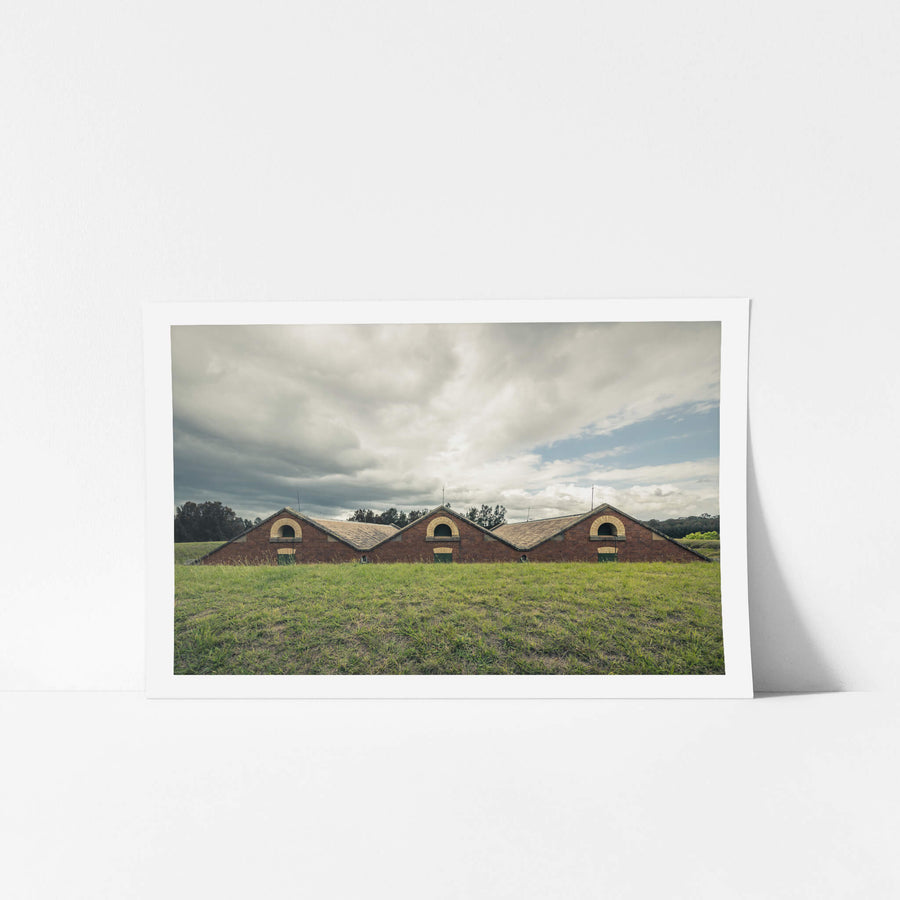
Magazine Roof
Provenance
- Camera
- NIKON D850
- Lens
- 14.0-24.0 mm f/2.8
- Settings
- 14mm · f/8.0 · 1/250 · ISO 100
- Paper
- Ilford Galerie Smooth Cotton Rag 310 gsm
Corrugated iron roof panels showing heavy rust and surface deterioration. Rust streaks run vertically down the weathered metal. The panels show uneven discolouration from prolonged exposure to the elements. No intact paint or protective coating visible.
Open edition
Printed to order, no fixed quantity. Each print is hand-signed by the photographer.
Limited edition
A fixed number of prints exist. Once sold, the edition closes permanently. Each print is individually numbered and signed.
Shipping Free shipping over $250. Ships worldwide, rates calculated at checkout.
Returns Damaged in transit? We replace it. Full policy →
Ships within 10 business days · signed & numbered
In situ




Print datasheet
- Title
- Magazine Roof
- Series
- Newington Armory
- Catalogue
- NAR-015
- Process
- Giclée
- Captured
- 11 October 2019
- Camera
- NIKON D850
- Lens
- 14.0-24.0 mm f/2.8
- Aperture
- f/8.0
- Shutter
- 1/250 s
- ISO
- 100
- Focal length
- 14 mm
- Paper
- Ilford Galerie Smooth Cotton Rag 310 gsm
- Paper size
- 297 × 210 mm
- Location
- Silverwater, New South Wales, Australia
- Authenticity
- C2PA verified provenance →
- Recognised by
- Highly Commended in Multimedia at the 2016 National Trust of Australia (NSW) Heritage Awards
Silverwater, New South Wales, Australia
Map · Mapbox · OpenStreetMap
About this print
The corrugated iron roof of a magazine building at the Newington Armament Depot and Nature Reserve shows what more than a century of salt air and rain can do to a working surface. These magazines stored gunpowder, explosive shells, cordite, depth charges, and torpedoes for the Australian, British, and United States Navies across 102 years of military use, from 1897 until the last ammunition operation over the wharf in December 1999. The rust is doing what rust does, quietly and without urgency.
Brett Patman

The series
Newington Armory
The Newington Armory operated as a Royal Australian Navy munitions depot from 1897 until decommissioning in 1999. Sandstone and brick magazines line the Parramatta River foreshore, their walls a metre thick in places, engineered to contain the force of an accidental detonation. The site now sits within Sydney Olympic Park, its original stores largely intact, paint peeling from heavy timber doors, river light filtering through narrow vents cut into stone.
Print sizes
The anatomy view shows what this finish is as a physical object: paper margin, mat band, frame depth, acrylic profile. The comparison strip shows how each size sits relative to the others at true scale. Click a size or a finish to update both.
| Type | Size | Width | Height |
|---|


