Nike Air

Provenance

Camera
NIKON D7000
Lens
24.0-70.0 mm f/2.8
Settings
57mm · f/6.3 · 1/100 · ISO 2000
Paper
Ilford Galerie Smooth Cotton Rag 310 gsm

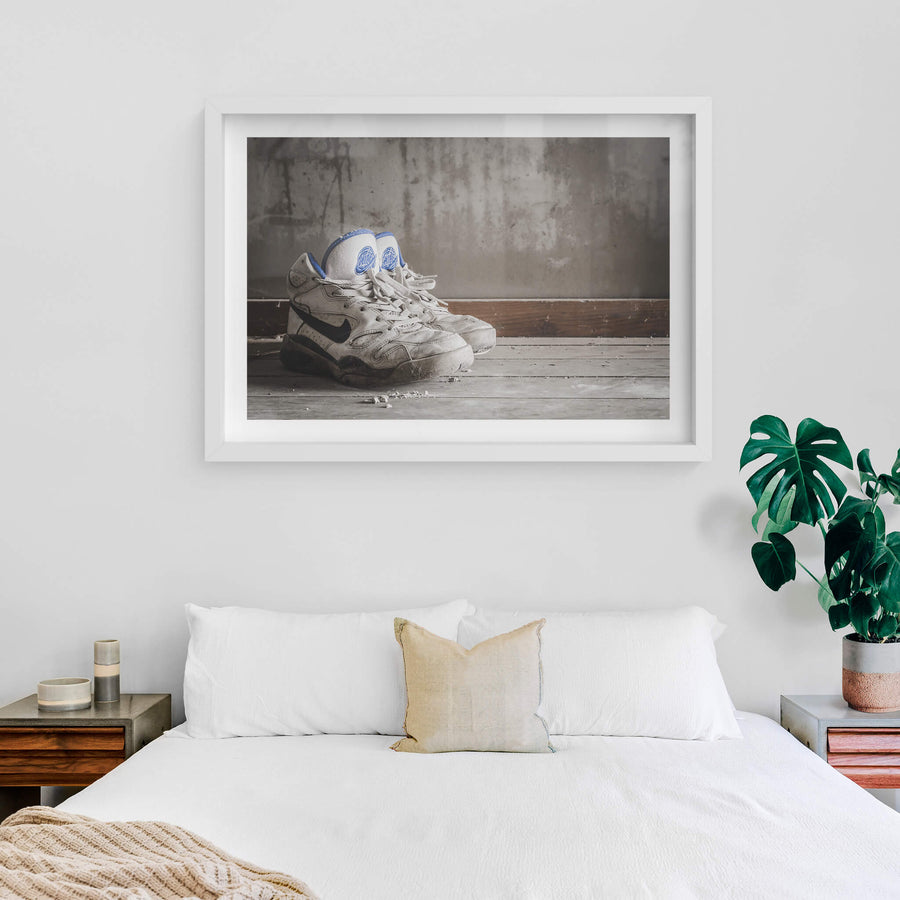
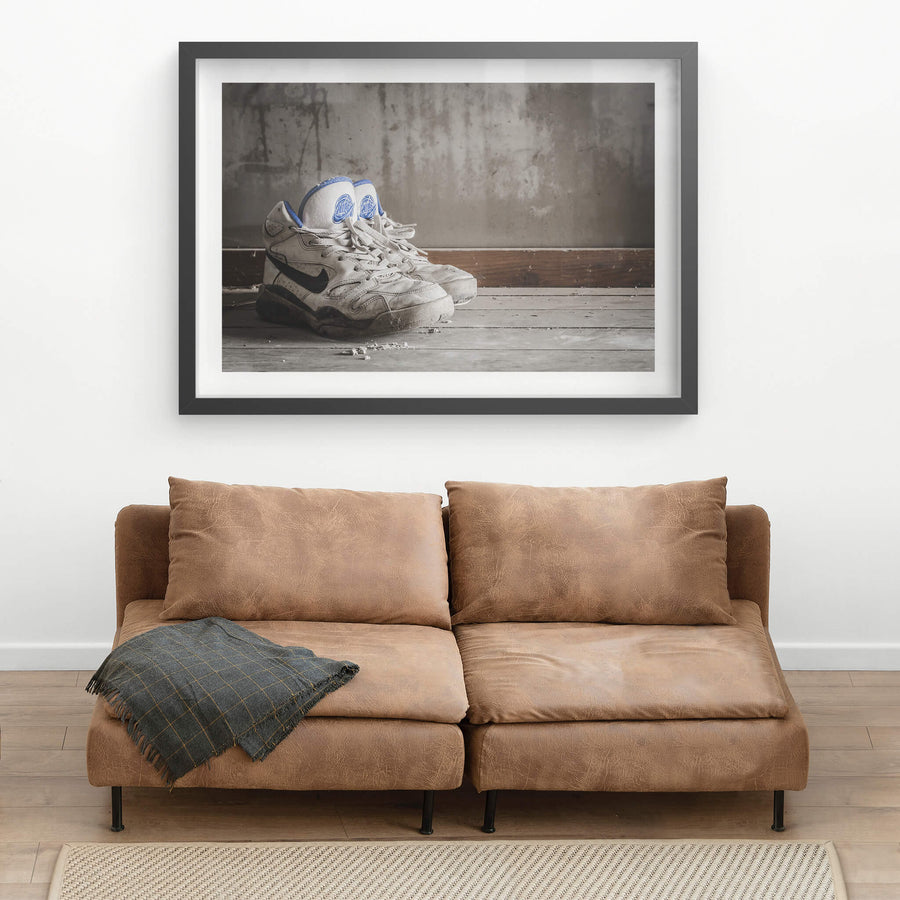
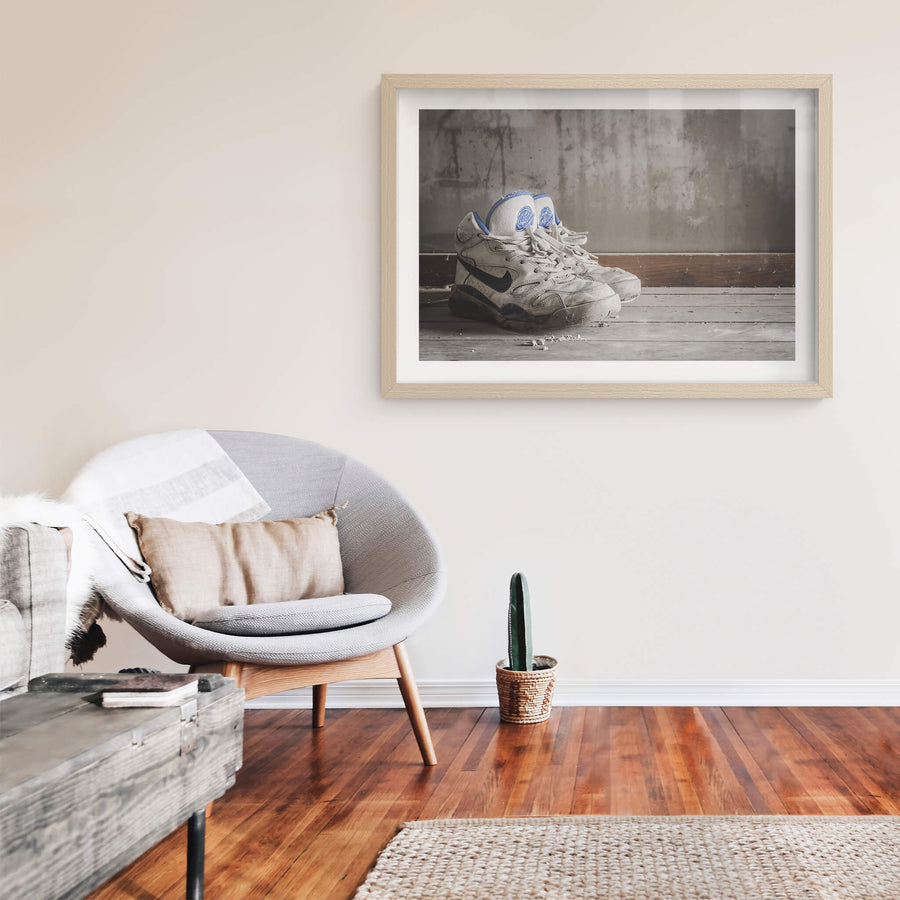
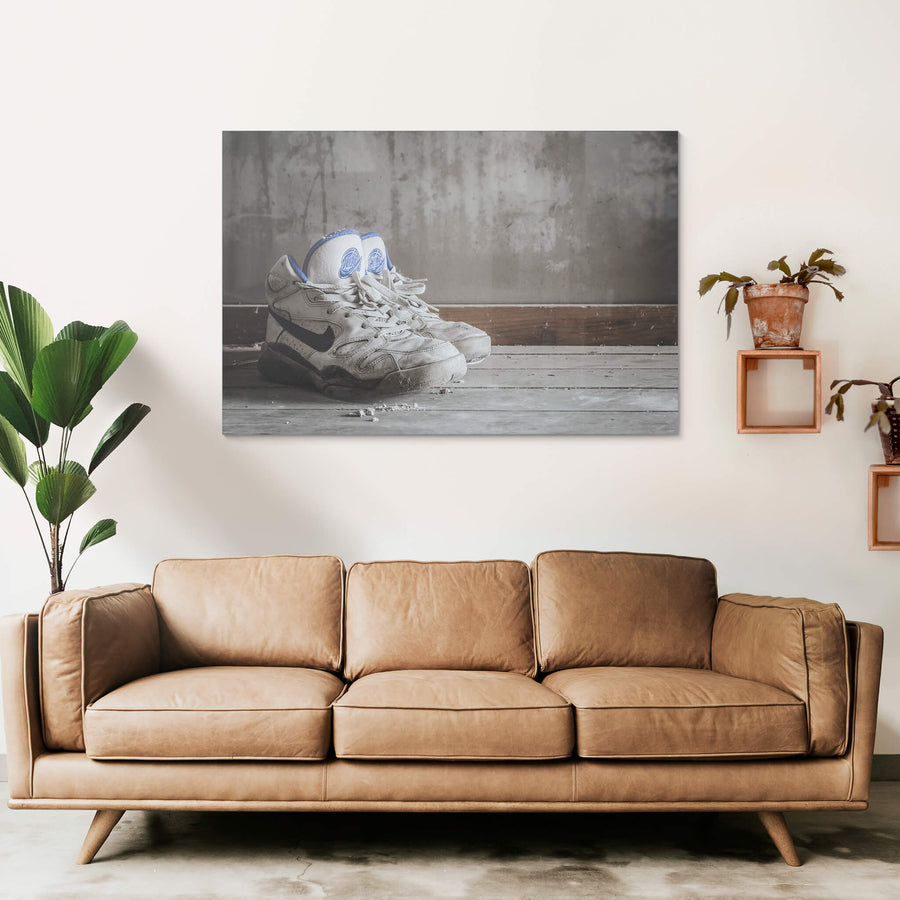
A single Nike Air trainer rests on a debris-covered floor. The shoe's colours have faded. The sole is partially separated. Dust and fragments of plaster surround it. Natural light falls across the scene from an unseen opening. No other footwear is present.

Edition
Open edition

Open edition
Printed to order, no fixed quantity. Each print is hand-signed by the photographer.

Limited edition
A fixed number of prints exist. Once sold, the edition closes permanently. Each print is individually numbered and signed.

$100.00 AUD
Size
Type
Colour
Signed, numbered, with COA. Made to order in 5 to 10 business days (unframed). Shipped in protective packaging with edition certificate, paper-stock reference and a printed care guide.
See certificate sample →

Shipping Free shipping over $250. Ships worldwide, rates calculated at checkout.

Returns Damaged in transit? We replace it. Full policy →

Ships within 10 business days · signed & numbered

In situ

Nike Air at Nichitsu Mining Village, a pair of white leather Nike high-tops sit on grey timber floorboards.Nike Air at Nichitsu Mining Village, a pair of white leather Nike high-tops sit on grey timber floorboards.Nike Air at Nichitsu Mining Village, a pair of white leather Nike high-tops sit on grey timber floorboards.Nike Air at Nichitsu Mining Village, a pair of white leather Nike high-tops sit on grey timber floorboards.Nike Air at Nichitsu Mining Village, a pair of white leather Nike high-tops sit on grey timber floorboards.
01 PROVENANCE

Print datasheet

Title
Nike Air
Series
Nichitsu Mining Village
Catalogue
NMV-025
Process
Giclée
Captured
4 May 2016
Camera
NIKON D7000
Lens
24.0-70.0 mm f/2.8
Aperture
f/6.3
Shutter
1/100 s
ISO
2000
Focal length
57 mm
Paper
Ilford Galerie Smooth Cotton Rag 310 gsm
Paper size
290 × 200 mm
Location
Chichibu, Saitama, Japan
Recognised by
Highly Commended in Multimedia at the 2016 National Trust of Australia (NSW) Heritage Awards
02 LOCATION

Chichibu, Saitama, Japan

Map · Mapbox · OpenStreetMap

03 THE STORY

About this print

A single Nike Air trainer sits on the floor of a building within the Ogurawa settlement at Nichitsu, Saitama Prefecture. Its colours have faded and its sole is separating from the upper. Plaster dust and debris surround it. It is the kind of object that should not be there and yet feels entirely at home. The Ogurawa settlement was built from the late 1930s onwards by the Nichitsu mining company to house the workforce of Chichibu Mine, the sole significant metal mine in Saitama Prefecture. The company built everything: stratified housing with tiled-roof residences for managers and concrete apartment blocks for workers, a school, a clinic, a bathhouse, a cultural hall, a general store, and a post office. At its peak in the 1960s, annual crude ore output reached 500,000 tonnes, with zinc and magnetite as the primary extractions. The settlement held thousands of residents. Metal extraction ceased in 1978. Workers and families began leaving. The school, which had enrolled 274 students in 1959, closed in March 1984 with just 7 students in its final cohort. The last general store shut around 2003. The last permanent resident left the settlement in September 2006. Crystalline limestone quarrying continued at the mine until 30 September 2022, when Chichibu Mine closed after more than 400 years of intermittent operation. By 2016, when this photograph was made, the Ogurawa settlement had been uninhabited for a decade. The concrete apartment blocks and tiled-roof manager houses were deteriorating. A record snowfall in February 2014 had caused partial structural collapses in several buildings. Vegetation was reclaiming the valley. The trainer records something the research files cannot: a modern object carried into an old place by someone whose name and reason are unrecorded. The shoe sits in the frame as a mark of the gap between the settlement's history and its present condition. Part of the Nichitsu Mining Village series.

04 FROM THE FIELD NOTES

A Nike Air trainer sits abandoned on the floor of a building in the Ogurawa settlement, the residential area built by the Nichitsu mining company to support the Chichibu Mine workforce. Its colours have faded and its sole is pulling away. The settlement emptied as metal extraction wound down after 1978, and the last permanent resident left in September 2006. What brought the shoe here, and when, is unknown. It sits now among the dust of a place that once housed thousands.

Brett Patman

Nichitsu Mining Village

The series

Nichitsu Mining Village

2016 · 36 photographs

Nichitsu Mining Village - formally Ogura-sawa settlement - sits in the mountains above Chichibu in Saitama Prefecture. The mine was first worked around 1600 by the Kai Takeda clan, Takeda Shingen's house, who panned gold and placer gold from its streams. In 1765 the Edo-period polymath Hiraga Gennai entered the valley to mine gold; his residence, Gennai-kyo, survives as a Chichibu City historic site. Yanase Trading bought the mine in 1910 and added iron-ore extraction. Nichitsu Mining Development took over in 1937 and reorganised as Nichitsu Mining Industry in 1950. By the 1960s the mine produced 500,000 tonnes a year of zinc, magnetite and over 140 mineral species - the most varied mine in Japan - supporting a town of 2,000 to 2,400 people with two schools, a hospital, a fire department, a cinema and a post office. Metal mining stopped in 1978; quartz sand began in 1969; crystalline limestone carried on until 30 September 2022, when Nitchitsu Co. closed the operation entirely.

View all in this series →

05 SIZE GUIDE

Print sizes

The anatomy view shows what this finish is as a physical object: paper margin, mat band, frame depth, acrylic profile. The comparison strip shows how each size sits relative to the others at true scale. Click a size or a finish to update both.

Anatomy · true ratio
TypeSizeWidthHeight
08 BY POST · NO SPAM

Read the full story

Articles when they're published. The history behind a place. The day of a shoot. The work between prints. No marketing, no schedule.

You're subscribed.