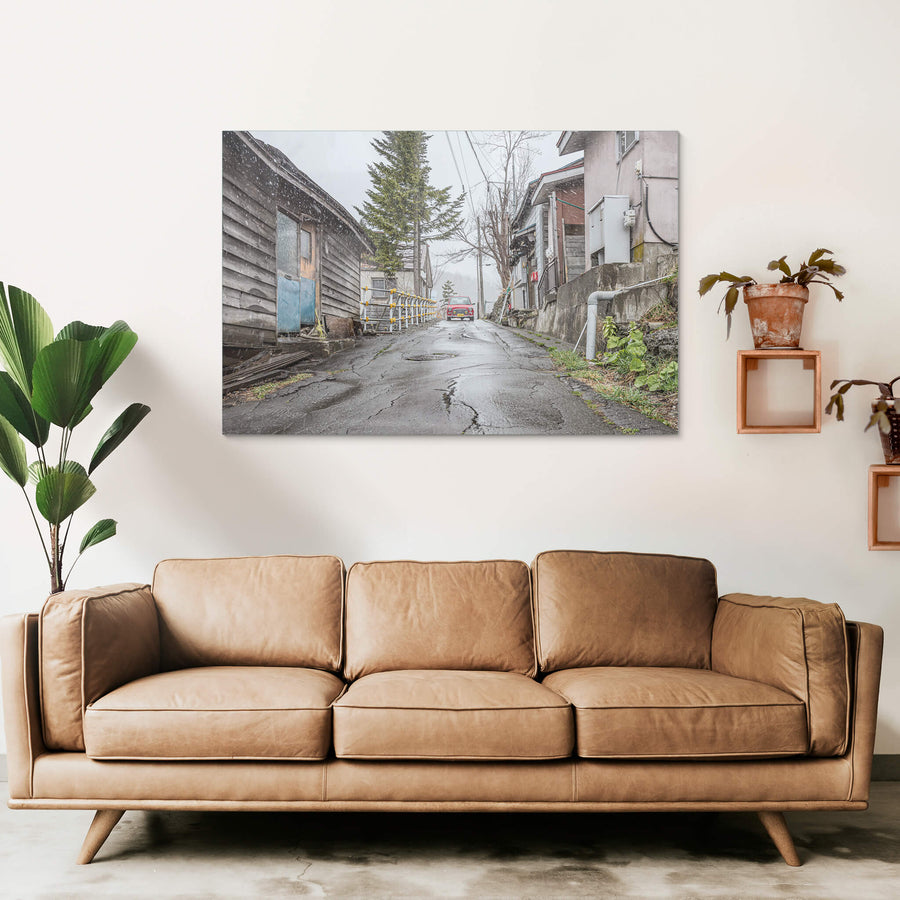
Old vs New

Provenance

Camera
NIKON D810
Lens
14.0-24.0 mm f/2.8
Settings
24mm · f/8.0 · 1/100 · ISO 500
Paper
Ilford Galerie Smooth Cotton Rag 310 gsm

A weathered timber-frame building with aged, rusted cladding occupies one side of the frame. Directly adjacent sits a recently constructed utilitarian structure with clean lines and modern materials. The two buildings share a streetscape in Yubari, Hokkaido. The older building shows surface deterioration consistent with extended exposure to heavy snowfall and temperature fluctuation.

Edition
Open edition

Open edition
Printed to order, no fixed quantity. Each print is hand-signed by the photographer.

Limited edition
A fixed number of prints exist. Once sold, the edition closes permanently. Each print is individually numbered and signed.

$100.00 AUD
Size
Type
Colour
Signed, numbered, with COA. Made to order in 5 to 10 business days (unframed). Shipped in protective packaging with edition certificate, paper-stock reference and a printed care guide.
See certificate sample →

Shipping Free shipping over $250. Ships worldwide, rates calculated at checkout.

Returns Damaged in transit? We replace it. Full policy →

Ships within 10 business days · signed & numbered

In situ

Old vs New at Streetscapes of Yubari, a residents car sits parked in the middle of the street between houses.Old vs New at Streetscapes of Yubari, a residents car sits parked in the middle of the street between houses.Old vs New at Streetscapes of Yubari, a residents car sits parked in the middle of the street between houses.Old vs New at Streetscapes of Yubari, a residents car sits parked in the middle of the street between houses.Old vs New at Streetscapes of Yubari, a residents car sits parked in the middle of the street between houses.
01 PROVENANCE

Print datasheet

Title
Old vs New
Series
Streetscapes of Yubari
Catalogue
SYU-023
Process
Giclée
Captured
28 April 2016
Camera
NIKON D810
Lens
14.0-24.0 mm f/2.8
Aperture
f/8.0
Shutter
1/100 s
ISO
500
Focal length
24 mm
Paper
Ilford Galerie Smooth Cotton Rag 310 gsm
Paper size
290 × 200 mm
Location
Yubari, Hokkaido, Japan
Recognised by
Highly Commended in Multimedia at the 2016 National Trust of Australia (NSW) Heritage Awards
02 LOCATION

Yubari, Hokkaido, Japan

Map · Mapbox · OpenStreetMap

03 THE STORY

About this print

Yubari's residential streets were built in layers. The oldest surviving fabric is timber-frame housing from the mining boom years, clad in corrugated steel that has spent decades absorbing Hokkaido winters. Walls rust, panels buckle, and the weight of accumulated snow works steadily on any roof that is no longer being maintained. These buildings were constructed for a city at full capacity, housing the workers and families who kept as many as 24 mines running simultaneously at the industry's peak. That city reached a registered population of approximately 116,908 in April 1960. By the 2020 national census, the figure was 7,334. By March 2026, city estimates put the remaining population at around 5,707. The arithmetic of that decline is visible in almost every block: boarded shopfronts, concrete slabs where buildings once stood, and occupied houses sitting alongside structures that have not been heated in years. What this photograph records is something specific to Yubari's more recent history. Alongside the ageing timber-frame building stands a newer, utilitarian structure, the kind of construction that has appeared in parts of the city as fiscal reconstruction and compact city planning have slowly redirected resources toward a smaller, more concentrated urban core. Since filing for fiscal rehabilitation in March 2007 with debts of approximately 35.3 billion yen, Yubari has been working to consolidate its remaining population around the Shimizusawa district, relocating services, building community infrastructure, and replacing the sprawling footprint of a mining-era city with something scaled to the people who remain. The two buildings in this frame do not acknowledge each other. The older structure carries the texture of everything that preceded the collapse. The newer one is indifferent to it. Between them, the street is largely empty. Photographed in 2016.

04 FROM THE FIELD NOTES

Yubari's streetscapes hold two building eras in close proximity: the timber-frame, corrugated-steel worker housing built across the mid-twentieth century mining boom, and the occasional newer structure that has gone up during decades of fiscal reconstruction and population consolidation. The older fabric was built for a city of over 100,000 people. Fewer than 6,000 remain. The gap between those two numbers is written into every block of the city, and this photograph places both sides of that gap in the same frame.

Brett Patman

Streetscapes of Yubari

The series

Streetscapes of Yubari

2018 · 54 photographs

Yūbari is a coal-mining city in central Hokkaido. Founded in 1943, its population peaked at around 120,000 in the 1960s and now sits at about 6,400. The colliery closed in the 1980s. The city's attempt to recover through tourism failed; in 2007 it became the first Japanese municipality to declare bankruptcy, owing 35.3 billion yen. These streetscapes were taken between the houses, shops, and schools the town no longer needs - most empty, some half-collapsed, some still in use by the people who stayed.

View all in this series →

05 SIZE GUIDE

Print sizes

The anatomy view shows what this finish is as a physical object: paper margin, mat band, frame depth, acrylic profile. The comparison strip shows how each size sits relative to the others at true scale. Click a size or a finish to update both.

Anatomy · true ratio
TypeSizeWidthHeight
08 BY POST · NO SPAM

Read the full story

Articles when they're published. The history behind a place. The day of a shoot. The work between prints. No marketing, no schedule.

You're subscribed.