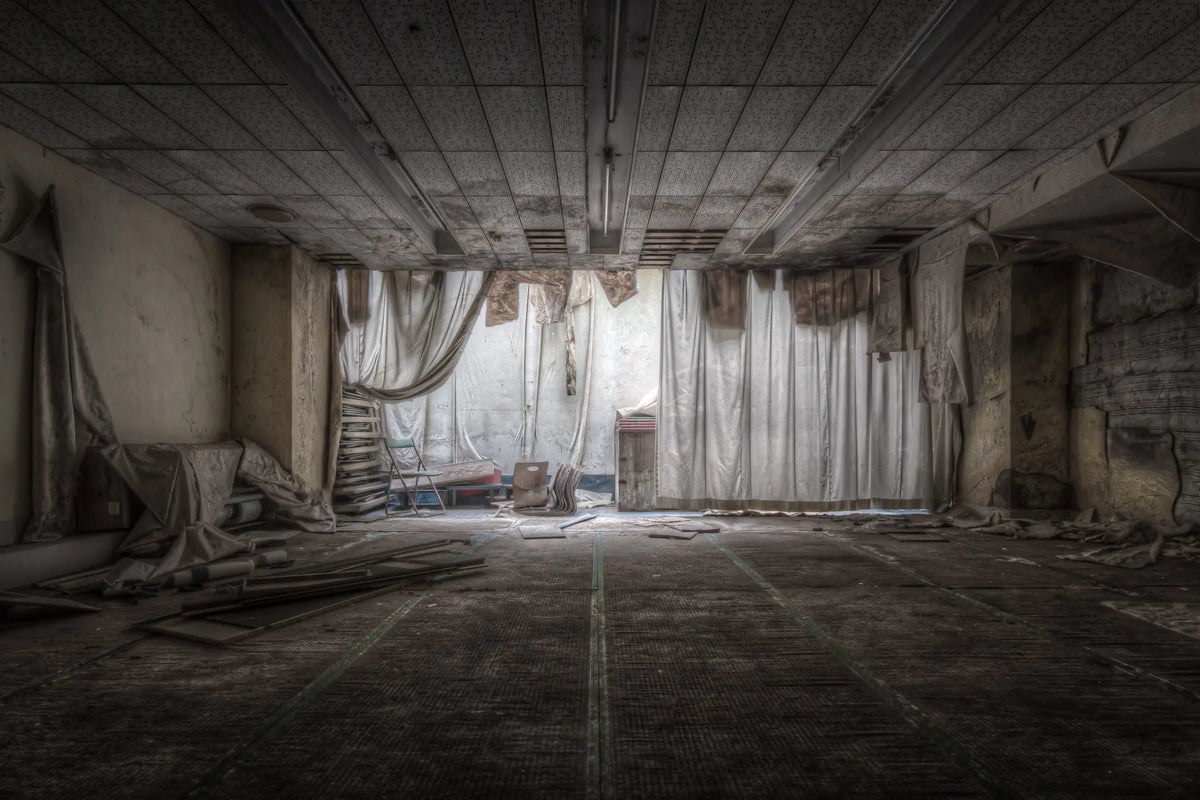
The first thing I do when I get into a new space is stop and stand still.
Most people walk into a room and immediately start looking at things. I try to stand in the doorway and let the room register for a minute. Where is the light coming from? What is the structure of the space? Which surfaces are picking up light and which are in shadow? Is the light directional or diffuse? Which part of the room is doing the most interesting thing?
By the time I start moving, I have a rough sense of where the photographs are going to come from.
I shoot available light. No flash, no artificial lighting rigs. Part of this is practical — I'm usually working alone, carrying everything myself, and hauling lighting equipment into a building with unstable floors and limited access is not sensible. But the bigger reason is that the light in an abandoned building is part of the truth of the place. The quality of light through a broken window, or a gap in a roof, or a row of clerestory windows that have lost half their glass, is specific to that building at that time of day. It tells you something about the building's condition, its orientation, its age. A flood-lit studio version of the same room would be a different photograph about a different thing.
The practical consequence is that I'm often working in low light. That means a tripod, slower shutter speeds, and planning around the time of day. An overcast morning and a sunny afternoon in the same room are effectively two different locations. I'll sometimes arrive at a location with a specific shot in mind and spend an hour waiting for the light to get where I need it. That's fine. It's part of the work.
I try not to move things. If a chair has been in the same position for thirty years, moving it for a better composition means I'm photographing my idea of the space rather than the space as it is. The discipline of working with what's there forces better decisions. You have to find the shot within the actual room, which is harder and more interesting than rearranging the room to get a shot you've already decided on before you arrived.
I also photograph slowly. I'll spend time in a single room that I could cover quickly if I were just moving through. I'm looking for the details that accumulate meaning: the date stamped on a piece of machinery, the pattern of wear on a floor, the layer of dust that's thick in one corner and thin in another because that's where a draught comes through. These details are often not the main subject of a photograph. They're in the margins, or the background, or visible in one frame in ten. But they're why you go back to a location more than once, because you didn't see them the first time.
I'm usually nervous. Not every visit and not at every location, but there's a background alertness that comes with working in a building you weren't formally invited into, in an area that may or may not be structurally sound in every section. Sounds that are just the building moving in the wind become something to track. A door slamming in another part of the structure makes you stop. I've been surprised a few times — by birds, by other photographers, once by a site manager who turned out to be less bothered than I expected — and I've gotten better at working in a way that keeps part of my attention on what's around me rather than just what's in front of the lens.
The other thing about working in these spaces is that they don't give you much for free. The buildings that are genuinely interesting are usually the ones that are harder to navigate, or that have less obvious photographic material. The dramatic spaces — the ones where it's immediately clear what you're supposed to photograph — tend to produce photographs that look like everyone else's photographs of that place. The less obvious spaces take longer, but what you find in them is more likely to be yours.
I don't know what that process looks like from the outside. From the inside, it's a lot of standing still, moving slowly, and waiting for something to clarify.

