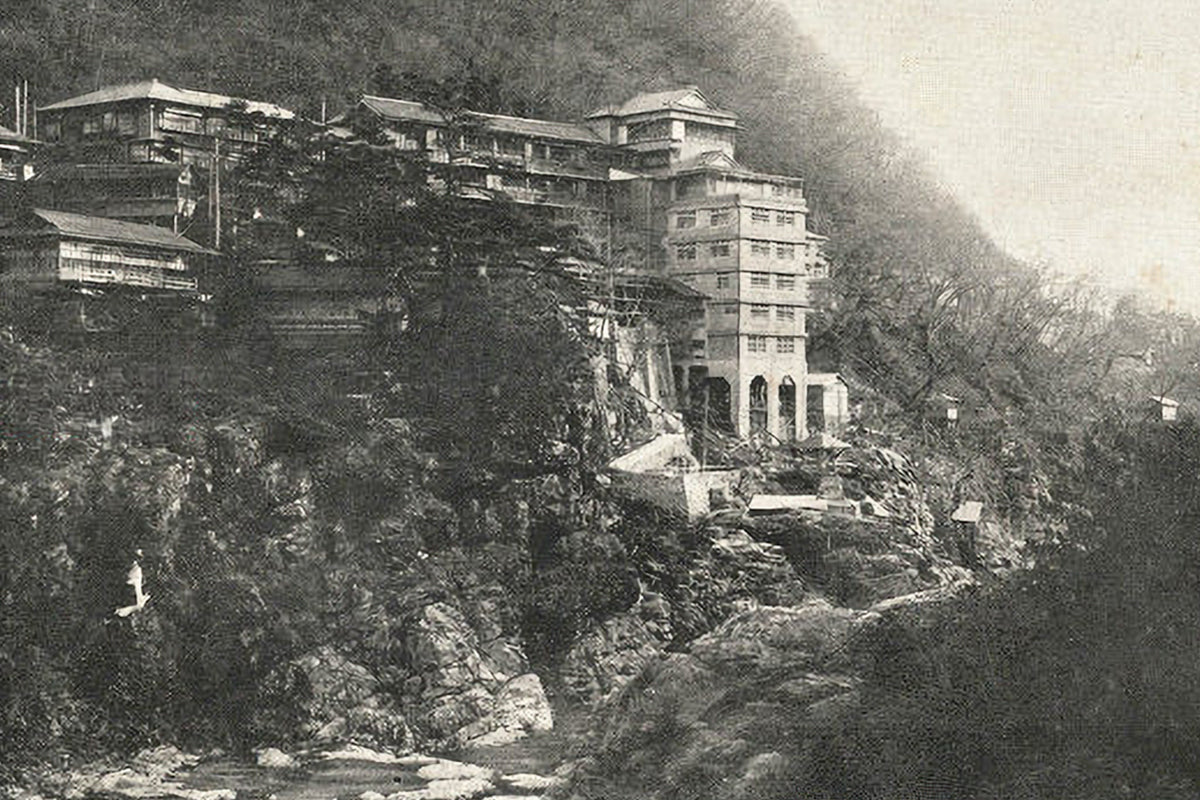
Kinugawa Kan opened on 31 December 1942 on a cliff above the Kinugawa River gorge at Kinugawa Onsen, in what is now Nikkō City, Tochigi. It ran for 57 years before filing for bankruptcy in June 1999, the first hotel at Kinugawa Onsen to fall in the post-bubble era. It has stood empty since.
What follows is that history alongside photographs of what is left. Some are from my own visits, the first in 2016. Some are from postcards and brochures I have collected.
Origins
The hot springs along the Kinugawa River have been documented since 1691, when a villager named Numao Shigebei (沼尾重兵衛) found a source bubbling out of the west bank. The spring was called Taki Onsen (滅温泉) and was reserved for daimyo, samurai, and the monks accompanying them on pilgrimages to Nikkō Tōshō-gū. In 1751 it formally became Tōshō-gū's property. The waters opened to the general public during the Meiji era. In 1927 the original Taki Onsen was unified with a separate spring discovered on the east bank, and the combined resort was renamed Kinugawa Onsen.


Two early postcards of riverbank ryokan at what was then Taki Onsen, predating Kinugawa Kan. The architecture, timber and tiled-roof, was the dominant style along the gorge into the 1940s.


Left: an early panorama of the resort town built on the cliffs above the gorge. Right: wooden boats carrying kimono-clad visitors beneath Kurogane Bridge, before motorised travel became routine. The original Kinugawa Onsen Station was sited near the bridge; today its concrete piers and a riverside stone bath mark the spot.
The Tobu Nikkō Line opened on 1 October 1929, putting the broader Nikkō region within a single rail journey of Asakusa. Three weeks later, the local Fujiwara Tramway from Shimo-Imaichi up the Kinugawa gorge gauge-converted to match Tobu's network. You could now reach Kinugawa Onsen from Tokyo with a transfer at Shimo-Imaichi. The transfer was removed in 1943 when Tobu absorbed the local line and ran direct services from Asakusa to Shin-Fujiwara.

A Tobu Railway prepaid card issued for Kinugawa Kan Honten, with two kappa across the design. Kappa, the legendary water-dwelling creatures of Japanese folklore, would become the hotel's mascots.
Kinugawa Kan, 1942
The Hoshi family already had an inn at Kinugawa Onsen when Kinugawa Kan was built. In 1918 Hoshi Kengo (星獻吐) found a source called Takara-no-Yu while walking by the river. In 1925 he opened Motoyu Hoshinoya (元湯 星のや) at the source. Seventeen years later, on 31 December 1942, a different generation of the same family incorporated 有限会社きぬ川館本店 (Yugen-gaisha Kinukawa-kan Honten) on a cliff above the gorge. Hoshi Takashi (星堅) was the founder of record.
The original 1942 building was nothing like the structure that stands today. Earlier wooden ryokan along the gorge, Sansuikaku among them (founded 1931), had set the architectural register: timber construction, tiled roofs, multi-storey but low-rise, traditional gabled entrances. Kinugawa Kan opened in the same register. The 10-storey reinforced-concrete tower visible in the ruins now is the result of decades of expansion. The 1942 building is buried inside it.


Two views of Kinugawa Kan in its original form, both most likely from the late 1940s to early 1950s, before the major expansions began. Timber construction, tiled roofs, and on the right the curved karahafu gable over the entrance. The cars and bus at the gate on the right mark the postwar return of road travel to the resort.

A later view: a concrete overhang above an exterior corridor on the upper floors, dating to the post-1942 reinforced-concrete expansion. The 1942 timber building is somewhere underneath, structurally absorbed by what came after.
The Kappa Bath
The hotel's signature was the Kappa Bath (かっぱ風呂), named after the kappa themselves. The original bath was carved into the rocky river bed below the hotel: open air, fed directly by the natural hot spring, with the river running past. As the hotel expanded through the 1960s and 70s the bath was relocated indoors into a tiled enclosure with arched windows facing the gorge. The kappa branding stayed. Kappa appear on the hotel's brochures, on the Tobu prepaid card above, on the bath's interior signage. By the closure they were on every surface. The curved bay of the Kappa Bath enclosure is still picked out from across the gorge.
There is a detail in the period-specific record worth knowing. The Kappa Bath was male-only with no time-based gender alternation. Women guests were directed to a small adjacent bath called Kodakara-buro (子宝風呂, "Child Blessing Bath"). The arrangement reflected a now-outdated convention, and it persisted until the hotel closed.


Left: a Kinugawa Kan brochure illustration of the relocated indoor Kappa Bath, with the kappa themselves still in the design. Right: the same bath now. Tile, arched windows, and tub all intact. The water has been off since 1999.
Expansion and peak
Kinugawa Kan expanded through the 1960s and 70s. The Annex (Bekkan, 別館) was added first, on the cliff face. The Second Annex (Daini Bekkan, 第二別館) followed at a separate site; that building was later rebranded as Hotel Quatre Saisons (ホテル キャトルセゾン) and has since been converted into condominiums. A reinforced-concrete addition in 1975 gave the main building its current 10-storey form. An open-air, hot-spring-fed swimming pool with mixed bathing was added to the Bekkan in the same broad period, part of the wider pattern of bubble-era leisure additions at the larger Kinugawa Onsen hotels. Its pale blue tiling is still visible today, buried under dense plant growth.


Above: the same pool now. Below left: a 1970s Kinugawa Kan brochure spread showing the lobby, banquet halls, and entertainment programme. Below right: a brochure shot of the Bekkan from across the gorge, with the indoor Kappa Bath enclosure and the open-air mixed-bathing pool both visible. A green-carpeted corridor on one of the upper floors marks the same fit-out era.

Kinugawa Kan Honten from across the gorge in a mid-20th century brochure shot.
By 1993 Kinugawa Onsen and the neighbouring Kawaji Onsen together recorded 3.41 million overnight guests. Kinugawa alone cleared 3 million. Guests arrived by train and tour bus from across the region. A 70-room operation running near capacity at bubble-era rates would have done tens of thousands of guest-nights per year at peak.

A 1960s or 1970s postcard showing Kinugawa Kan from the wooded slopes opposite, at the height of the bubble-era resort economy.
Japanese-language coverage of the building today calls it "Japan's Kowloon Walled City" (日本の九龍城砧) and "Battleship Island on land" (陸の軍艦島), both labels for the tangled, multi-wing layout. The nicknames are post-2010s. They belong to the era of the ruin, not the era of the hotel.
Chronology
The full arc, from the first Tokyo rail connection to the 2022 sealing, in eleven marks.
- 1929 · Tobu line opens
- The Tobu Nikkō Line opens on 1 October, connecting Asakusa to Tobu-Nikkō on a dual-track electric service. Three weeks later the local Fujiwara Tramway up the Kinugawa gorge gauge-converts to match Tobu's network.
- 1942 · Incorporated
- 有限会社きぬ川館本店 is incorporated on 31 December under Hoshi Takashi, a local Kinugawa Onsen notable. The original is a low-rise timber ryokan; the multi-storey form comes with later expansion.
- 1956 · Daiichi opens
- 鬼怒川第一ホテル opens nearby as an Asaya Hotel branch. The cluster of Kinugawa Onsen hotels that will later contract around Kinugawa Kan begins to form.
- 1975 · Expanded
- The hotel is expanded to its ten-storey footprint. The Kappa-buro had moved indoors earlier in the operating life; an outdoor mixed-bathing onsen pool had been added at the Bekkan annex through the late 1960s.
- 1993 · Peak
- Kinugawa Onsen and neighbouring Kawaji Onsen record 3.41 million overnight guests combined; Kinugawa alone exceeds three million. By 2021 the combined figure has fallen to 852,917.
- 1999 · Bankruptcy
- Kinugawa Kan Honten files for bankruptcy in June with debts of approximately 30 億円 (around three billion yen). The first hotel at Kinugawa Onsen to fail in the post-bubble era. The operating company enters legal suspension but is never wound up; the family retains the corporate registration.
- 2008 · Cluster forms
- 鬼怒川観光ホテル東館 (the Okabe Group East Wing, 1981 build) closes. The wave of Kinugawa Onsen hotel closures that followed the 2003 Ashikaga Bank nationalisation reaches the gorge. Kinugawa Kan, abandoned since 1999, is no longer the lone ruin.
- 2009 · Family leaves
- Hotel Quatre Saisons, the former Second Annex rebranded under the Hoshi family, closes in late October. Earlier in the year the corporate registry records the Representative Director's residential address moving from the Kinugawa Kan parcel to an apartment in Utsunomiya.
- 2010 · Hoshinoya ends
- Motoyu Hoshinoya, founded in 1925 by Hoshi Kengo at the Takara-no-Yu spring, closes. The Hoshi family's primary remaining onsen operation in Kinugawa ends; the building cluster on the gorge is fully unmanaged from this point.
- 2021 · Study and proposal
- Nikkō City and Utsunomiya University begin a joint research project into demolition of the cluster. Demolition proves infeasible due to unresolved title issues; the project pivots to anti-trespass measures. Separately, Honda Arisa's graduation thesis at the Nagaoka Institute of Design proposes ruin-coexistence interventions: two pedestrian bridges, an observation hub, four site-level moves.
- 2022 · Sealed
- Nikkō City conducts the first formal interior safety inspection of three abandoned hotels on 24 December 2021; in March 2022 the openings are sealed against trespass. In July, Bunshun Online's Takeuchi Kenrei publishes a six-page feature with direct interviews from three Nikkō City officials.
Collapse
June 1999. The hotel ceased operations. The operating company, Yugen-gaisha Kinukawa-kan Honten (有限会社きぬ川館本店), filed for bankruptcy with debts of approximately ¥3 billion. It was the first Kinugawa Onsen hotel to fall in the post-bubble era. The closure preceded the November 2003 nationalisation of Ashikaga Bank, the region's dominant tourism-sector lender, which set off the wider wave of resort closures that rolled through Kinugawa from 2005 onward.
The legal status was business suspension (休業), not full dissolution. The operating company remains on the corporate register; Hoshi Takashi continues as Representative Director. The corporate registry records his residential address moving from the Kinugawa Kan parcel to an apartment in Utsunomiya in March 2009. The family's other Kinugawa Onsen operation, Motoyu Hoshinoya, founded in 1925 by Hoshi Kengo at the Takara-no-Yu spring, closed in 2010, ending the Hoshi family's primary onsen presence on the gorge. Kinugawa Kan has been fully unmanaged since.

A lounge on one of the lower floors. The carpet has been under water enough times to be part of the floor. Across the river, working hotels are visible.
The ruin
What's left is the building and what was inside it when the doors closed. Down the stone-step corridor to the public bath, back through the rooms.


A guest room with the zaisu, low table, television, and rotary phone in place. Most of the room fit-outs were left intact through the suspension years.

A small annex room. A fern has come up through the tatami. The ceiling panels are coming loose.

A function room on a middle floor. Chairs stacked, curtains sagging.


Left: a games room fitted out for guests between dinner and the evening bath, near the back of the building. Right: a former dining room with the kappa-themed mosaic floor intact and teapots stacked on a side table.

A utility room behind the kitchen. The rice cooker has tipped. The pipework is rusted through.


Stoves and the kitchen behind that, stainless-steel benches running both walls.

A balcony at the front of the hotel, facing downstream. On the far side of the river, working hotels are still operating. On this side, weather has taken the railings.
Now

Kinugawa Kan from the river path. The Kappa Bath enclosure is at lower left. The 2022 sealing covered the openings visible at the base.
Demolition has been studied. The cost estimate is approximately ¥600 million, the building sits over the same hot-spring sources that supply other working hotels nearby, and it is close to a national road. None of those is the binding obstacle. The binding obstacle is that the operating company has had no income since 1999 and no funds to pay for demolition. The popular framing is that the owner is unknown; that is procedurally accurate, in the sense that the property registry for the Fujiwara 2 parcel is held in paper form at the Utsunomiya District Legal Affairs Bureau's Nikkō Branch, which is pre-computerisation and not in the online system. The records exist. They are not online.
In 2021, Nikkō City and Utsunomiya University's Faculty of Regional Design Science started a joint study on demolishing the cluster of ruined hotels along this stretch of the gorge. By March 2022 the study had concluded that demolition was infeasible and pivoted to anti-trespass measures. On 24 December 2021 the City conducted the first formal entry inspection of three abandoned hotels in the cluster, Kinugawa Kan among them. In March 2022 the openings were sealed. In July 2022, Bunshun Online published a six-page feature on the cluster by Takeuchi Kenrei with direct interviews from three named Nikkō City officials, confirming the cluster's decay is progressing rapidly and that no concrete demolition funding has been secured.
A parallel academic engagement that year took a different direction. Honda Arisa's graduation thesis at the Nagaoka Institute of Design proposed not demolition but coexistence with the ruins: two pedestrian bridges over the gorge, an observation hub, four site-level moves that integrate the buildings into a re-routed pedestrian flow through the resort. Whether anything from that proposal will be built is an open question.
Kinugawa Kan was the first to fall, but it was not the last. The 1956 Kinugawa Daiichi Hotel, which opened as an Asaya Hotel branch, closed in January 2009. The 1981 Okabe Kanko East Wing closed in 2008. Suimeikan, the Okabe West Wing, closed around 2005 and was demolished in 2007. Sansuikaku, the 1931 wooden ryokan that had set the architectural register before Kinugawa Kan was even built, burned down in 1951; its 1970s concrete rebuild now operates as Kinugawa Plaza Hotel. The Hoshi family's Motoyu Hoshinoya is closed. The Quatre Saisons annex is condominiums.
Asaya Hotel, founded in 1888, is still going. It is the oldest hotel in Kinugawa Onsen and predates everything else along the gorge.
The building has outlived its last working day by more than two decades.

An old stone bath on the riverbank below the hotel.

A reflection caught in the Kappa Bath mirror, 2016 visit.
If you stayed at Kinugawa Kan, worked there, or have postcards or brochures I haven't seen, I'd like to hear from you. The same is true of everything in the collection that didn't come out of my camera.
References
Primary sources and institutional records. 法務局 (Hōmukyoku, Legal Affairs Bureau, Ministry of Justice Japan), 有限会社きぬ川館本店 法人登記簿(全部事項), retrieved via 登記情報提供サービス 2026-05-26, 会社法人等番号 0600-02-016052. Ministry of Land, Infrastructure, Transport and Tourism (国土交通省 観光庁), 国際観光ホテル整備法 登録旅館一覧, 令和8年3月31日 (PDF). Tobu Railway Co., Ltd., History of the Tobu Nikkō Line & the SPACIA Limited Express.
Institutional archives, scholarly work, and trade-body records. Honda Arisa, 「鬼怒川温泉郷における廃墟問題を考える」, graduation thesis, 長岡造形大学 建築・環境デザイン学科 (Nagaoka Institute of Design), 2021. Japan Ryokan Association (日本旅館協会), successor body formed October 2012 from the merger of 国際観光旅館連盟 and 日本観光旅館連盟. Nikkō City official tourism site, 鬼怒川温泉. 鬼怒川金谷ホテル, Kanaya Premium magazine, Issue 11.
Press. Takeuchi Kenrei, 「進む劣化と進まぬ解体、消えた経営者…鬼怒川温泉"廃墟群"はなぜ生まれてしまったのか」, 文春オンライン (Bunshun Online), 2 July 2022, six-page feature. Asaya Hotel, official corporate history. 」きぬ川館本店」, Japanese Wikipedia.


