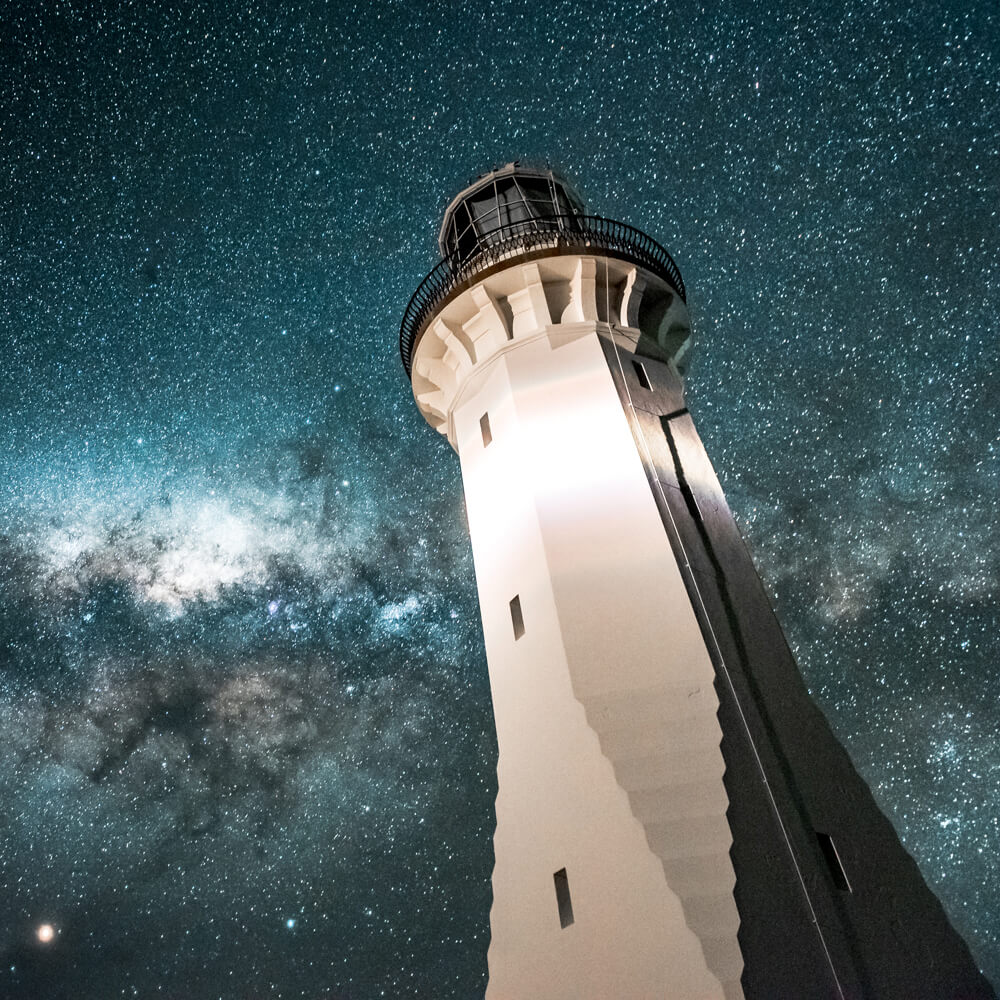
There's a lot of story behind this 30-second astro-landscape timelapse at Green Cape Lighthouse.
Green Cape Lightstation is about 40 km south of Eden, on the NSW far south coast. The original 1883 tower, designed by NSW Colonial Architect James Barnet, was the tallest lighthouse in NSW when it was built and one of Australia's earliest major concrete structures.
There's wildlife everywhere. Wombats, bandicoots, rabbits, possums, wallabies. I remember shining my torch into the bush at one stage to see a dozen or so eyes reflecting back at me.
No light pollution. Clear skies. The lighthouse for the foreground. Nothing to do the next day.
Inside the prism of the lighthouse:

I checked The Photographer's Ephemeris for the position of the Milky Way, set up the shot from about 10:30 PM, and let the intervalometer do its thing.
What was meant to be an uneventful night changed when I noticed the lighthouse becoming illuminated from the other side (about 9 seconds in).
I looked over the keepers' cottages and saw multiple flashlights waving around in the dark.
Two hours of photos already in the bag. I started to panic that they were going to be ruined.
So I ran over, in pitch black, with my phone screen lighting the way so I didn't ruin the timelapse myself.
The newer steel tower replaced the original concrete tower on 17 March 1992, after 109 years of continuous human operation. The keepers were withdrawn the same year.

As I got closer, I realised the people with torches were NSW Police, looking at a solar panel array, still totally unaware of my presence.
From about two metres away, in my most unconvincing tone, I said "hello". The two police and the keeper promptly swung around with their flashlights.
"I'm trying to do a timelapse, and you're kind of ruining everything for me. Can you please stop shining your torches on the lighthouse?"
In one of the worst cases of wrong place, wrong time ever, the police told me they were investigating the theft of tens of thousands of dollars worth of solar panels.
I was then asked who I am, and why I am at a lighthouse 40 km from the nearest town at midnight on a Thursday.

After identity checks, pleading for the torches to be turned off, and showing them the Nikon on the tripod with the intervalometer clicking through frames, I was able to go back to my business. The result wasn't too much affected in the end.
A couple of hours later, walking back to the car for a fresh battery, I met the lighthouse keeper sitting on the porch of his cottage.

He apologised for what had happened. I said to think nothing of it. It looks pretty suspect if you take the camera out of the equation.
We got talking about the history of the lighthouse, which turned into the wreck of the Ly-ee-Moon.
A paddle-steamer carrying 86 people from Melbourne to Sydney, the Ly-ee-Moon struck rocks at the base of the lighthouse on the night of 30 May 1886. Seventy-one people drowned. The keepers, under Head Keeper George Giblet, saw the distress rockets but couldn't launch a boat into the seas. They later recovered 24 bodies and buried them in unmarked graves in a small cemetery near the cottages. Flora MacKillop, mother of Mary MacKillop, was among the dead.
The cottages are said to be haunted by some of the victims, in particular a thickly-bearded sailor that guests have reported seeing.
My daughter Heidi was with us for the weekend. She now wants to live in a lighthouse.

So I went back to monitor the camera at 2:30 in the morning, slightly shaken from the police encounter, hoping the timelapse wasn't ruined, listening to the sounds of all the nearby scurrying animals I couldn't see in the dark, while hoping I wouldn't meet the vengeful ghost of a sailor I'd just been warned about.
Postscript, 2026: after nearly 34 years dark, the original 1883 lighthouse was re-lit on 4 February 2026, with a modern LED beacon installed in the heritage lens. The 1992 steel tower I sheltered behind that night is being removed.

