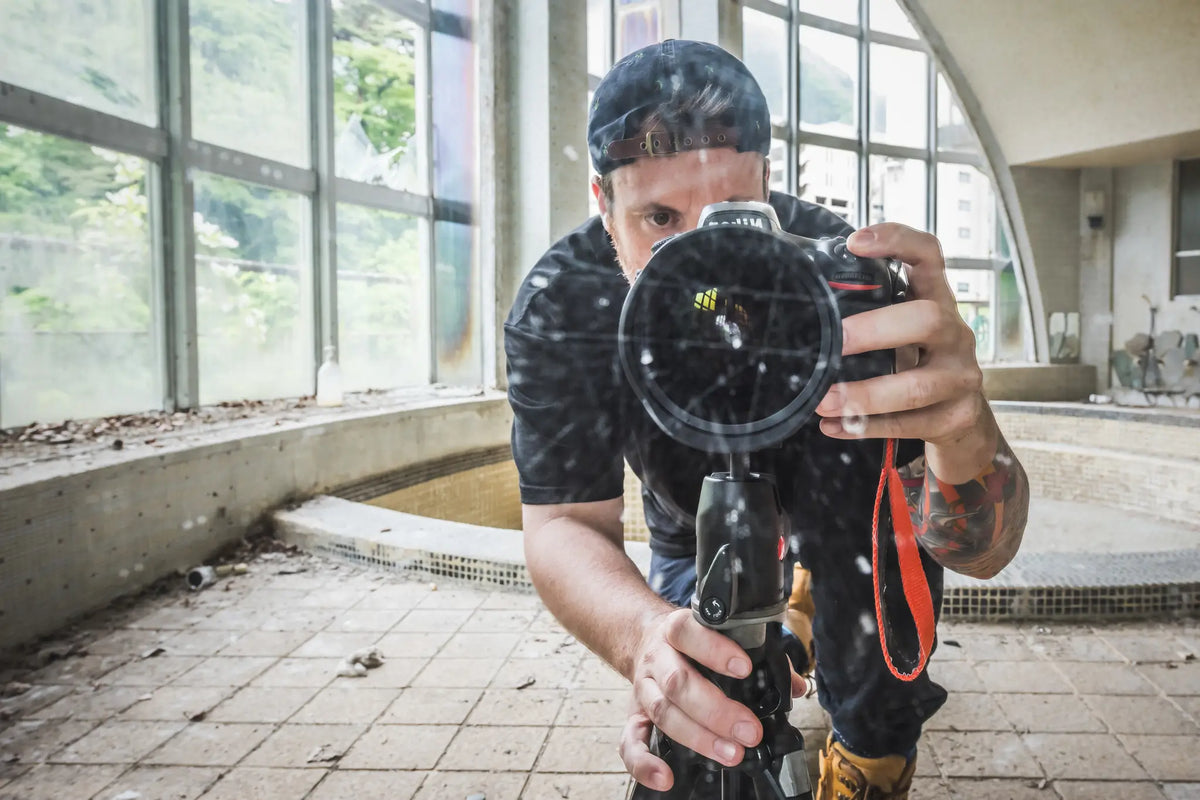
The honest answer is Google Maps.
I open Google Maps, type in whatever category of place I'm looking for — "abandoned factory", "decommissioned power station", "motel" — and make a list of everything that comes up within a reasonable drive. Then I start working through the list. That's how the motel series started. That's how most of them start.
The longer version involves a few other inputs: tips from people who follow the work on social media, newspaper articles about buildings facing redevelopment, the occasional referral from local historical societies who want a photographic record of something before it goes. Architectural researchers sometimes get in touch. Former workers point me toward places that wouldn't come up in a standard search because the building has already been partly demolished, or because it's on private land with no obvious street frontage, or because it's just not the sort of place that generates much online discussion.
But Google Maps is probably responsible for half of what I've shot. It is not a romantic process.
Once I have a location, I'll spend some time on background research before I go. Council heritage registers, newspaper archives, Trove, industry histories if I can find them. Sometimes the research is thin — a building that operated for a specific company in a specific suburb but left almost no public record. Other times there's more than I'll ever use: heritage assessments, oral history projects, digitised company reports going back decades. I read whatever I can find and take what's useful.
The research isn't just background. It changes what I look for when I'm inside. Knowing what a factory made, or what workforce it employed, or when it was built and to what standard, means I notice things I'd otherwise walk past. A date stamped on a piece of equipment that matches something in the records. A layout that confirms or contradicts the original plans. Machinery that's more recent than the building because something was upgraded late in the building's operating life. That kind of detail matters.
The first visit to any location is a scout rather than a shoot. I'm not trying to come home with photographs. I'm trying to understand the space: where the light comes from, how the building is structured, which areas repay attention and which don't. I'll take some frames, but mostly I'm building a mental map for the visits that follow.
Some locations I've visited once and never gone back to. The space turned out to be less interesting than I expected, or I got what I needed in a single session, or the access situation changed before I could return. Others I've visited eight or ten times over several years, returning as the building changes, as more of it becomes accessible, or as the light in a particular room finally lines up with what I need.
What makes me go back is hard to reduce to a clear criterion. Part of it is practical — I didn't get enough in the first visit. Part of it is that the place keeps coming up in my thinking between visits. When a room or a detail is still occupying space in my head a week after I was there, that's usually a sign there's more to get from it. The photographs I've taken don't yet account for why the place is interesting, and I need to go back and work out what's missing.
The other thing that brings me back is community. After I post from a location, messages come in from people who worked there, or whose parents did, or who grew up nearby and remember the building as a landmark. Those stories shift how I see the place on subsequent visits. I'll go back looking for the specifics they described — a particular room, a piece of equipment, a feature they mentioned. Sometimes I find it. Sometimes I realise I've been walking straight past it for multiple visits.
I don't have a fixed rule about when a location becomes a series. Somewhere around the third visit, when the photographs start to feel like they belong together rather than just being photographs of the same place. A series needs range: different light conditions, different areas of the building, different scales of detail. A single room photographed five different ways isn't a series. A building properly explored, where the photographs sit alongside each other and tell you more together than they do separately — that's a series.
The whole thing is less cinematic than it probably sounds. A lot of driving. A lot of parking and walking the perimeter, deciding whether it's worth pursuing. A lot of photographs that go nowhere. The locations that turn into something are the minority. You don't know which ones they are until you're already well into the process.

