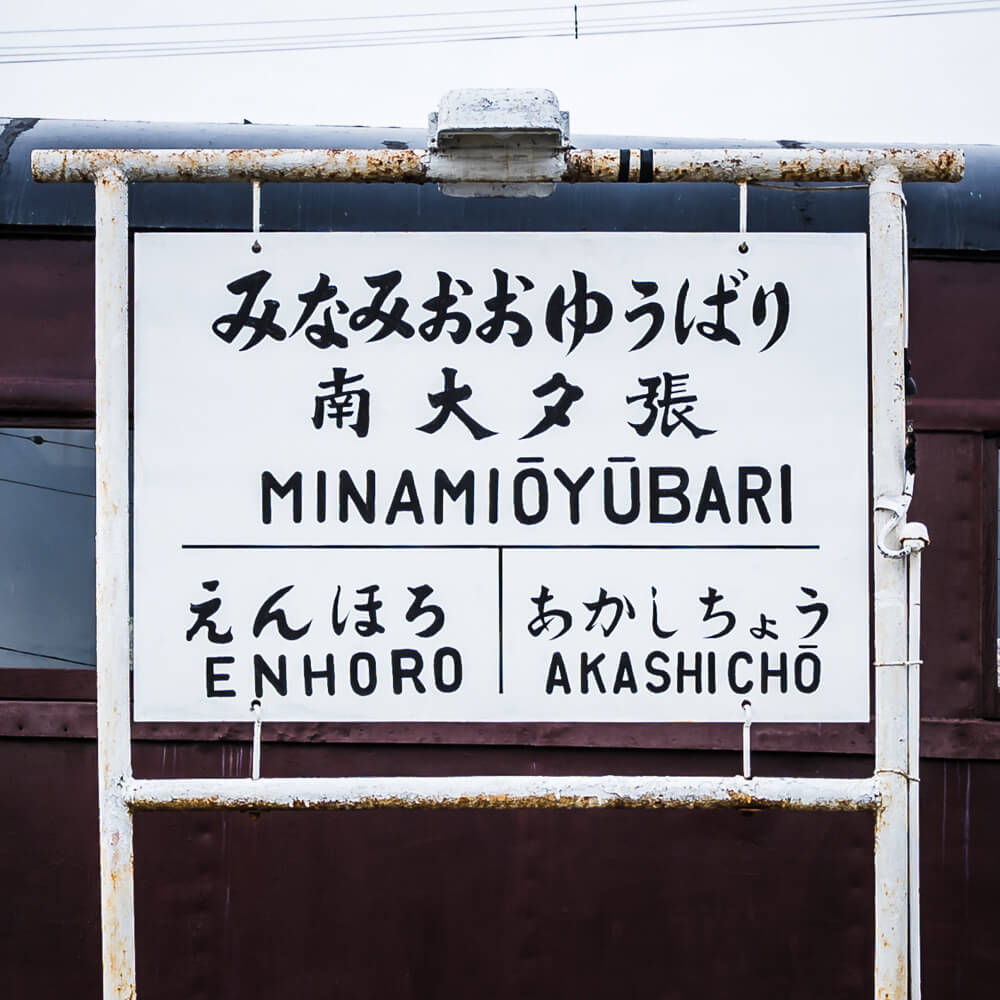
This is the Mitsubishi Minami-Ōyūbari rail yard, on the south-eastern fringe of Yubari. A small open-air collection of preserved carriages, a snowplough locomotive, and the original station platform: what remains of the private mining railway that once threaded through Yubari's coal valleys.
The line was not part of Japan National Railways. It was Mitsubishi's own, a freight and worker railway built to serve the company's mining operations in the Sorachi region, connecting Mitsubishi pits to the JNR Sekishō Line at Shimizusawa Station. When the last Mitsubishi mine in the area closed, the railway lost its reason for being.
That mine was the Mitsubishi Minami-Ōyūbari Coal Mine, which shut on 30 March 1990 after a 1985 gas explosion that killed 62 miners. With the mine gone, so was the freight. Yubari's wider coal industry had been winding down for two decades by then. You can read more about that in my Streetscapes of Yubari gallery.

The map above shows the network at its working height. Branches into hamlets that no longer exist on most maps. Spurs into pit-heads sealed off forty years ago.
Most of the line was lifted long before I got here, and walking what remains takes a level of local knowledge I don't have. Old grades, cuttings, and bridge abutments are still scattered through the bush around Shimizusawa, Minami-Ōyūbari, and Numanosawa. I'd like to come back one day and follow them properly.

This is Ki 1, a snowplough engine built in February 1941 at the Naebo railway factory in Sapporo, under order from Mitsubishi Mining's in-house engineering department. The information plate gives its dimensions as 11,388 mm long, 3,985 mm tall, 2,522 mm wide. I haven't measured it, but Japanese engineering of that era tends to be exact.

The carriage above is the Suhani 6, a three-axle bogey passenger car (plate T R 70), built in 1912 at the Ōmiya rail factory. It was rated to carry 68 passengers in summer and 64 in winter. I assume the reduced winter capacity made room for the stove heater that used to sit on the steel plate at the left of the frame.

Front-on view of the snowplough. It was never used to pull carriages. Its job was to clear the Mitsubishi line through the Yubarigama mountain area, where winter snow sits deep enough to bury a service road.
The last steam locomotive that worked these carriages is no longer here. It was moved to a purpose-built shed inside Sekitan no Rekishi Mura, the Coal Mining History Village that Yubari opened in 1983 as the centrepiece of its pivot from coal to tourism.

The History Village did not survive Yubari's bankruptcy. The amusement-park rides were dismantled around 2008; only the Coal Museum has been retained, on a much smaller footprint. The locomotive shed is part of the closed section. Restoration funding is not on anyone's agenda.

The building attached to the locomotive is the museum hall. The landscape in the background is the rest of the now-defunct theme park.

Back at the open-air yard: the Oha 1 (truck TR 11) below was another steel-and-timber passenger car, built in 1906 at the Shinbashi railway workshop. The plate gives a capacity of 104 in summer and 96 in winter, the same seasonal pattern as the Suhani 6, presumably for the same stove-heater reason.

In 1999, the Mitsubishi Ōyūbari Railway Preservation Society was formed: heritage preservationists, rail aficionados, volunteers. They handle the regular maintenance work that keeps the carriages and snowplough from rotting into the ground.

The information on the cars and the station came almost entirely from a Japanese-language plate document on site, which I couldn't read. I photographed each section, ran it through Google Translate, and worked back to the photos one passage at a time. It took most of an afternoon. I'd be glad of corrections from anyone who reads Japanese fluently. There's a copy of the original document at the bottom of this post.

I hadn't planned to spend much time here. I'd come to Yubari for the abandoned schools and the Shimizusawa power plant and the wider question of what happens to a city when its industry dies. The rail yard was a stop on the way through. It became one of the quietest hours of the trip.
None of what survives here is on a national heritage register. The preservation society do this work because no one else will, and the work is unfunded.


If you're planning a trip to Yubari, the preservation society accepts donations. Volunteer maintenance and the occasional grant are what's kept this yard from being levelled.
One practical note: Yubari is not a part of Japan where English is commonly spoken. People are warm and welcoming, but without someone in your group who reads and speaks Japanese, you will hit barriers that none of you can do much about. I had help from the Shimizusawa Project for most of my own visit; without them, I'd have got almost nothing done.
For Japanese readers: here is the on-site document I used as the basis for everything above. I'd be interested to know how close I got.


