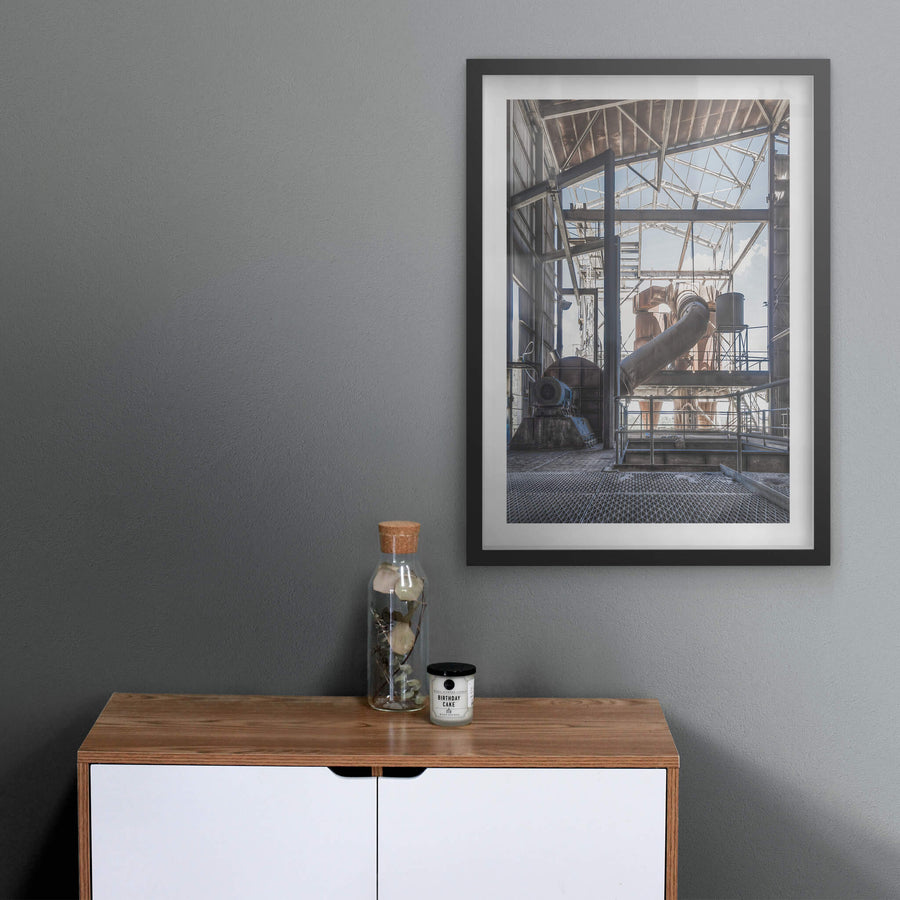
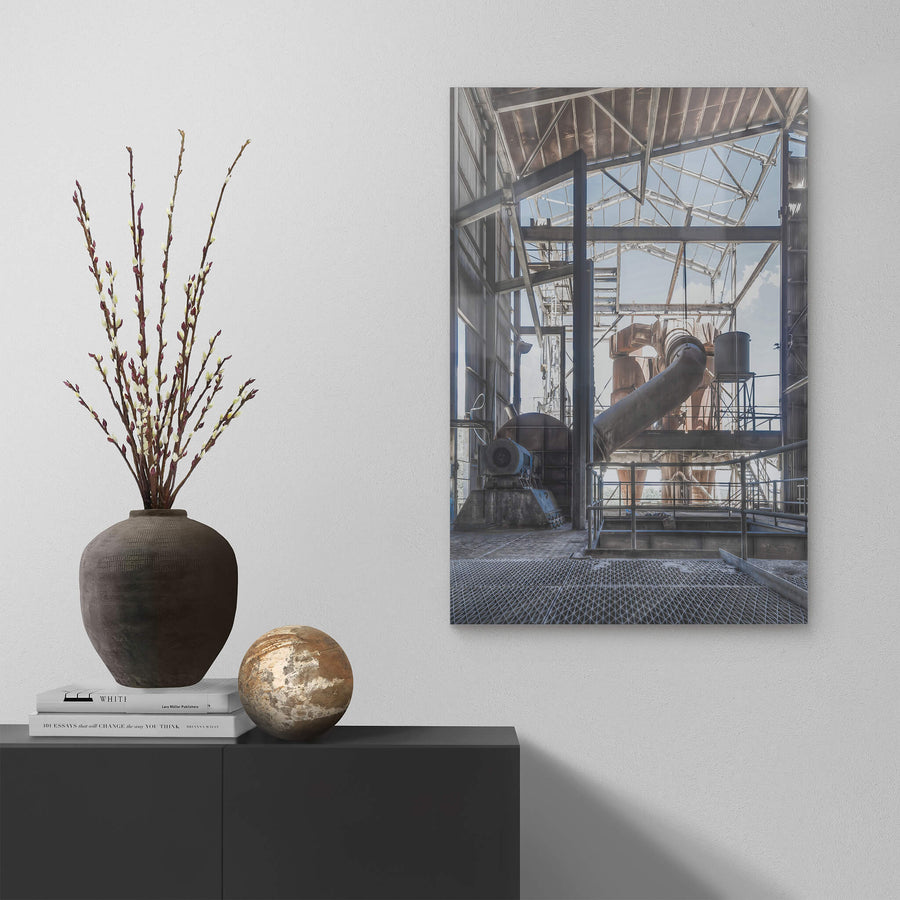
Fan Casing And Ductwork

Provenance

Camera
NIKON D7000
Lens
14.0-24.0 mm f/2.8
Settings
14mm · f/8.0 · 1/10 · ISO 100
Paper
Ilford Galerie Smooth Cotton Rag 310 gsm

Fan casing and ductwork at the top of the preheater building at Kandos Cement Works. The system drew waste heat from the kiln back into the process for reuse. The plant produced Portland cement from 1916 to 2011.

Edition
Open edition

Open edition
Printed to order, no fixed quantity. Each print is hand-signed by the photographer.

Limited edition
A fixed number of prints exist. Once sold, the edition closes permanently. Each print is individually numbered and signed.

$100.00 AUD
Size
Type
Colour
Signed, numbered, with COA. Made to order in 10 to 20 business days (framed). Shipped in protective packaging with edition certificate, paper-stock reference and a printed care guide.
See certificate sample →

Shipping Free shipping over $250. Ships worldwide, rates calculated at checkout.

Returns Damaged in transit? We replace it. Full policy →

Ships within 10 business days · signed & numbered

In situ
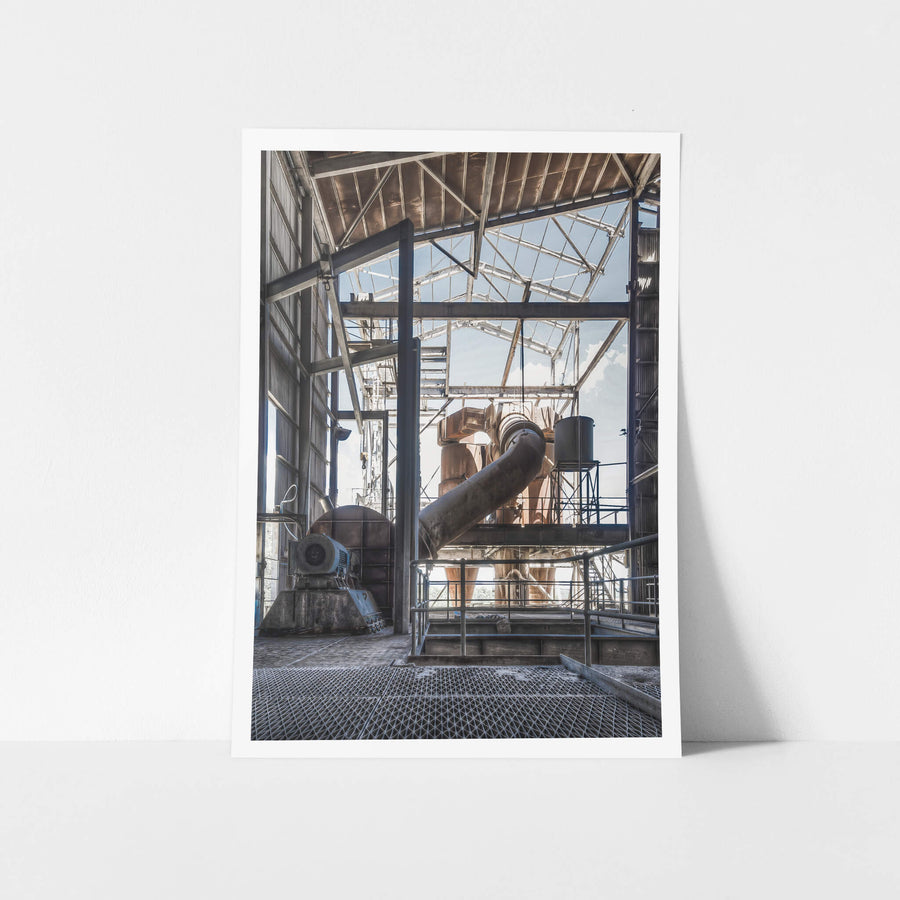
Fan Casing And Ductwork at Kandos Cement Works, this is the fan casing and ductwork at the top level of the preheater.Fan Casing And Ductwork at Kandos Cement Works, this is the fan casing and ductwork at the top level of the preheater.Fan Casing And Ductwork at Kandos Cement Works, this is the fan casing and ductwork at the top level of the preheater.Fan Casing And Ductwork at Kandos Cement Works, this is the fan casing and ductwork at the top level of the preheater.Fan Casing And Ductwork at Kandos Cement Works, this is the fan casing and ductwork at the top level of the preheater.
01 PROVENANCE

Print datasheet

Title
Fan Casing And Ductwork
Series
Kandos Cement Works
Catalogue
KCW-013
Process
Giclée
Captured
13 February 2016
Camera
NIKON D7000
Lens
14.0-24.0 mm f/2.8
Aperture
f/8.0
Shutter
1/10 s
ISO
100
Focal length
14 mm
Paper
Ilford Galerie Smooth Cotton Rag 310 gsm
Paper size
290 × 200 mm
Location
Kandos, New South Wales, Australia
Recognised by
National Trust of Australia (NSW), 2016 Heritage Award, Multimedia
02 LOCATION

Kandos, New South Wales, Australia

Map · Mapbox · OpenStreetMap

03 THE STORY

About this print

A large fan casing and the ductwork running off it sit in one of the mechanical bays at Kandos Cement Works, the casing a riveted steel volute roughly the height of a worker, with a horizontal shaft running through the centre to the drive motor on the far side. The fan inlet is open at the front, the impeller visible inside, its blades darkened from years of dust-laden air passing through them. The outlet duct rises from the top of the casing and bends through a right angle into the cladding overhead, where it disappears into the run that links it back to the bag filters and stack. The frame the fan sits on is concrete and steel, anchored to the floor against vibration. A walkway runs alongside the casing for maintenance access.

Cement works rely on continuous airflow to move hot exhaust gases through the preheater and kiln circuits and to collect dust through the plant's filtration system. Fans like this one moved enormous volumes of air at high temperature for the entire operational life of the plant. Kandos Cement Works ran from August 1916 to September 2011. Through that 95-year operation the fan motors were one of the plant's largest electricity loads. The closure was announced on 11 July 2011, when Cement Australia CEO Chris Leon told the workforce in a Thursday morning meeting that the plant would shut. Production ceased that September. The fan has been still since.

04 FROM THE FIELD NOTES

This is the fan casing and ductwork at the top level of the preheater building. It once played a vital role in the cement production process, drawing waste heat from the kiln to be reused in heating the ball mills, ensuring maximum efficiency.

Brett Patman

Kandos Cement Works

The series

Kandos Cement Works

2016 · 40 photographs

The town's first name was Candos, an acronym of the directors' surnames at the NSW Cement Lime and Coal Company. They bought 100 acres from local farmer John Lloyd Junior for £2,000 in 1913 and had surveyor James Dawson lay out the township. The Postmaster General ruled the name change to Kandos in 1915, and by August 1916 the kilns at the new cement works were firing.

View all in this series →

05 SIZE GUIDE

Print sizes

The anatomy view shows what this finish is as a physical object: paper margin, mat band, frame depth, acrylic profile. The comparison strip shows how each size sits relative to the others at true scale. Click a size or a finish to update both.

Anatomy · true ratio
TypeSizeWidthHeight
08 BY POST · NO SPAM

Read the full story

Articles when they're published. The history behind a place. The day of a shoot. The work between prints. No marketing, no schedule.

You're subscribed.