Storage Shelves

Provenance

Camera
NIKON D7000
Lens
AF-S Zoom-Nikkor 24-70mm f/2.8G ED
Settings
67mm · f/8.0 · 1/8 · ISO 100
Paper
Ilford Galerie Smooth Cotton Rag 310 gsm

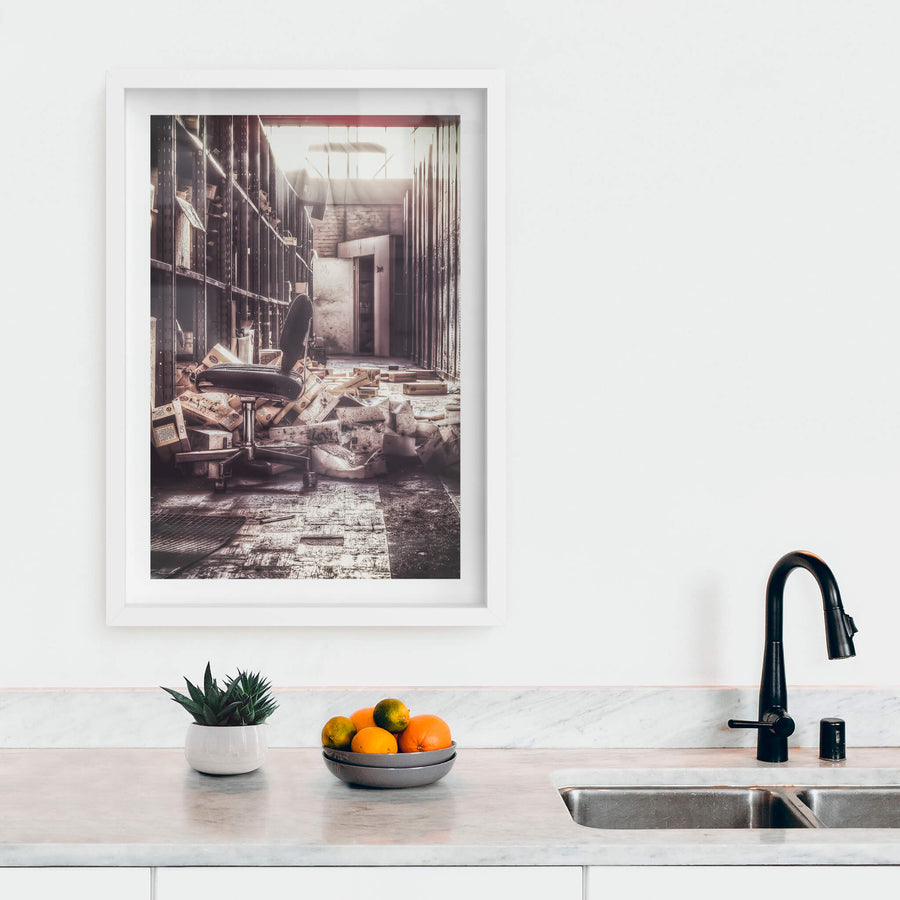
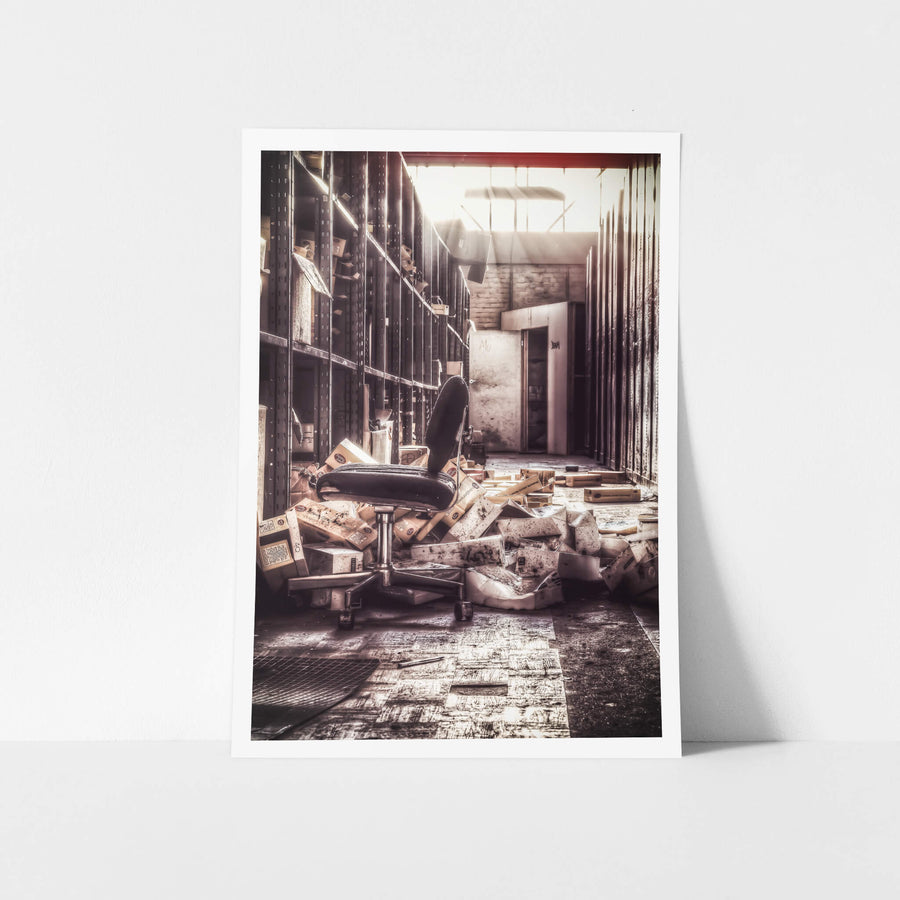
Steel shelving runs the full length of a storeroom, brackets intact. Cardboard boxes cover the floor, flattened and scattered in no particular order. An office chair sits upright in the middle of the debris. Clerestory windows at the far end of the room admit daylight. Surfaces are dusty. No shoe stock remains on the shelves.

Edition
Open edition

Open edition
Printed to order, no fixed quantity. Each print is hand-signed by the photographer.

Limited edition
A fixed number of prints exist. Once sold, the edition closes permanently. Each print is individually numbered and signed.

$100.00 AUD
Size
Type
Colour
Signed, numbered, with COA. Made to order in 5 to 10 business days (unframed). Shipped in protective packaging with edition certificate, paper-stock reference and a printed care guide.
See certificate sample →

Shipping Free shipping over $250. Ships worldwide, rates calculated at checkout.

Returns Damaged in transit? We replace it. Full policy →

Ships within 10 business days · signed & numbered

In situ
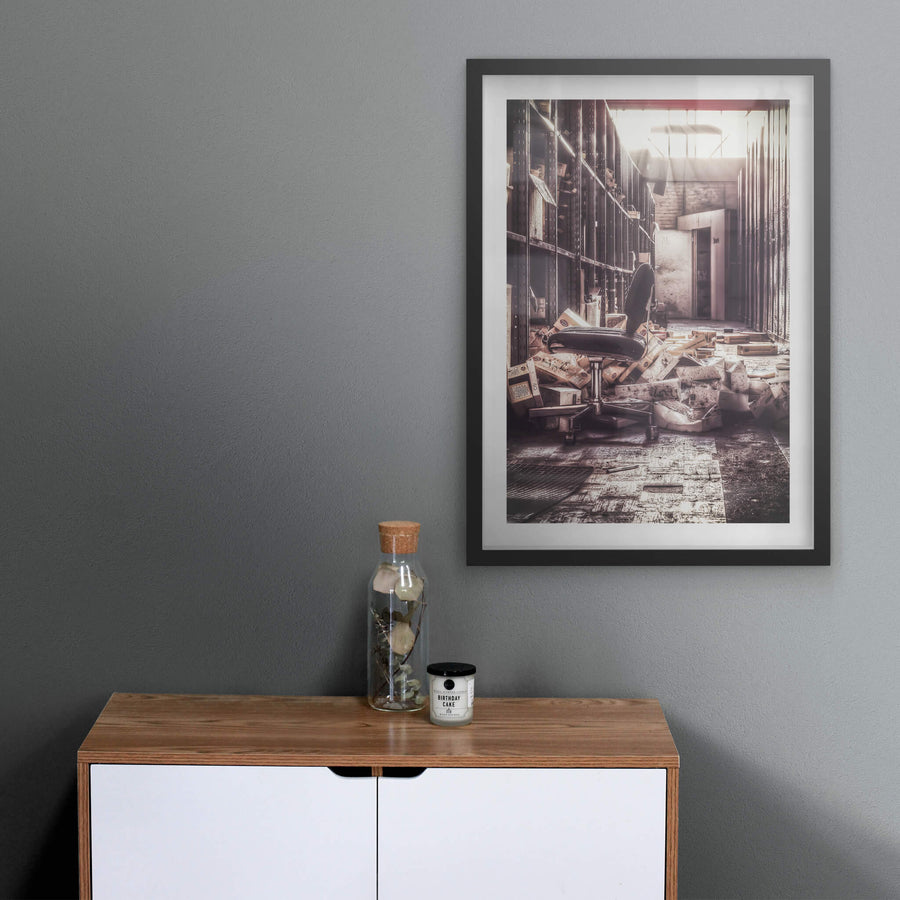
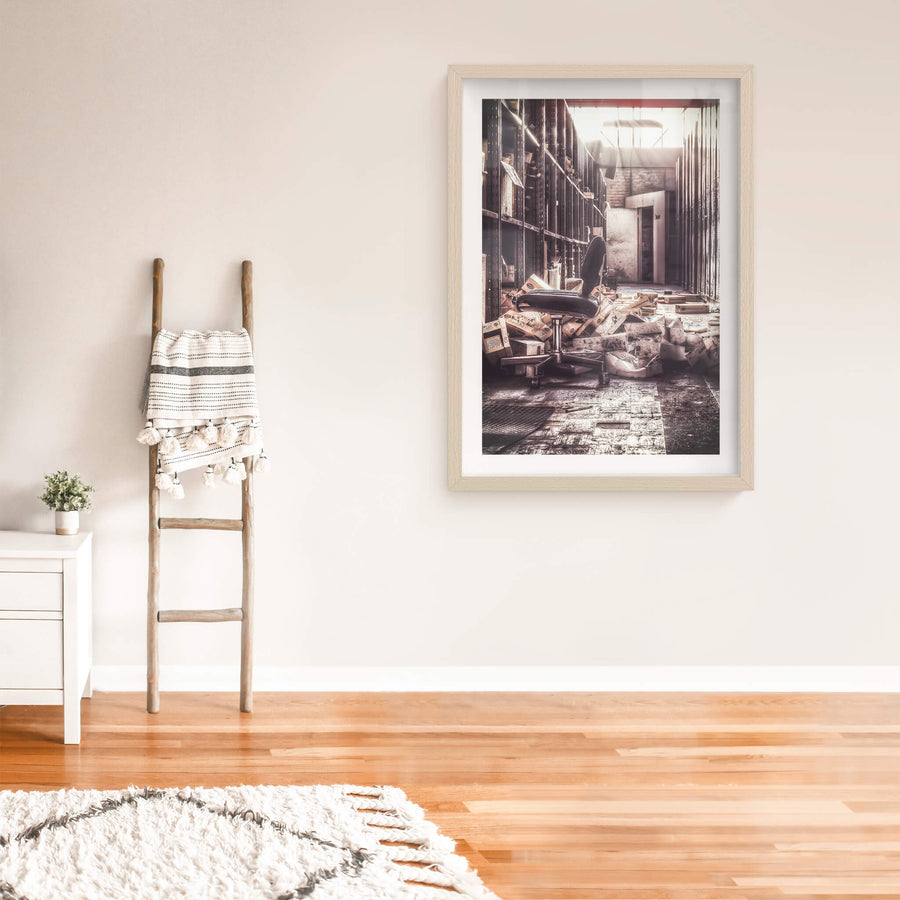
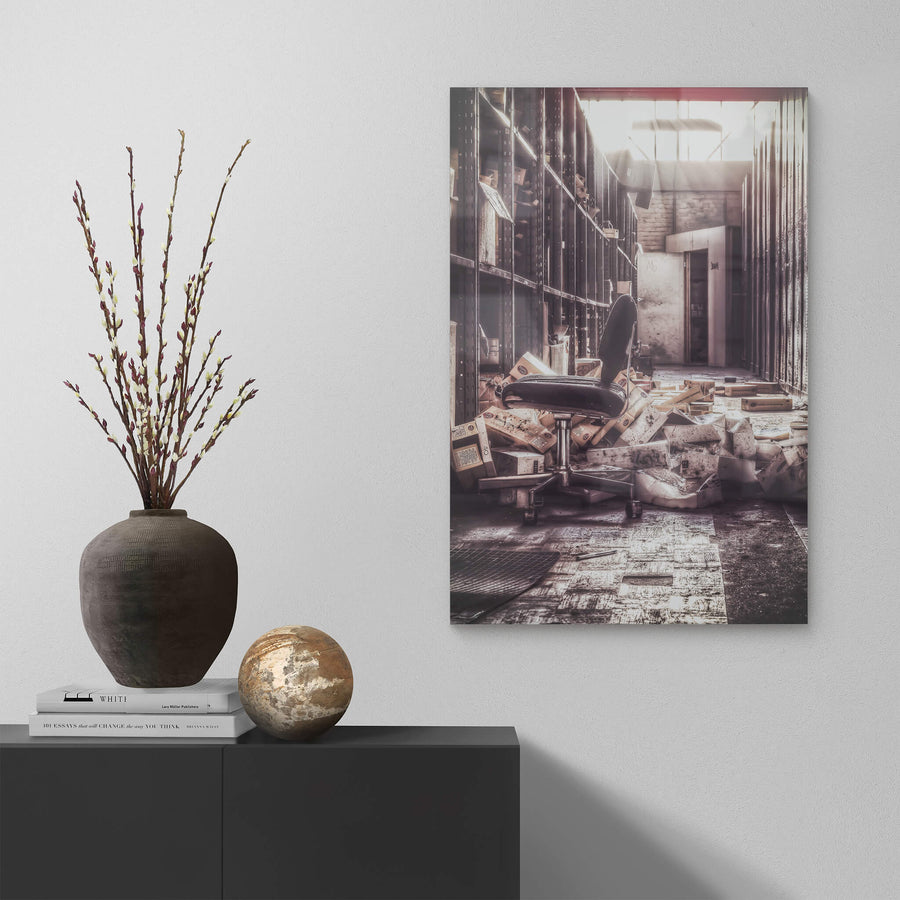
Storage Shelves at Abandoned Shoe Factory, unframed print displayed in situ on a wall.Storage Shelves at Abandoned Shoe Factory, white-framed print displayed in situ on a wall.Storage Shelves at Abandoned Shoe Factory, black-framed print displayed in situ on a wall.Storage Shelves at Abandoned Shoe Factory, raw timber-framed print displayed in situ on a wall.Storage Shelves at Abandoned Shoe Factory, glass print displayed in situ on a wall.
01 PROVENANCE

Print datasheet

Title
Storage Shelves
Series
Abandoned Shoe Factory
Catalogue
ASF-009
Process
Giclée
Captured
11 March 2012
Camera
NIKON D7000
Lens
AF-S Zoom-Nikkor 24-70mm f/2.8G ED
Aperture
f/8.0
Shutter
1/8 s
ISO
100
Focal length
67 mm
Paper
Ilford Galerie Smooth Cotton Rag 310 gsm
Paper size
290 × 200 mm
Location
Northcote, Victoria, Australia
Recognised by
Highly Commended in Multimedia at the 2016 National Trust of Australia (NSW) Heritage Awards
02 LOCATION

Northcote, Victoria, Australia

Map · Mapbox · OpenStreetMap

03 THE STORY

About this print

The steel shelving is still in position along the full length of the storeroom wall, brackets and uprights intact. Cardboard boxes cover the floor below it, flattened and scattered as though dropped there and never retrieved. An office chair sits upright in the middle of the room, surrounded by the debris. Clerestory windows at the far end let daylight fall across the scene. The shelves are empty. Whatever was stored here was taken or sold before the doors closed for good. The Northcote Shoe Factory was purpose-built in 1926 on the corner of Arthurton Road and Helen Street, Northcote. The company had already been operating out of two smaller buildings on nearby Eastment Street before purchasing the corner land and constructing the new facility. By 1933, Northcote was described in its Jubilee souvenir programme as "an important, flourishing manufacturing city," with boot and shoe production part of a broader industrial base that included brickworks, tanneries, furniture making, and hat manufacturing. The factory was one of many in Melbourne's inner northern suburbs, a concentration of footwear manufacturing that stretched across Collingwood, Fitzroy, Richmond, Clifton Hill, and Northcote. Employment in Melbourne's footwear industry peaked in the 1960s at nearly 12,000 workers. By the 1970s the Arthurton Road factory was operating under the name Purnell Shoe Company. The closure came during the contraction that followed tariff reductions across the Australian footwear industry in the 1980s and 1990s. Low-cost imports made the economics unworkable for small suburban manufacturers. The exact date the Purnell Shoe Company ceased production has not been confirmed from available sources, but the factory was abandoned by the time Lost Collective documented it in 2012, production equipment and storage fittings still in place throughout the building. The factory was demolished and the site redeveloped as a residential unit complex in 2016. What remains is the photograph: shelving, boxes, a chair, and light through clerestory windows at the end of a storeroom that no longer exists.

04 FROM THE FIELD NOTES

The storeroom of the Northcote Shoe Factory on Arthurton Road still held its shelving when the building was photographed in 2012, steel brackets intact and running the full length of the room. Cardboard boxes lay flattened across the floor, an office chair left standing among them. Light came in through clerestory windows at the far end. The factory had been purpose-built on the corner of Arthurton Road and Helen Street in 1926, replacing two earlier buildings on nearby Eastment Street, and was operating as Purnell Shoe Company by the 1970s before closing as cheap imports reshaped the industry.

Brett Patman

Abandoned Shoe Factory

The series

Abandoned Shoe Factory

2012 · 12 photographs

Shoe manufacturing began in two small buildings on Eastment Street, Northcote, before the company purchased corner land at Arthurton Road and Helen Street in 1926 and built a purpose-built factory at 13-15 Arthurton Road. By the 1970s the operation was trading as the Purnell Shoe Company; a pair of brown lace-up shoes in their original Purnell-branded cardboard box from that period sits in the State Library of Victoria's collection as call YLTTEX 198. The factory closed during the contraction of the Australian footwear industry in the 1980s and 1990s, and the site was demolished and consolidated into Lot 102 PS722836, redeveloped as a unit complex from 2016.

View all in this series →

05 SIZE GUIDE

Print sizes

The anatomy view shows what this finish is as a physical object: paper margin, mat band, frame depth, acrylic profile. The comparison strip shows how each size sits relative to the others at true scale. Click a size or a finish to update both.

Anatomy · true ratio
TypeSizeWidthHeight
08 BY POST · NO SPAM

Read the full story

Articles when they're published. The history behind a place. The day of a shoot. The work between prints. No marketing, no schedule.

You're subscribed.