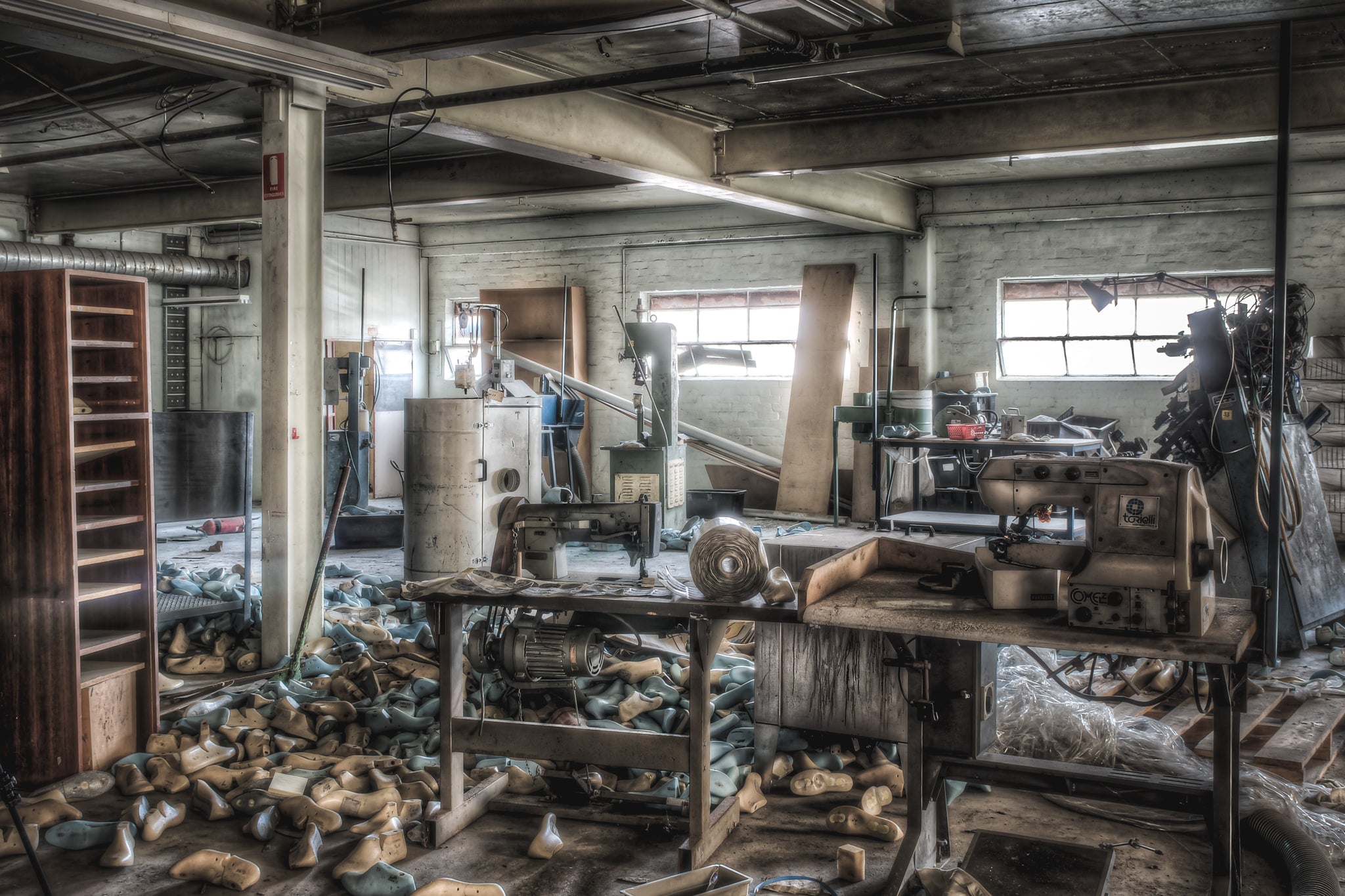
01 Abandoned Shoe FactoryNorthcote2012
ISO 1002sf/8.036mm
Series · 12 prints
Abandoned Shoe Factory
Series story
Map · Mapbox · OpenStreetMap
Shoe manufacturing began in two small buildings on Eastment Street, Northcote, before the company purchased corner land at Arthurton Road and Helen Street in 1926 and built a purpose-built factory at 13-15 Arthurton Road. By the 1970s the operation was trading as the Purnell Shoe Company; a pair of brown lace-up shoes in their original Purnell-branded cardboard box from that period sits in the State Library of Victoria's collection as call YLTTEX 198. The factory closed during the contraction of the Australian footwear industry in the 1980s and 1990s, and the site was demolished and consolidated into Lot 102 PS722836, redeveloped as a unit complex from 2016.
Melbourne's inner northern suburbs of Collingwood, Fitzroy, Richmond, Clifton Hill and Northcote formed a concentration of boot and shoe manufacturing from the mid-19th century through to the 1970s. By 1933, the year of Northcote's Jubilee celebrations, the borough described itself as an important manufacturing city with a population of 36,129; the Arthurton Road factory was operational by then. Factories in Northcote from this period typically featured sawtooth roofs and decorative brickwork, blending functional design with regional interwar industrial style.
Lost Collective photographed the abandoned interior in 2011 and 2012, with the production floor still carrying its clicker press, sewing desks, vacuum sealer and dispatch equipment. Print titles for the series identify the surviving operational areas (sewing desk, dispatch, vacuum sealer front, vacuum sealer hoses, rear workshop, upstairs workshop, clicker press) along with the smoko area and its radio still in place. A clicker press is a die-cutting machine used to stamp leather or synthetic material into shoe component shapes; its presence confirms leather-cutting on site.
Employment in Melbourne's footwear industry peaked in the 1960s at nearly 12,000 workers, most of them women. From the 1980s, tariff reductions under the Hawke government's economic liberalisation programme exposed Australian manufacturers to low-cost imported footwear, and small mid-sized factories closed across the inner north. The Purnell Shoe Company has no Australian Business Number on record, consistent with a company that ceased before the ABN system was introduced on 1 July 2000; the factory was demolished and the consolidated parcel at 9-13 Arthurton Road redeveloped as a unit complex from 2016.
Prints in this series
Hand-signed and numbered, printed from the original RAW file. Open editions in the two smallest sizes; limited editions of 100, 50 and 25 in the three larger, never reissued once they sell through.


How they’re made
Made to order by Brett in Sydney, from the original RAW file. Each print is hand-signed and numbered before it ships.
Paper
Ilford Galerie cotton rag, 310 gsm. Acrylic on metallic gloss, 260 gsm.
Lead time
Unframed: 5 to 10 business days. Framed and acrylic: 10 to 20.