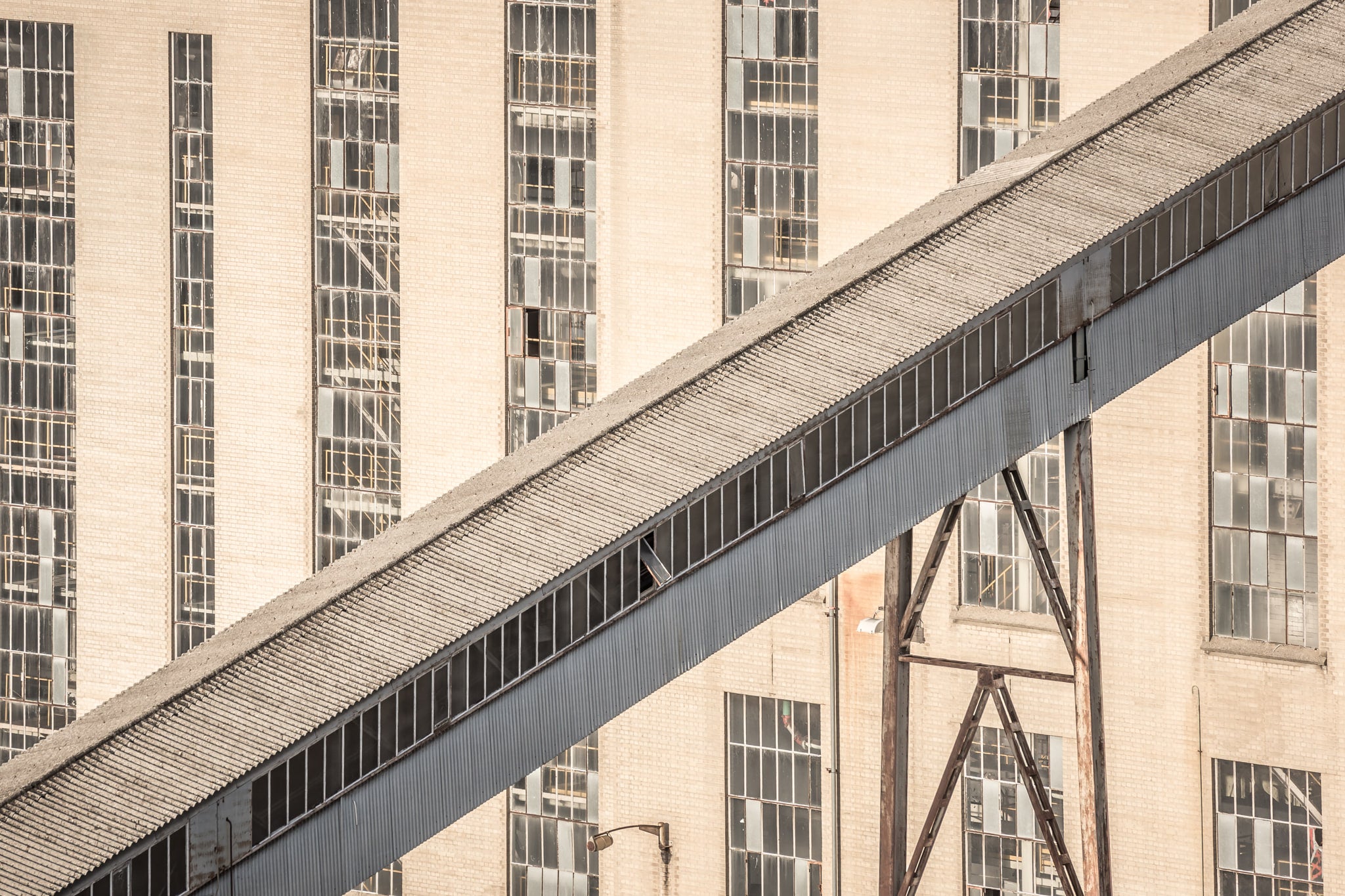
01 Morwell Power StationMorwell2017
ISO 1001/250f/8.0200mm
Series · 79 prints
Morwell Power Station
Series story
Map · Mapbox · OpenStreetMap
The State Electricity Commission of Victoria built Morwell as the centrepiece of its postwar plan to sever Victoria's reliance on black coal from New South Wales. Construction ran from 1949 to 1959; electricity production commenced in December 1958 and the first commercial briquettes followed in December 1959. With the demolition of Old Yallourn between 1995 and 1999, Morwell became the earliest surviving large-scale Victorian state-grid power station, registered on the Victorian Heritage Register as H2377 on 1 March 2018.
The complex sits on Gunaikurnai Country, traditional land of the Braiakaulung people of the Gunnaikurnai clan. Premier John Cain Snr proclaimed the project on 8 August 1947; parliament approved the first two briquette factories and a power station the following year, and the State Executive Council added two more factories and the British and German equipment contracts on 11 October 1950. Post-war credit restrictions halted the project in 1951 under SECV chairman R.A. Hunt; construction staff was cut from 1,360 to 300 by December 1952, and the third and fourth factories were cancelled when Premier Galbally's government resumed work in May 1954.
SECV chief engineer Ernest Bate sourced the briquette presses from Maschinenfabrik Buckau R. Wolf of Germany, two 30,000-kilowatt back-pressure turbo-generators from Metropolitan-Vickers of Manchester, the boiler plant and steel chimneys from Mitchell Engineering Group of London, and the generator houses from Wright Anderson of England; the dredgers and conveyors were Australian-built. About 250 single British men came to Australia as assisted migrants from 1951 to erect the equipment, joined by a post-war operational workforce drawn largely from Britain, Italy, the Netherlands, Germany and other European countries, many of whom settled permanently in the Latrobe Valley. The Morwell brown coal proved unsuitable for briquetting because of its high alkali and sulphur content, so Yallourn coal was railed across the interconnecting line; after Hazelwood Power Station went into operation in 1971, the proportion of Victoria's electricity supply sourced from brown coal in the Latrobe Valley reached almost 90%.
In 1993 Energy Brix Australia was created as the first new Victorian Government Business Enterprise under the State Owned Enterprises Act. A Boxing Day 2003 fire destroyed the coal cross-over conveyor feeding the B, C and D briquette plants; only A plant continued, and the complex ran at a fraction of its intended capacity until Energy Brix Australia decided to close in July 2014. After Moe resident Cheryl Wragg secured an Interim Protection Order in March 2017, the Heritage Council of Victoria determined the complex significant on 12 February 2018 and Heritage Victoria registered it on 1 March 2018 as VHR H2377; the November 2018 to June 2020 demolition program followed under a Heritage Victoria permit.
Chronology
Prints in this series
Hand-signed and numbered, printed from the original RAW file. Open editions in the two smallest sizes; limited editions of 100, 50 and 25 in the three larger, never reissued once they sell through.


Victorian Heritage Register Statement of Significance The earliest surviving large-scale Victorian state-grid power station from the State Electricity Commission era
How they’re made
Made to order by Brett in Sydney, from the original RAW file. Each print is hand-signed and numbered before it ships.
Paper
Ilford Galerie cotton rag, 310 gsm. Acrylic on metallic gloss, 260 gsm.
Lead time
Unframed: 5 to 10 business days. Framed and acrylic: 10 to 20.
From the field
Read all field notesI photographed Morwell over two days in 2017, in late March and again in April. The Heritage Council had just placed an interim protection order over the complex, so demolition was on hold and the buildings were still standing, closed and cold.
The boilers, the turbines, the briquette presses, the conveyors and the control rooms were all in place, just switched off. You could walk the briquette factories floor by floor, the whole production line still there from the wet section up to the presses. By the middle of 2020 all of it had been demolished.
Sources and further reading
-
01
Victorian Heritage Database, Morwell Power Station and Briquette Factory, VHR H2377vhd.heritagecouncil.vic.gov.au/places/200429T1
-
02
Registrations Committee determination, Morwell Power Station and Briquette Factoriesassets.heritagecouncil.vic.gov.au/assets/Morwell-Power-Station-and-Briquette-Factories.pdfT1
-
03
Morwell briquette project, fold-out pamphletfind.slv.vic.gov.au/discovery/fulldisplay?docid=alma999390153607636&vid=61SLV_INST:SLVT1
-
04
Morwell briquette construction coverage, 1950 to 1954trove.nla.gov.au/search/category/newspapers?keyword=Morwell%20briquetteT1
-
05
Morwell briquette photographic and report holdingsfind.slv.vic.gov.au/T1
-
06
Morwell Power Station heritage listedlatrobevalleyexpress.com.au/news/2018/02/12/morwell-power-station-heritage-listed/T2