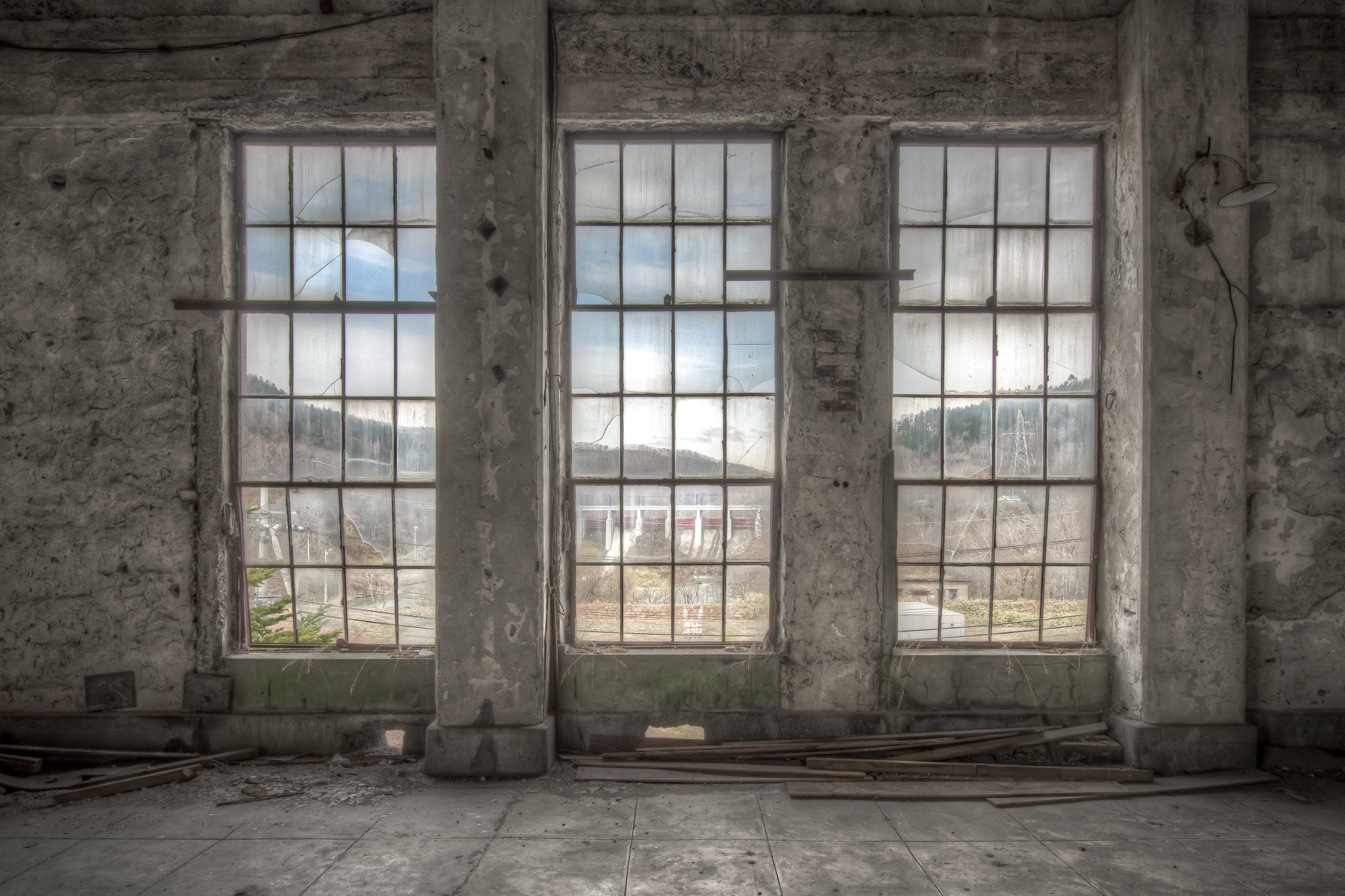
Old Hokutan Shimizusawa Thermal Power Plant is a former coal-fired power plant at Shimizusawa in Yubari, Hokkaido, Japan, built by Hokkaido Colliery and Steamship Co., known as Hokutan, as its own power plant for its coal mines. It ran from 1926 until 1990, starting with two 6,000 kW generators, and its installed capacity reached 74,500 kW. About three-quarters of the building has been demolished; the part still standing holds generating equipment.
Hokutan built Old Hokutan Shimizusawa Thermal Power Plant after the Takinoue hydroelectric plant of 1924, as it electrified its mines in the Taisho era, and in that era completed more than 100 km of its own high-voltage transmission lines. At its peak it was one of Japan's leading in-house power plants.
In 1948 and 1949 the plant generated power under contract to ease the postwar electricity shortage. By 1957 it had 13 boilers, and gas drawn from the mines was burned with coke-oven gas to help fire some of them. Kerosene was added in 1971, and Old Hokutan Shimizusawa Thermal Power Plant became a single site drawing on four resources: coal, gas, oil and the hydroelectric plant beside it.
Generation stopped in 1990 with the closure of Hokutan's Horonai mine, the last place the plant supplied, and the plant was closed in 1992, under Hokutan Mayaji Coal Mine Co. Demolition began in 1996. In 2011 the Yubari Shimizusawa Art Project was held in the plant, and demolition stopped with about three-quarters of the building gone. The surviving part of Old Hokutan Shimizusawa Thermal Power Plant is shown on guided tours, and in 2025 Maruyama Junko's installation Toki no Awai took its whole interior as the work.