
Rear Tool Room
Provenance
- Camera
- NIKON D7000
- Lens
- 24.0-70.0 mm f/2.8
- Settings
- 24mm · f/8.0 · 1/4 · ISO 100
- Paper
- Ilford Galerie Smooth Cotton Rag 310 gsm
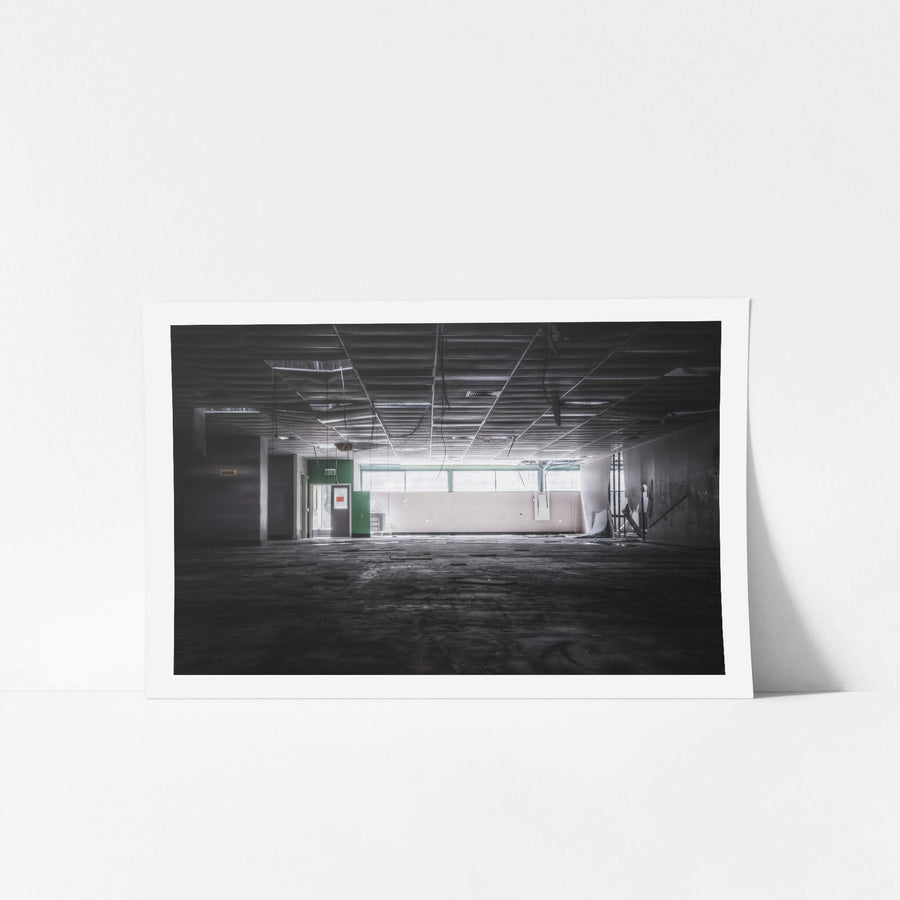
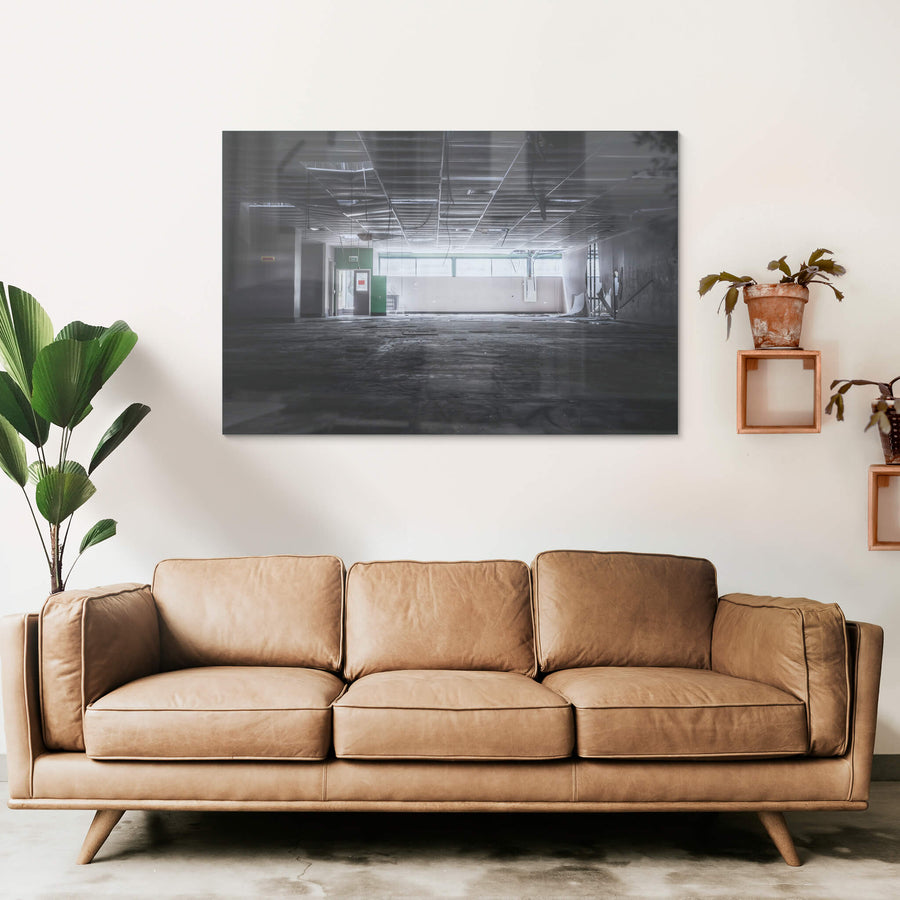
Torn plasterboard and exposed wall studs run along the right side of the room, beneath a suspended ceiling grid shedding wires and displaced panels onto the concrete floor. A green exit sign hangs above a half-open door at the far end, and a white plastic chair stands near the windows to the left. Natural light catches the pale lower half of the far wall, the upper section lost to shadow.
Open edition
Printed to order, no fixed quantity. Each print is hand-signed by the photographer.
Limited edition
A fixed number of prints exist. Once sold, the edition closes permanently. Each print is individually numbered and signed.
Shipping Free shipping over $250. Ships worldwide, rates calculated at checkout.
Returns Damaged in transit? We replace it. Full policy →
Ships within 10 business days · signed & numbered
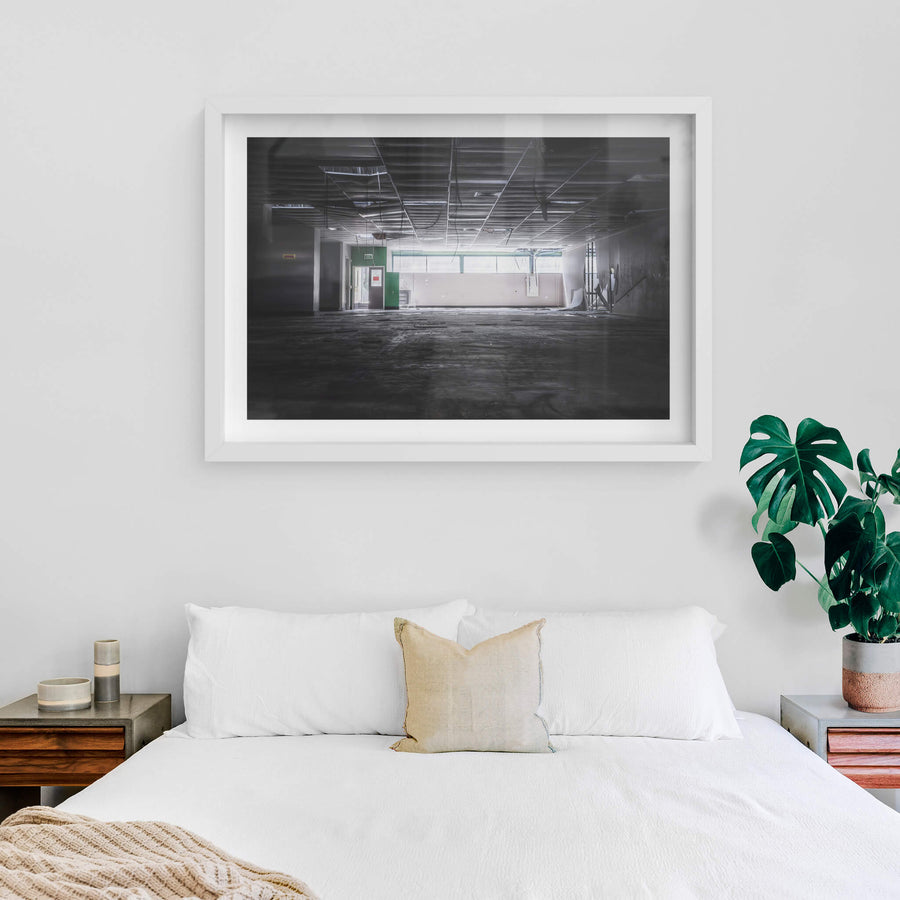
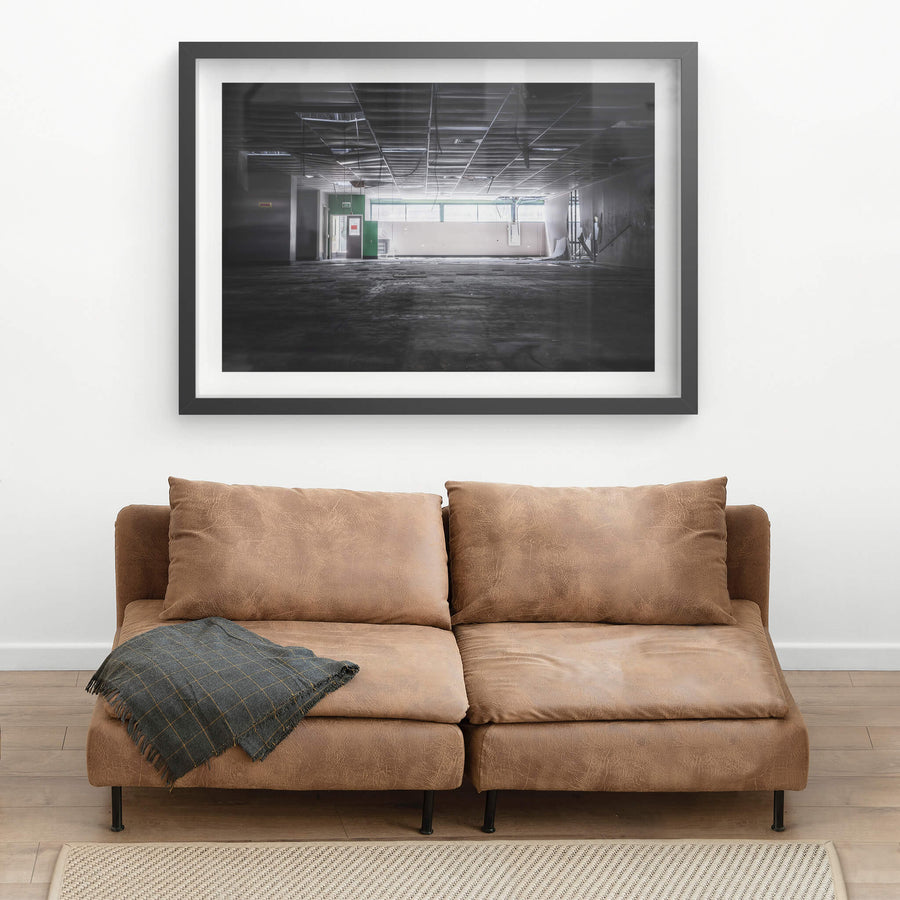
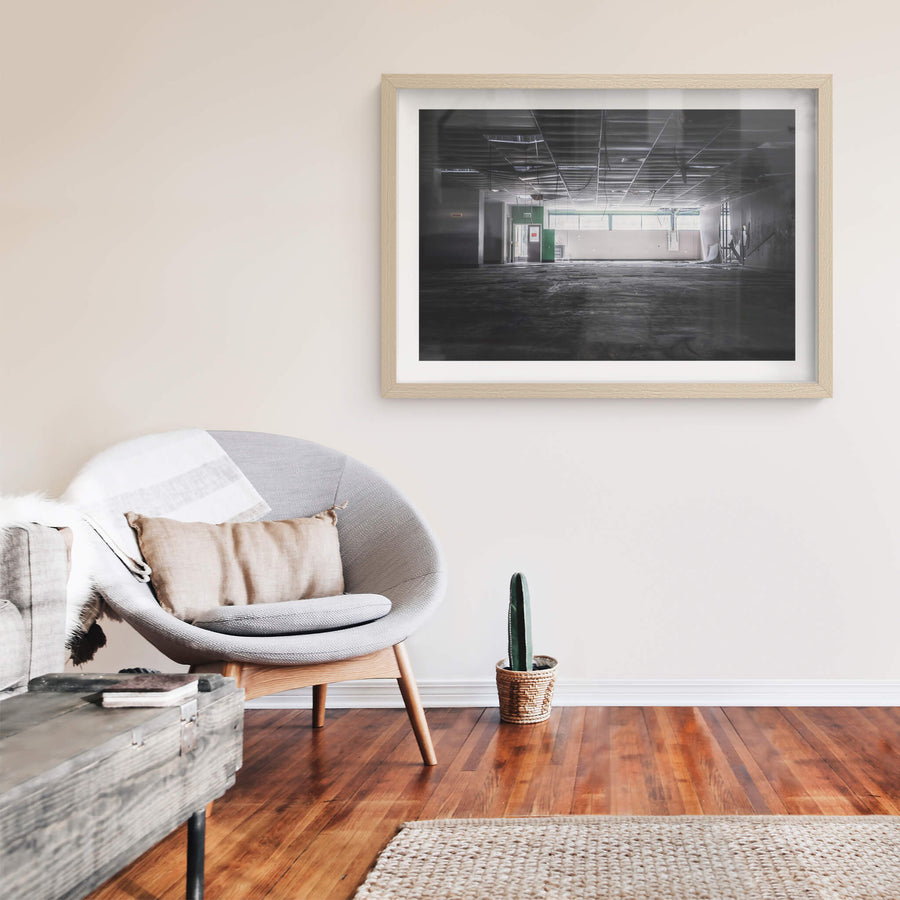
In situ
Print datasheet
- Title
- Rear Tool Room
- Series
- ATL Building
- Catalogue
- ABU-009
- Process
- Giclée
- Captured
- 16 October 2015
- Camera
- NIKON D7000
- Lens
- 24.0-70.0 mm f/2.8
- Aperture
- f/8.0
- Shutter
- 1/4 s
- ISO
- 100
- Focal length
- 24 mm
- Paper
- Ilford Galerie Smooth Cotton Rag 310 gsm
- Paper size
- 297 × 210 mm
- Location
- Meadowbank, New South Wales, Australia
- Authenticity
- C2PA verified provenance →
- Recognised by
- Highly Commended in Multimedia at the 2016 National Trust of Australia (NSW) Heritage Awards
Meadowbank, New South Wales, Australia
Map · Mapbox · OpenStreetMap
About this print
The rear toolroom of the ATL Building at Nancarrow Avenue, Meadowbank, photographed in 2015 as demolition worked through the interior. The suspended ceiling grid hangs open above a concrete floor stripped of equipment. Partition walls are partly down. A green-trimmed doorframe and exit sign survive in the middle of the room, daylight reaching them through a bank of windows at the far end. The factory, purpose-built in 1947 for Automatic Totalisators Limited, manufactured precision betting systems exported to racecourses across 29 countries. The building was demolished circa 2016.
Brett Patman

The series
ATL Building
The ATL Building was the Meadowbank factory of Automatic Totalisers Limited, the company that built the mechanical and electromechanical totaliser machines for racecourse betting, ticket printing, and department-store sales recording. Designed in 1947 by Julius Poole and Gibson for Sir George Julius, the engineer who patented the automatic totaliser, it ran as two Art Deco buildings on the same site, one for the factory, warehouse, and offices, the other for the dressing rooms, showers, and canteen. The toolroom was said to be the largest and best equipped in the southern hemisphere. A second toolroom was added in 1975. As totaliser technology gave way to computers, the factory ceased production and the buildings were repurposed as a gym, church, office space, and dance school before being demolished in 2016 for apartment redevelopment.
Print sizes
The anatomy view shows what this finish is as a physical object: paper margin, mat band, frame depth, acrylic profile. The comparison strip shows how each size sits relative to the others at true scale. Click a size or a finish to update both.
| Type | Size | Width | Height |
|---|


