
BOS Scrap Loading
Provenance
- Camera
- NIKON D7000
- Lens
- 24.0-70.0 mm f/2.8
- Settings
- 70mm · f/8.0 · 6s · ISO 100
- Paper
- Ilford Galerie Smooth Cotton Rag 310 gsm
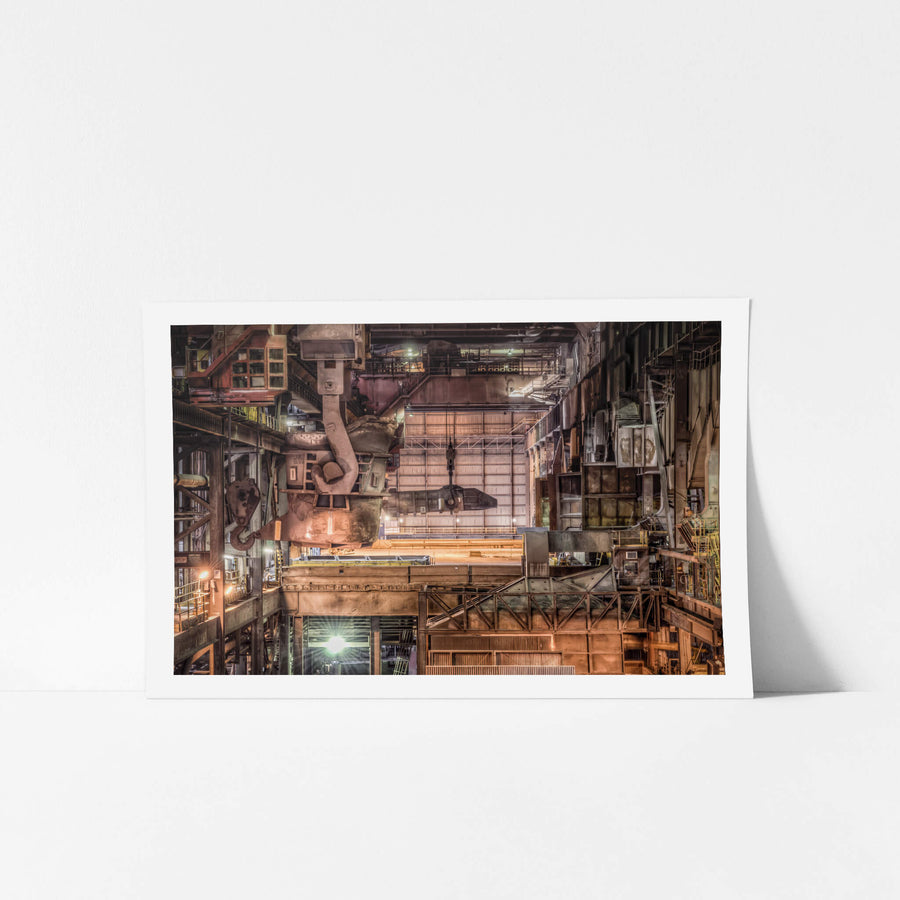
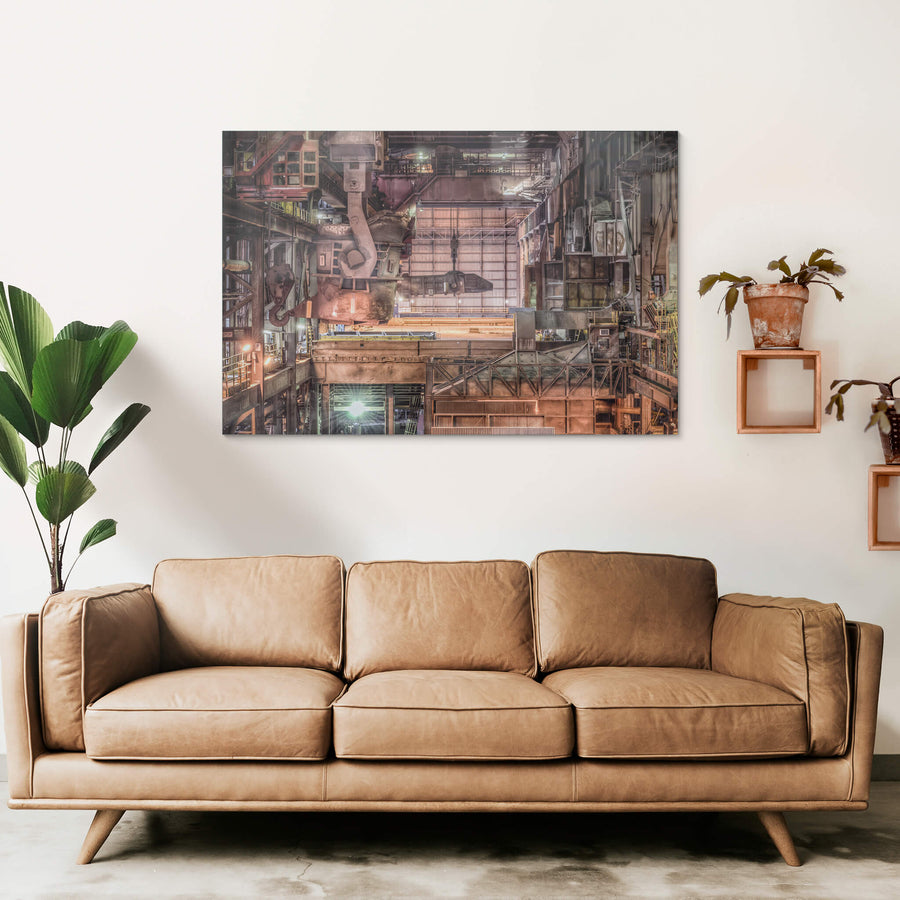
A skip loaded with steel scrap occupies the centre of the frame inside the steelmaking bay at Port Kembla Steelworks, while a large ladle of iron hangs from an overhead crane to the left, suspended mid-air above the floor. The crane hook carries a 302 marking and safety signage is legible on the lower platform. Artificial lighting throws a warm cast across the gantry steelwork, walkways and control room above.
Open edition
Printed to order, no fixed quantity. Each print is hand-signed by the photographer.
Limited edition
A fixed number of prints exist. Once sold, the edition closes permanently. Each print is individually numbered and signed.
Shipping Free shipping over $250. Ships worldwide, rates calculated at checkout.
Returns Damaged in transit? We replace it. Full policy →
Ships within 10 business days · signed & numbered
In situ
Print datasheet
- Title
- BOS Scrap Loading
- Series
- BlueScope Port Kembla
- Catalogue
- BPK-004
- Process
- Giclée
- Captured
- 18 March 2016
- Camera
- NIKON D7000
- Lens
- 24.0-70.0 mm f/2.8
- Aperture
- f/8.0
- Shutter
- 6s s
- ISO
- 100
- Focal length
- 70 mm
- Paper
- Ilford Galerie Smooth Cotton Rag 310 gsm
- Paper size
- 297 × 210 mm
- Location
- Port Kembla, New South Wales, Australia
- Authenticity
- C2PA verified provenance →
- Recognised by
- Highly Commended in Multimedia at the 2016 National Trust of Australia (NSW) Heritage Awards
Port Kembla, New South Wales, Australia
Map · Mapbox · OpenStreetMap
About this print
Inside the Basic Oxygen Steelmaking plant at Port Kembla Steelworks, a skip sits loaded with steel scrap, cranes positioned overhead ready to charge the vessels below. The BOS plant was introduced in 1972, running 200/250 tonne converters that eventually replaced every open hearth furnace on site by 1982. The scrap loading bay represents the first stage of that process, where raw material is gathered and prepared before the oxygen lance drops and the heat begins. Port Kembla Steelworks has been producing steel continuously since the first open hearth heat was tapped on 8 November 1931.
Brett Patman

The series
BlueScope Port Kembla
The BlueScope Port Kembla steelworks is the largest crude-steel production plant in Australia and the largest single industrial operation in the Illawarra. The site began in 1928 as Australian Iron & Steel, taking over Charles Hoskins's iron operation from Lithgow. First steel was made in 1931. BHP merged with AIS in 1935 and the works ran as BHP Steel, demerged from BHP in 2002 and renamed BlueScope in 2003. The No.6 Blast Furnace was decommissioned in 2011 when BlueScope withdrew from the export market and stood dormant for over a decade before reline work was approved in 2022. The Lost Collective photographs document the dormant sections of the works during the period after the 2011 shutdown.
Print sizes
The anatomy view shows what this finish is as a physical object: paper margin, mat band, frame depth, acrylic profile. The comparison strip shows how each size sits relative to the others at true scale. Click a size or a finish to update both.
| Type | Size | Width | Height |
|---|


