
Pot
Provenance
- Camera
- NIKON D7000
- Lens
- 14.0-24.0 mm f/2.8
- Settings
- 24mm · f/8.0 · 4s · ISO 100
- Paper
- Ilford Galerie Smooth Cotton Rag 310 gsm
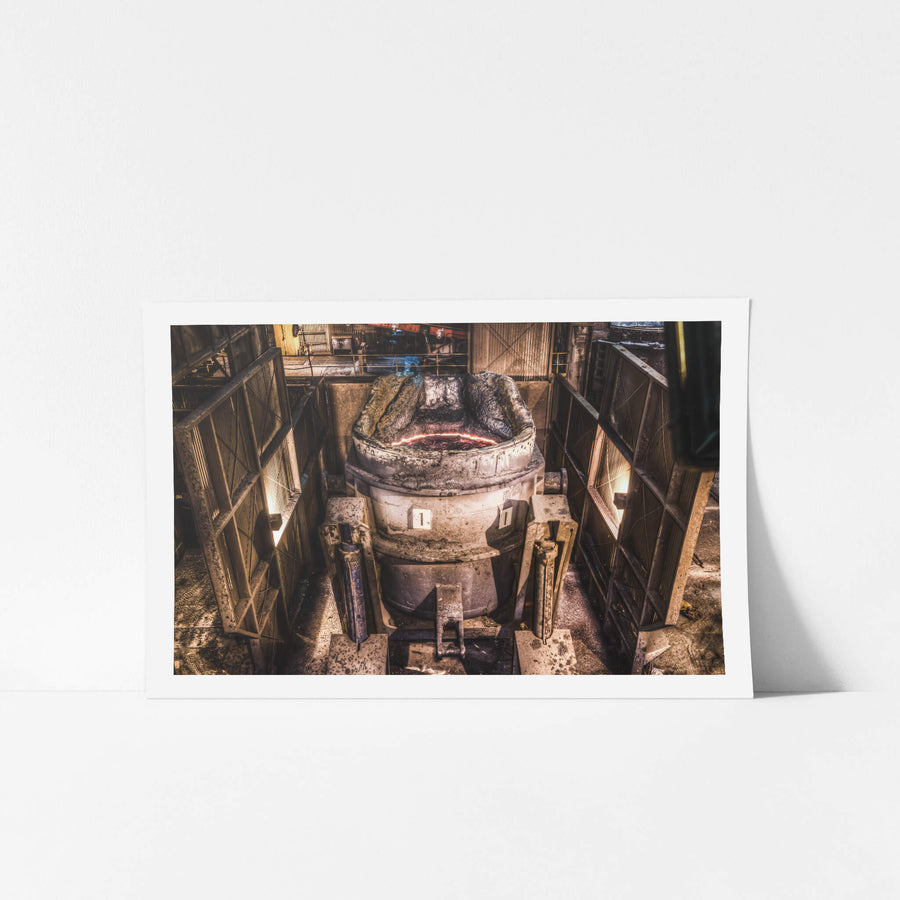
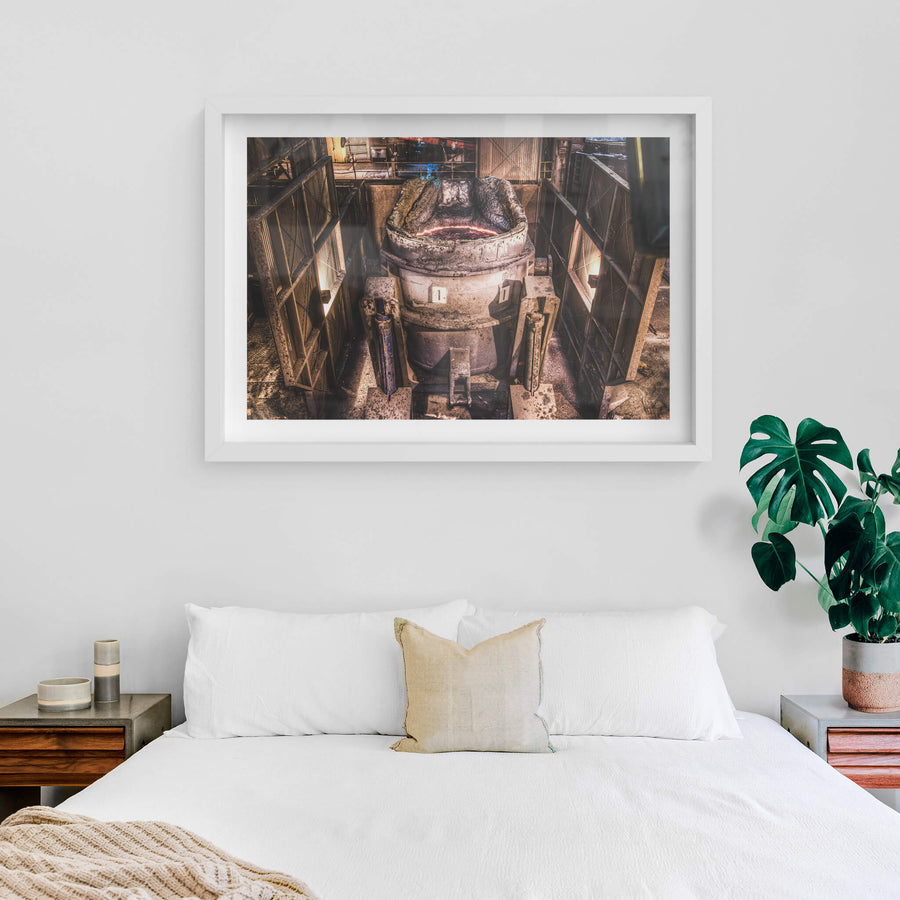
Crucible number 1 sits within a heavy metal framework at Port Kembla Steelworks, its interior walls thick with slag residue and its base pooling with glowing molten metal. The markings 'SMI 300E Tare 80T' are stamped along its side, and diamond-patterned safety grating lines the barriers on either flank. Warm light rises from below, catching the rough, encrusted surface of the vessel against the dark of the bay.
Open edition
Printed to order, no fixed quantity. Each print is hand-signed by the photographer.
Limited edition
A fixed number of prints exist. Once sold, the edition closes permanently. Each print is individually numbered and signed.
Shipping Free shipping over $250. Ships worldwide, rates calculated at checkout.
Returns Damaged in transit? We replace it. Full policy →
Ships within 10 business days · signed & numbered
In situ


Print datasheet
- Title
- Pot
- Series
- BlueScope Port Kembla
- Catalogue
- BPK-007
- Process
- Giclée
- Captured
- 18 March 2016
- Camera
- NIKON D7000
- Lens
- 14.0-24.0 mm f/2.8
- Aperture
- f/8.0
- Shutter
- 4s s
- ISO
- 100
- Focal length
- 24 mm
- Paper
- Ilford Galerie Smooth Cotton Rag 310 gsm
- Paper size
- 297 × 210 mm
- Location
- Port Kembla, New South Wales, Australia
- Authenticity
- C2PA verified provenance →
- Recognised by
- Highly Commended in Multimedia at the 2016 National Trust of Australia (NSW) Heritage Awards
Port Kembla, New South Wales, Australia
Map · Mapbox · OpenStreetMap
About this print
Inside the Port Kembla Steelworks, a massive industrial pot sits as evidence of the scale and intensity of steelmaking at this site. The steelworks has operated continuously since No. 1 blast furnace was blown in on 29 August 1928. What began as an 800-tonne-per-day operation under Australian Iron and Steel Ltd has grown into Australia's largest crude steel production plant, with six blast furnaces constructed across seven decades of expansion.
Brett Patman

The series
BlueScope Port Kembla
The BlueScope Port Kembla steelworks is the largest crude-steel production plant in Australia and the largest single industrial operation in the Illawarra. The site began in 1928 as Australian Iron & Steel, taking over Charles Hoskins's iron operation from Lithgow. First steel was made in 1931. BHP merged with AIS in 1935 and the works ran as BHP Steel, demerged from BHP in 2002 and renamed BlueScope in 2003. The No.6 Blast Furnace was decommissioned in 2011 when BlueScope withdrew from the export market and stood dormant for over a decade before reline work was approved in 2022. The Lost Collective photographs document the dormant sections of the works during the period after the 2011 shutdown.
Print sizes
The anatomy view shows what this finish is as a physical object: paper margin, mat band, frame depth, acrylic profile. The comparison strip shows how each size sits relative to the others at true scale. Click a size or a finish to update both.
| Type | Size | Width | Height |
|---|


