Stripped Interior

Provenance

Camera
NIKON D7000
Lens
14.0-24.0 mm f/2.8
Settings
14mm · f/8.0 · 2.5 · ISO 100
Paper
Ilford Galerie Smooth Cotton Rag 310 gsm

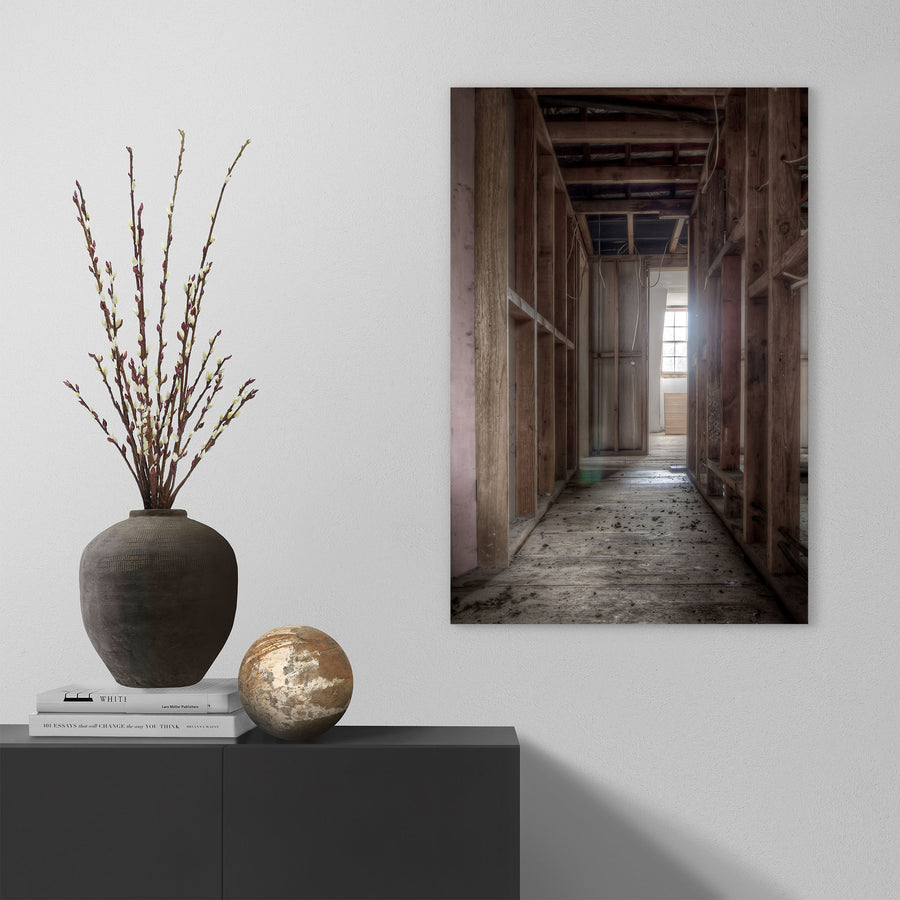
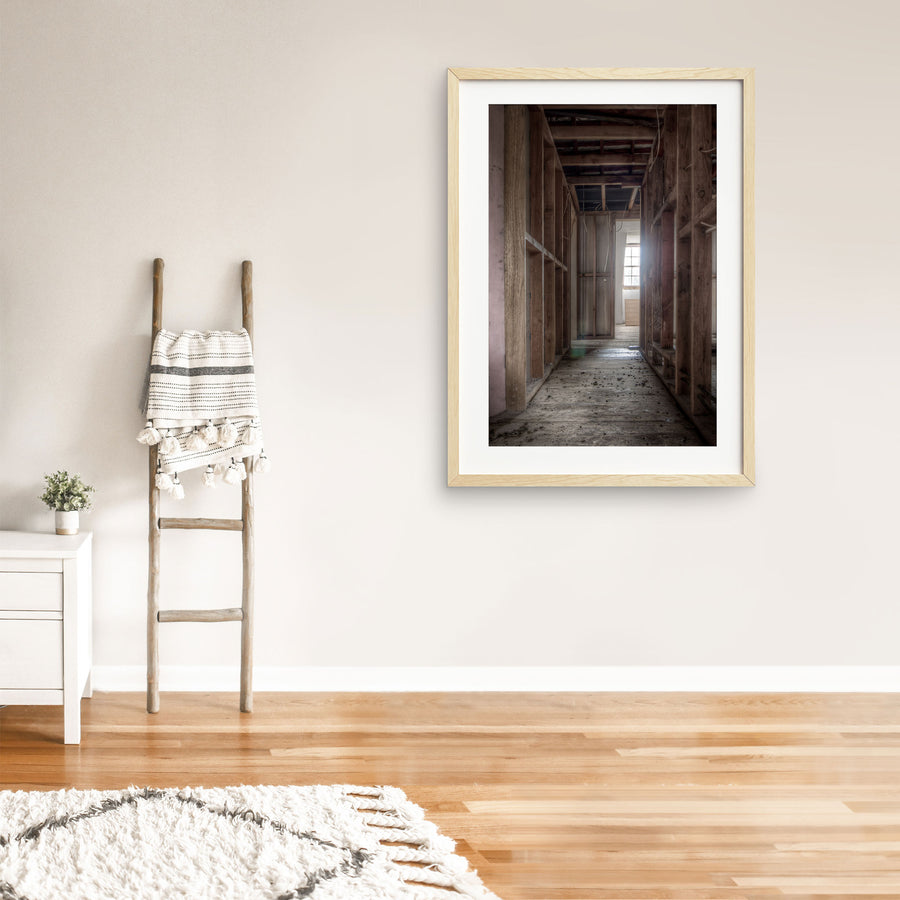
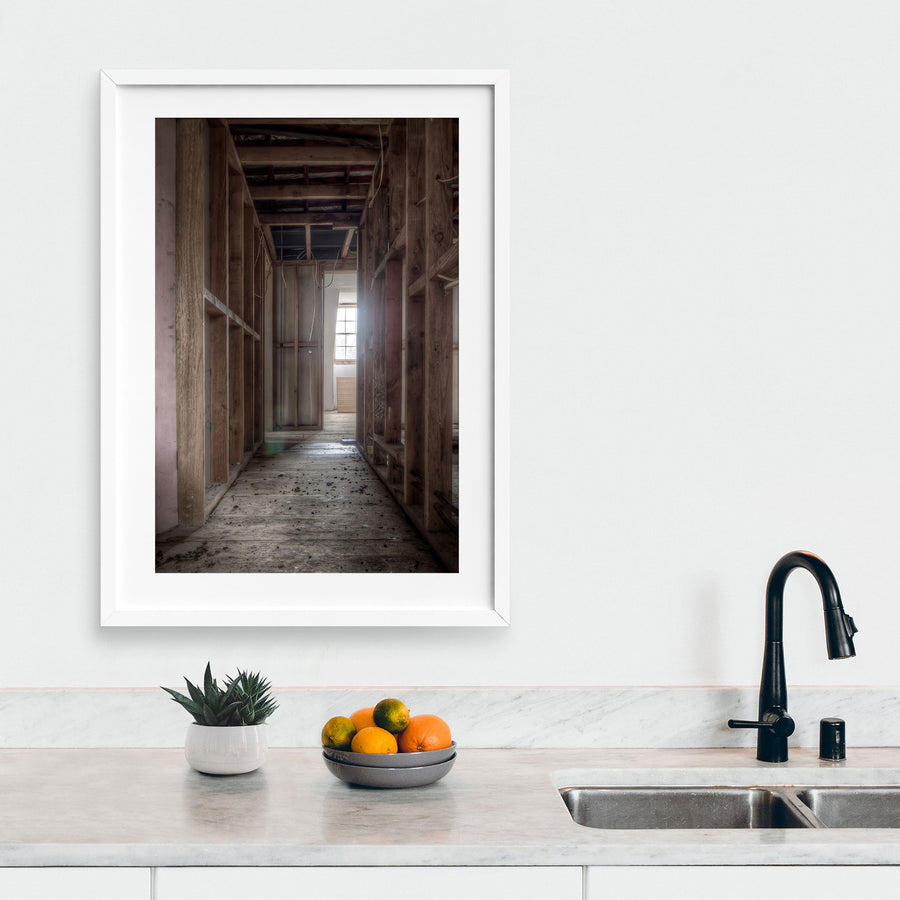
A narrow corridor with all wall lining removed, exposing timber wall studs on both sides. Ceiling joists are bare overhead. Loose electrical wiring hangs down from above. Bare floorboards run the length of the corridor toward a multi-pane window at the far end. A sheet of plywood partially covers the window opening, allowing daylight through the gaps.

Edition
Open edition

Open edition
Printed to order, no fixed quantity. Each print is hand-signed by the photographer.

Limited edition
A fixed number of prints exist. Once sold, the edition closes permanently. Each print is individually numbered and signed.

$100.00 AUD
Size
Type
Colour
Signed, numbered, with COA. Made to order in 10 to 20 business days (framed). Shipped in protective packaging with edition certificate, paper-stock reference and a printed care guide.
See certificate sample →

Shipping Free shipping over $250. Ships worldwide, rates calculated at checkout.

Returns Damaged in transit? We replace it. Full policy →

Ships within 10 business days · signed & numbered

In situ
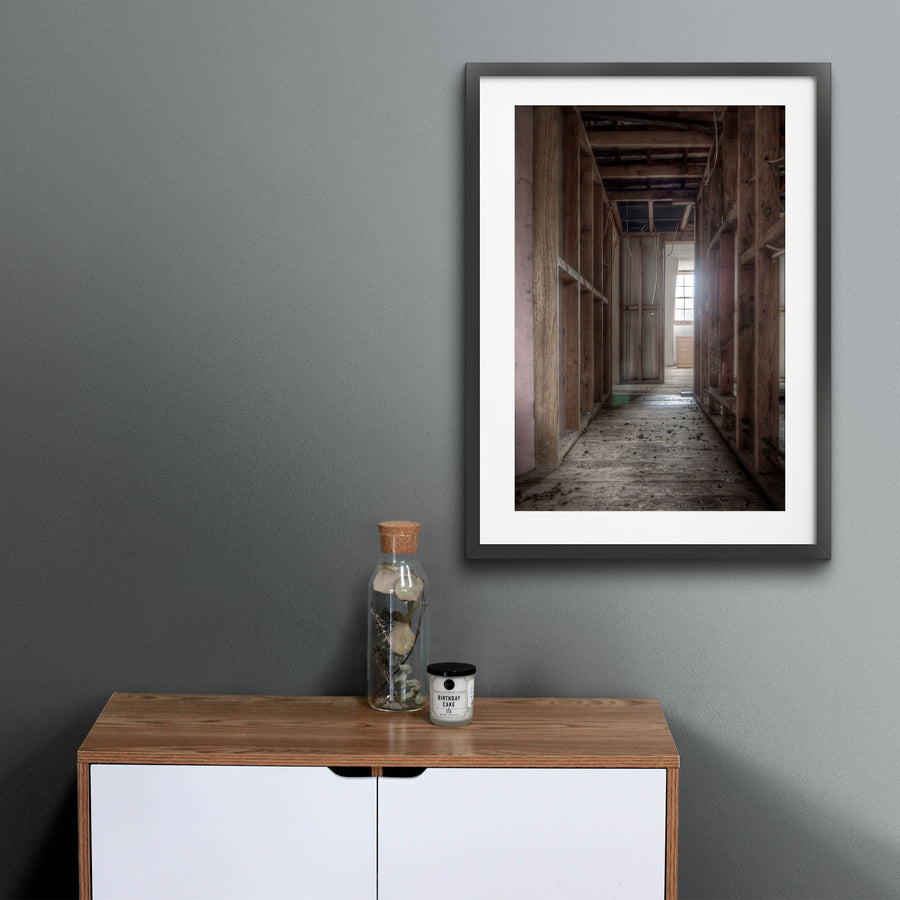
Exposed timber wall framing and ceiling joists in a stripped corridor at the Braidwood Hotel, with bare floorboards leading to a multi-pane window partially covered by plywood.Exposed timber wall framing and ceiling joists in a stripped corridor at the Braidwood Hotel, with bare floorboards leading to a multi-pane window partially covered by plywood.Exposed timber wall framing and ceiling joists in a stripped corridor at the Braidwood Hotel, with bare floorboards leading to a multi-pane window partially covered by plywood.Exposed timber wall framing and ceiling joists in a stripped corridor at the Braidwood Hotel, with bare floorboards leading to a multi-pane window partially covered by plywood.Exposed timber wall framing and ceiling joists in a stripped corridor at the Braidwood Hotel, with bare floorboards leading to a multi-pane window partially covered by plywood.
01 PROVENANCE

Print datasheet

Title
Stripped Interior
Series
Braidwood Hotel
Catalogue
BHO-018
Process
Giclée
Captured
4 June 2016
Camera
NIKON D7000
Lens
14.0-24.0 mm f/2.8
Aperture
f/8.0
Shutter
2.5 s
ISO
100
Focal length
14 mm
Paper
Ilford Galerie Smooth Cotton Rag 310 gsm
Location
Braidwood, New South Wales, Australia
Recognised by
Highly Commended in Multimedia at the 2016 National Trust of Australia (NSW) Heritage Awards
02 LOCATION

Braidwood, New South Wales, Australia

Map · Mapbox · OpenStreetMap

03 THE STORY

About this print

The wall lining is gone. What remains in this narrow corridor of the Braidwood Hotel is the building's structural logic laid bare: timber wall studs on both sides, ceiling joists exposed overhead, loose electrical wiring hanging from above in loose loops. Bare floorboards run the length of the passage toward a multi-pane window at the far end, its lower half blocked by a sheet of plywood. Daylight finds its way through regardless. The Braidwood Hotel stands at 180 Wallace Street, built in 1859 as the Commercial Hotel during the Gold Rush-era expansion of the town. Braidwood was the primary supply centre for the Araluen, Majors Creek and Mongarlowe goldfields; by 1861 the surrounding goldfields held approximately 8,199 people, and the town's Wallace Street had filled with Georgian commercial buildings to service them. The Commercial Hotel was among those built during that period of rapid growth, constructed in rendered brick over stone foundations, with the Georgian proportions characteristic of the town: high ceilings, a symmetrical facade, cast iron columns and decorative lacework on the second-storey balcony. The town's population contracted sharply after the goldfields declined. That contraction, which might elsewhere have brought redevelopment, instead left the 19th-century streetscape largely untouched. The NSW State Heritage Register listing for "Braidwood and its Setting," gazetted on 3 April 2006, notes this directly: the rural recession paradoxically preserved the fabric of the town. The SHR listing, the first to cover an entire town and described by Heritage NSW at the time as "by far the most complex listing" it had undertaken, covers the hotel within a conservation area of state significance. Through all of it, the hotel has operated continuously as a licensed premises since 1859. The stripped corridor photographed in 2016 was part of an ongoing restoration programme. Wall linings removed, wiring exposed, floorboards bare: this is what a building in the middle of being worked on looks like, not a building in decline. The photograph records a moment of transition, the old fabric of the building visible before it is covered again.

04 FROM THE FIELD NOTES

With the wall lining stripped away, the corridor of the Braidwood Hotel reads like a cross-section of 165 years of continuous use. Timber studs frame the passage on both sides, electrical wiring hanging loose from the joists above. Bare floorboards lead toward a multi-pane window at the far end, its lower half covered with plywood. The building was constructed in 1859 as the Commercial Hotel, rising during the Gold Rush-era commercial expansion of Wallace Street. It has operated as a licensed hotel without interruption since that year, passing through successive restoration programmes while Braidwood's population contracted and its Georgian streetscape, paradoxically, remained intact.

Brett Patman

Braidwood Hotel

The series

Braidwood Hotel

2016 · 11 photographs

Braidwood Hotel sits at 180 Wallace Street and has run continuously as a country pub since 1859, when it went up during the Gold Rush. Gold was found in the nearby Araluen Valley in 1851-52, thousands of prospectors filled the diggings, and Braidwood became the base town for the surrounding goldfields. The Wallace Street streetscape that survives today is largely the result of that boom. The hotel is built in the Georgian style: high ceilings, oversized fireplaces, a verandah with cast iron lacework. It is a local heritage item under the Queanbeyan-Palerang LEP. The whole town of Braidwood was given permanent conservation protection by the NSW Government in 2006 and is classified by the National Trust as an historic town. The pub has been continuously open for more than 165 years.

View all in this series →

05 SIZE GUIDE

Print sizes

The anatomy view shows what this finish is as a physical object: paper margin, mat band, frame depth, acrylic profile. The comparison strip shows how each size sits relative to the others at true scale. Click a size or a finish to update both.

Anatomy · true ratio
TypeSizeWidthHeight
08 BY POST · NO SPAM

Read the full story

Articles when they're published. The history behind a place. The day of a shoot. The work between prints. No marketing, no schedule.

You're subscribed.