
Cash Register
Provenance
- Camera
- NIKON D810
- Lens
- 14.0-24.0 mm f/2.8
- Settings
- 24mm · f/9.0 · 0.8s · ISO 100
- Paper
- Ilford Galerie Smooth Cotton Rag 310 gsm
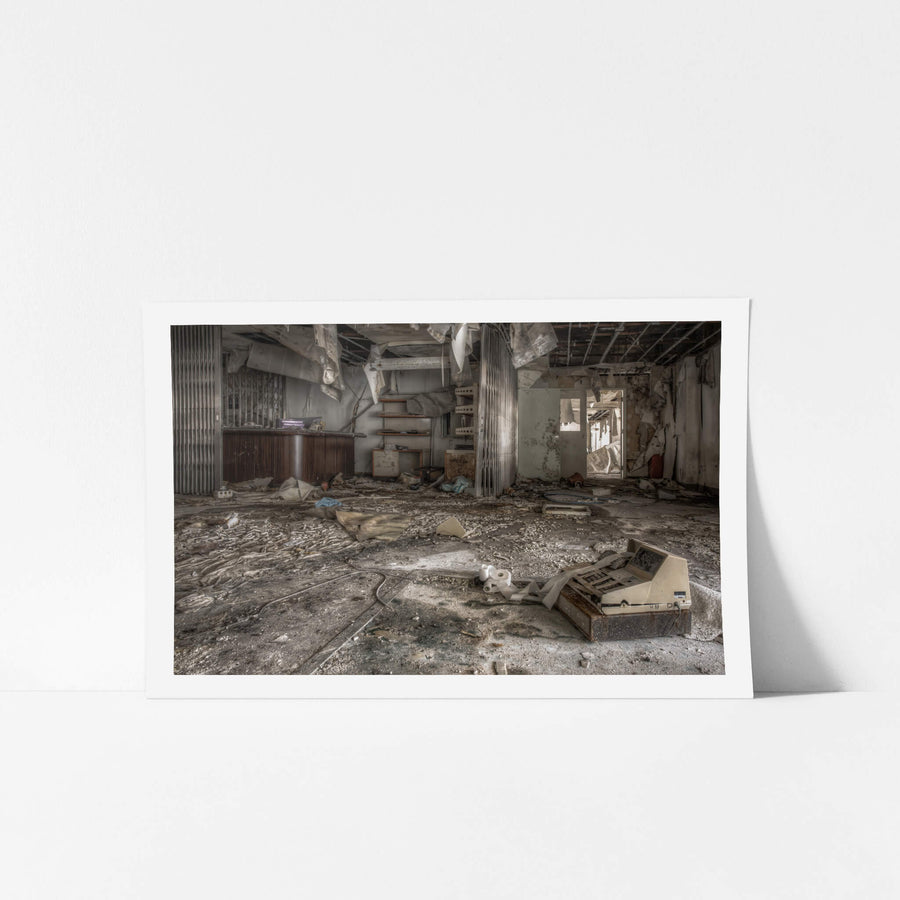
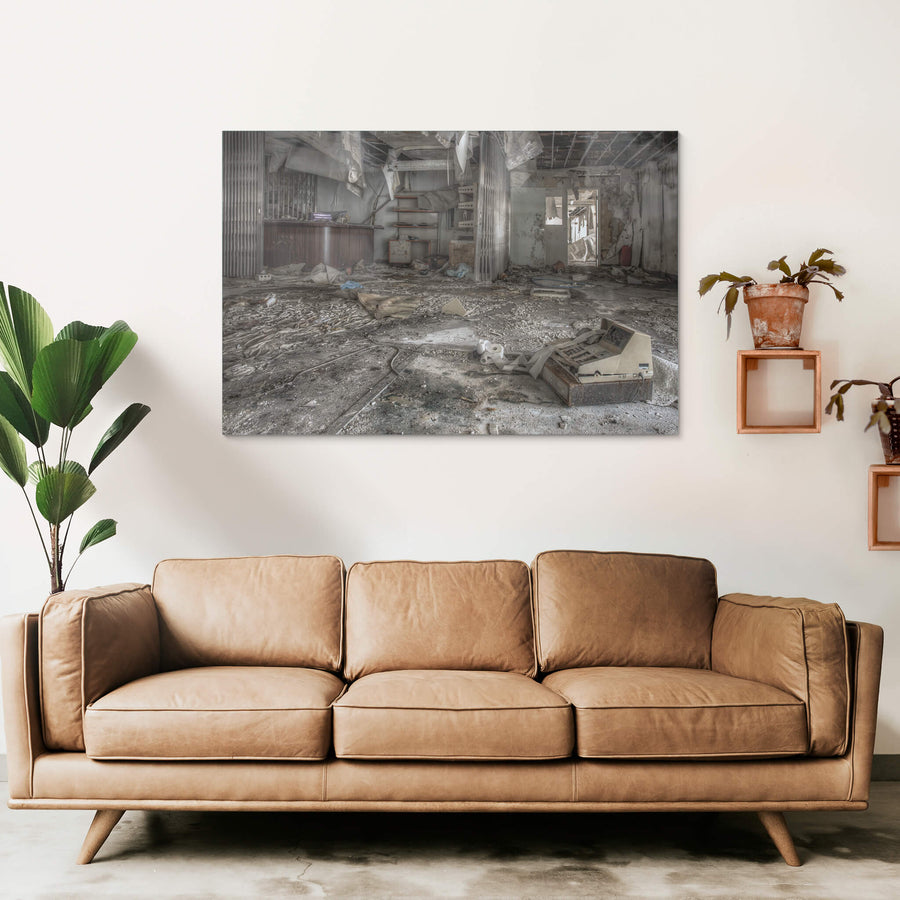
A beige cash register and a loose paper roll sit on the debris-covered floor near a wooden reception counter at Family School Fureai in Yubari, Hokkaido. An accordion security gate is folded back against the left wall. Daylight reaches through an open doorway at the rear, falling across fallen ceiling panels and scattered refuse in the room beyond. The counter and register date from the building's lodging phase, after its years as a school had ended.
Open edition
Printed to order, no fixed quantity. Each print is hand-signed by the photographer.
Limited edition
A fixed number of prints exist. Once sold, the edition closes permanently. Each print is individually numbered and signed.
Shipping Free shipping over $250. Ships worldwide, rates calculated at checkout.
Returns Damaged in transit? We replace it. Full policy →
Ships within 10 business days · signed & numbered
In situ
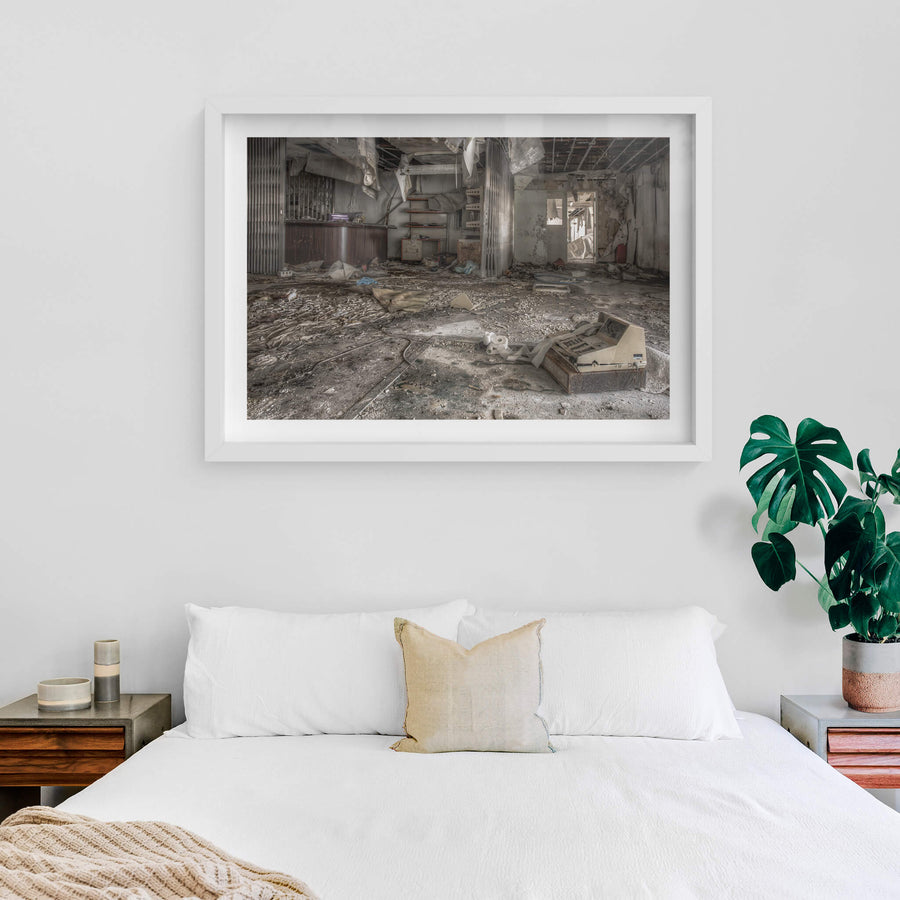
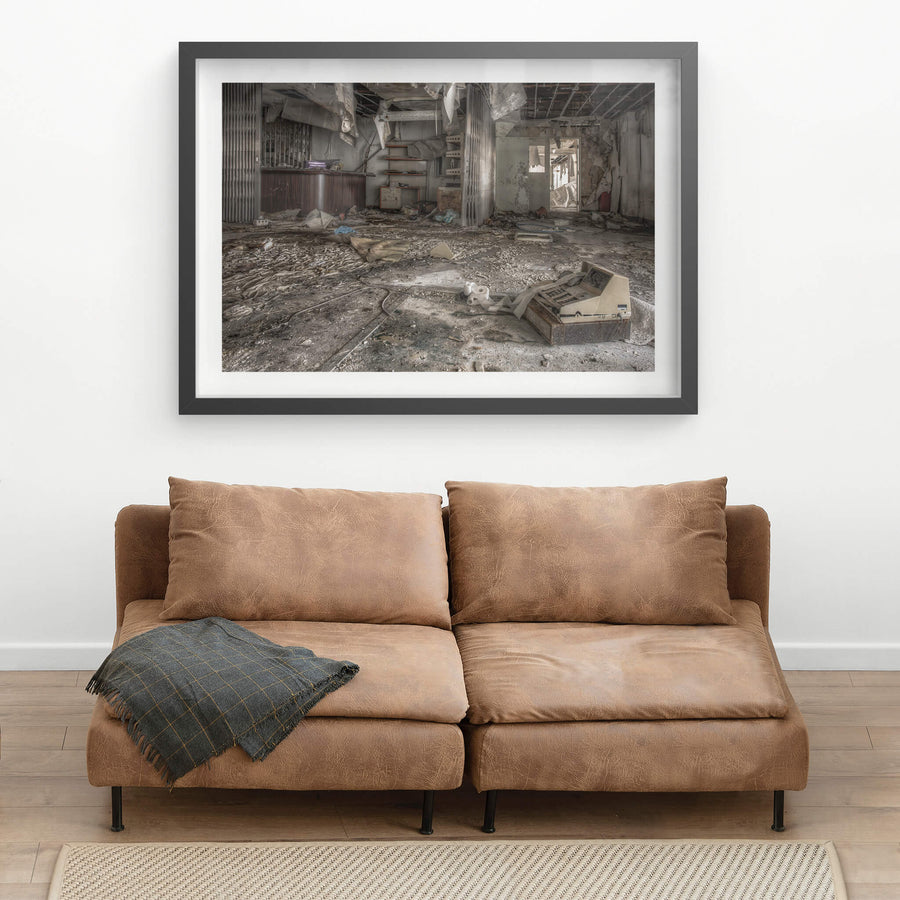
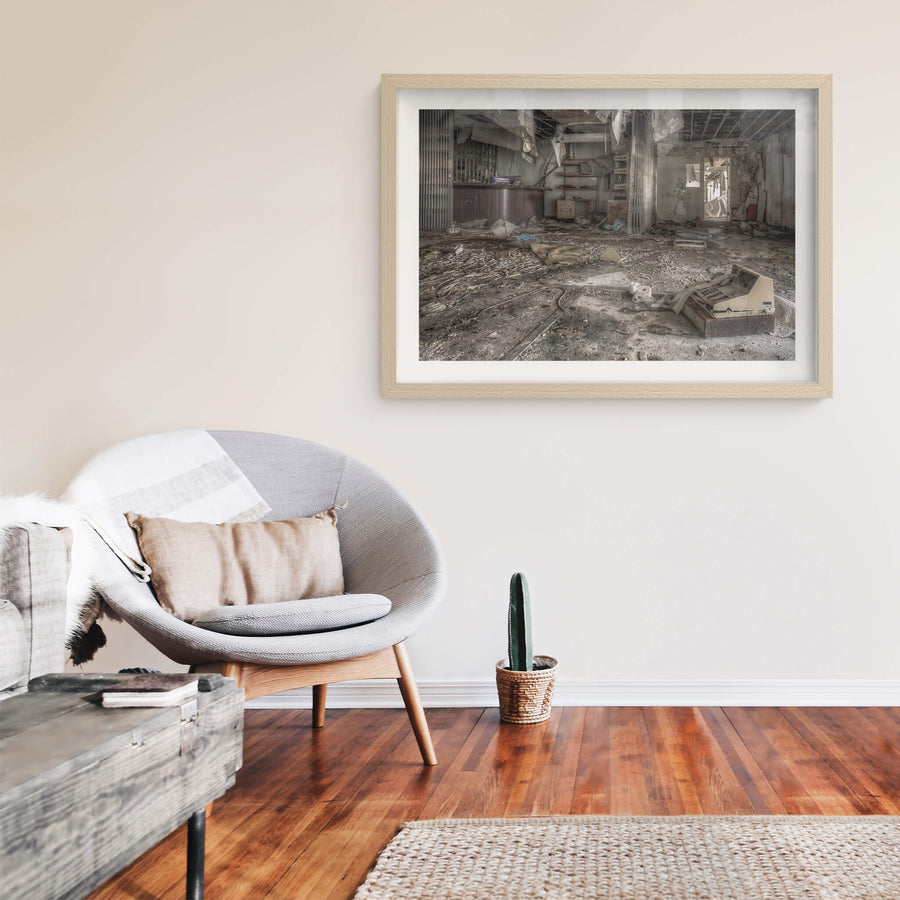
Print datasheet
- Title
- Cash Register
- Series
- Family School Fureai
- Catalogue
- FSF-007
- Process
- Giclée
- Captured
- 28 April 2016
- Camera
- NIKON D810
- Lens
- 14.0-24.0 mm f/2.8
- Aperture
- f/9.0
- Shutter
- 0.8s s
- ISO
- 100
- Focal length
- 24 mm
- Paper
- Ilford Galerie Smooth Cotton Rag 310 gsm
- Paper size
- 297 × 210 mm
- Location
- Yubari, Hokkaido, Japan
- Authenticity
- C2PA verified provenance →
- Recognised by
- Highly Commended in Multimedia at the 2016 National Trust of Australia (NSW) Heritage Awards
Yubari, Hokkaido, Japan
Map · Mapbox · OpenStreetMap
About this print
The cash register at Family School Fureai recorded transactions at a facility that was itself a product of financial invention. The former Yubari Municipal Asahi Elementary School opened in 1975, consolidated three predecessor schools into one reinforced-concrete building, and closed just eight years later in 1983 as the coal industry's decline took the children with it. That year the empty classrooms were converted to guest rooms and the building opened as a public lodging facility. When Yubari declared fiscal rehabilitation in June 2006, the tourism business that included Family School Fureai accounted for ¥18.6 billion of the ¥35.3 billion deficit. By 2016, the register had been sitting untouched for a decade.
Brett Patman

The series
Family School Fureai
Family School Fureai stands on a hillside at the northern end of Yubari in Hokkaido. The building opened on 1 April 1975 as Asahi Elementary School, a new three-storey reinforced-concrete structure built on the site of the demolished wooden Yubari Second Elementary (Daini). It consolidated three local schools - Daini, Fukuzumi and Teibi - that had lost most of their students as Yubari's coal industry shrank. By the early 1980s enrolment had collapsed; the school closed on 31 March 1983 after just eight years. In 1983 the building was repurposed as the Family School Fureai public dormitory. In June 2006 Yubari City announced its fiscal collapse; the city formally entered financial reconstruction status on 6 March 2007. The building has sat empty since. Inside there is no graffiti - only kanji on the chalkboards. Deer and foxes use it now.
Print sizes
The anatomy view shows what this finish is as a physical object: paper margin, mat band, frame depth, acrylic profile. The comparison strip shows how each size sits relative to the others at true scale. Click a size or a finish to update both.
| Type | Size | Width | Height |
|---|


