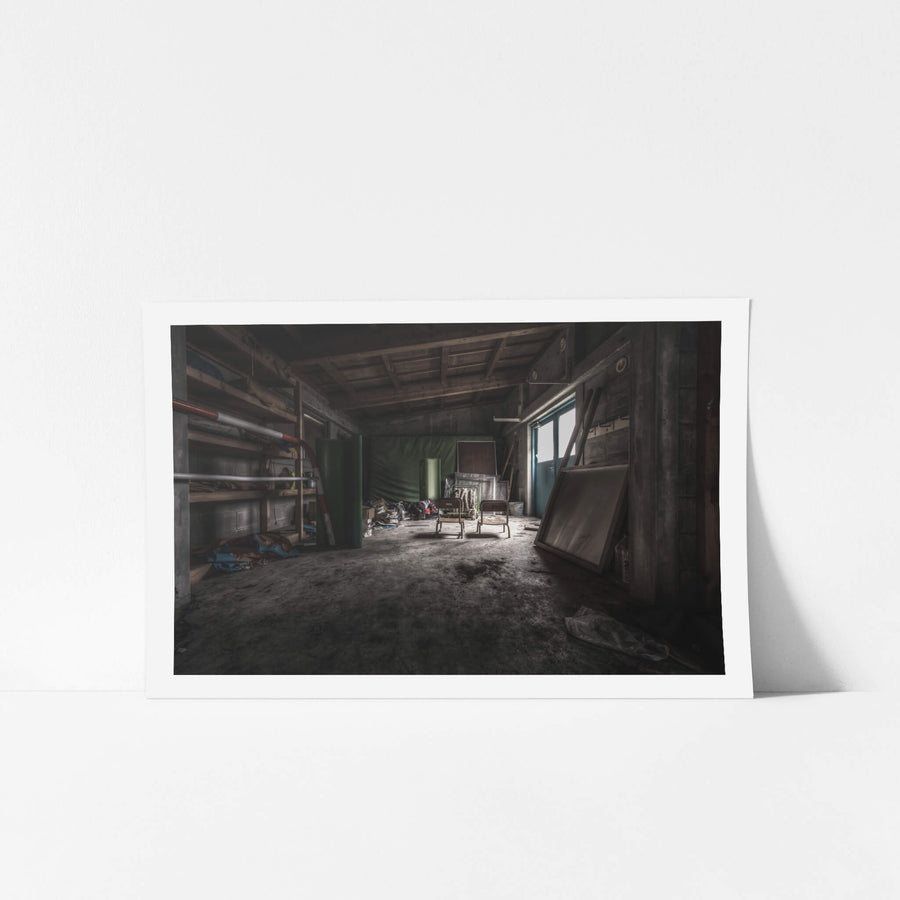
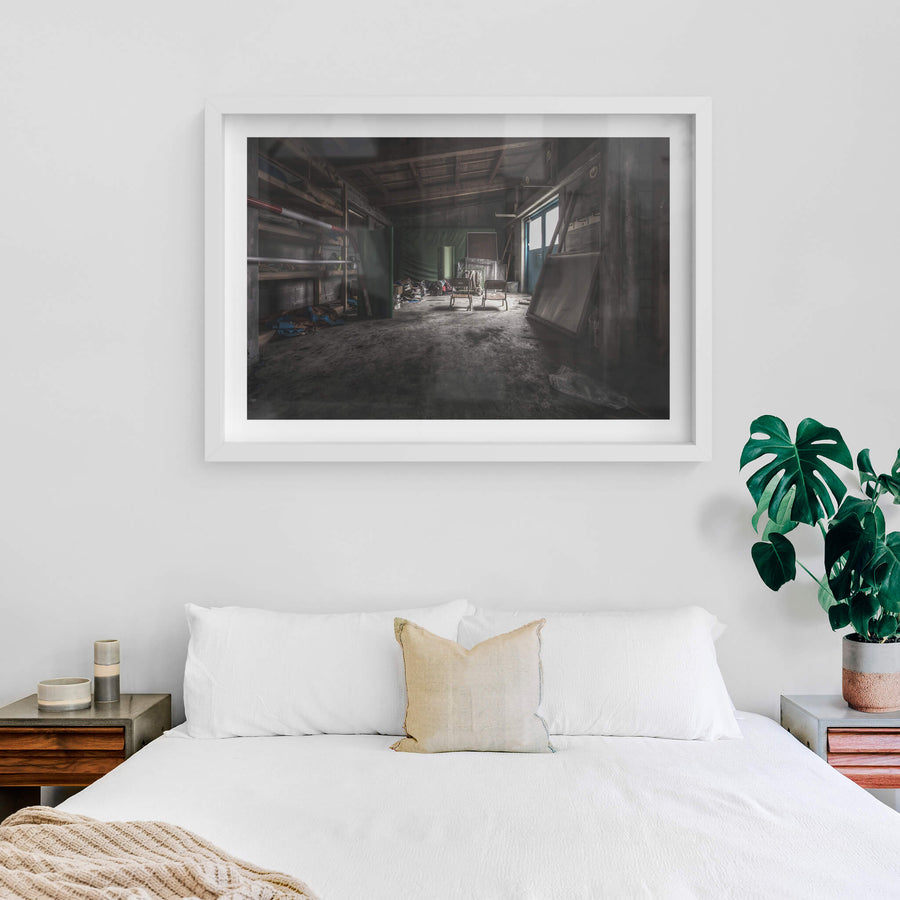
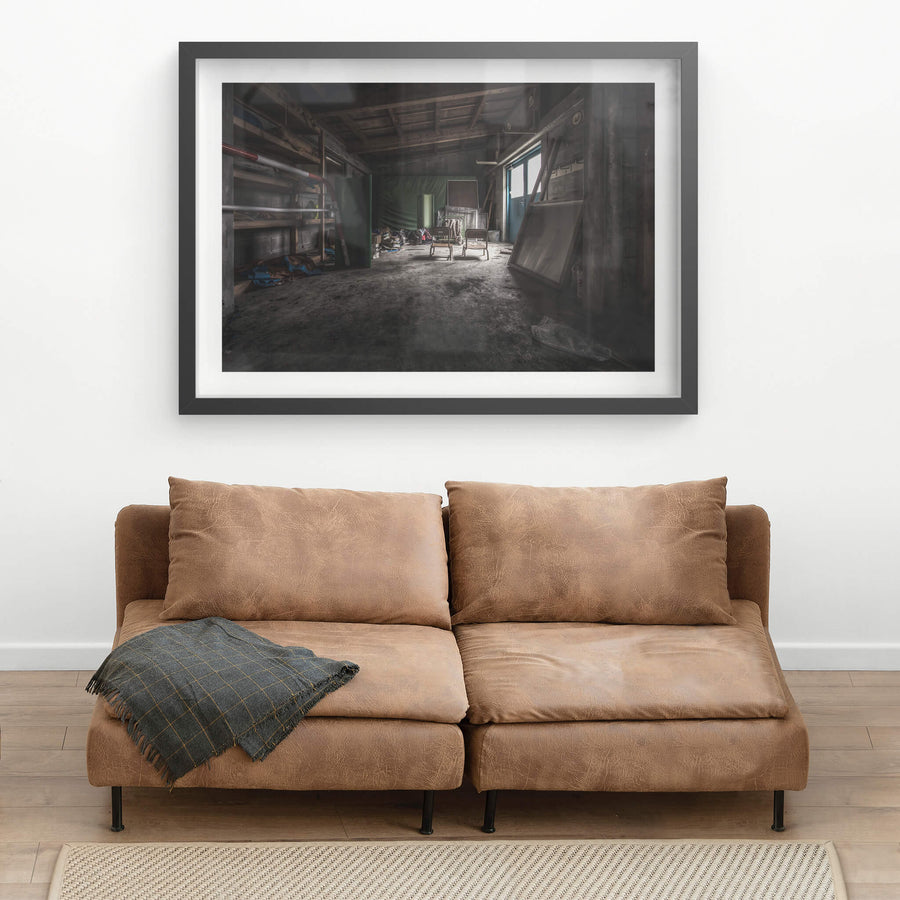
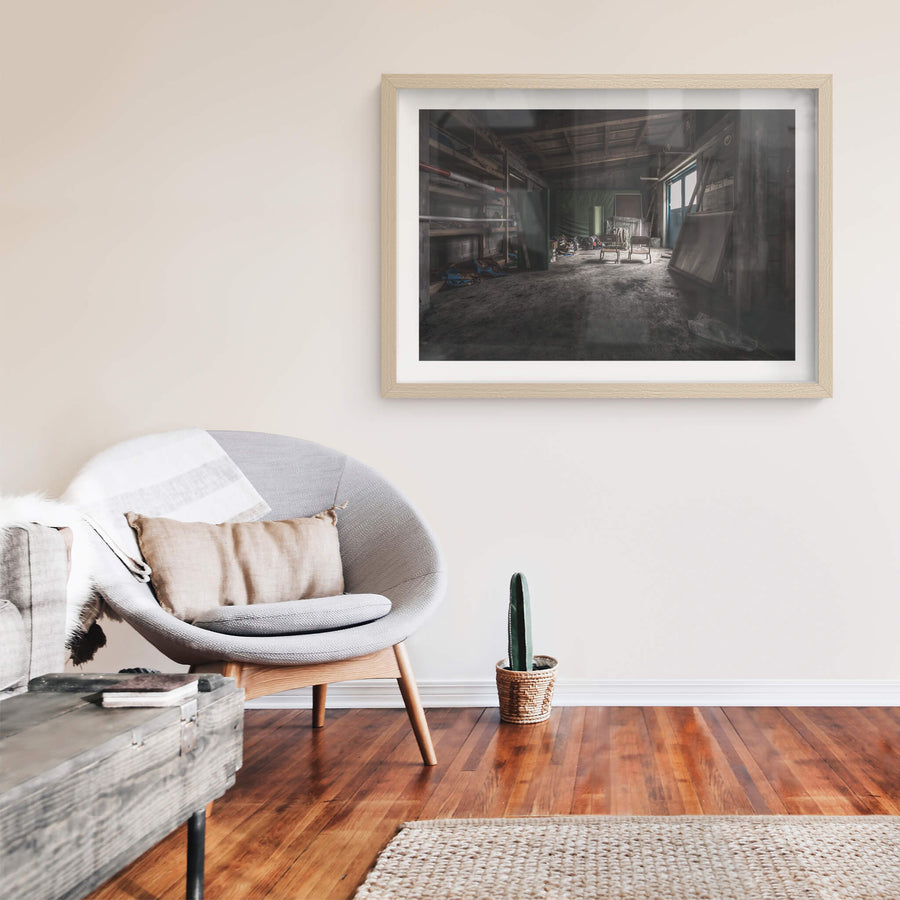
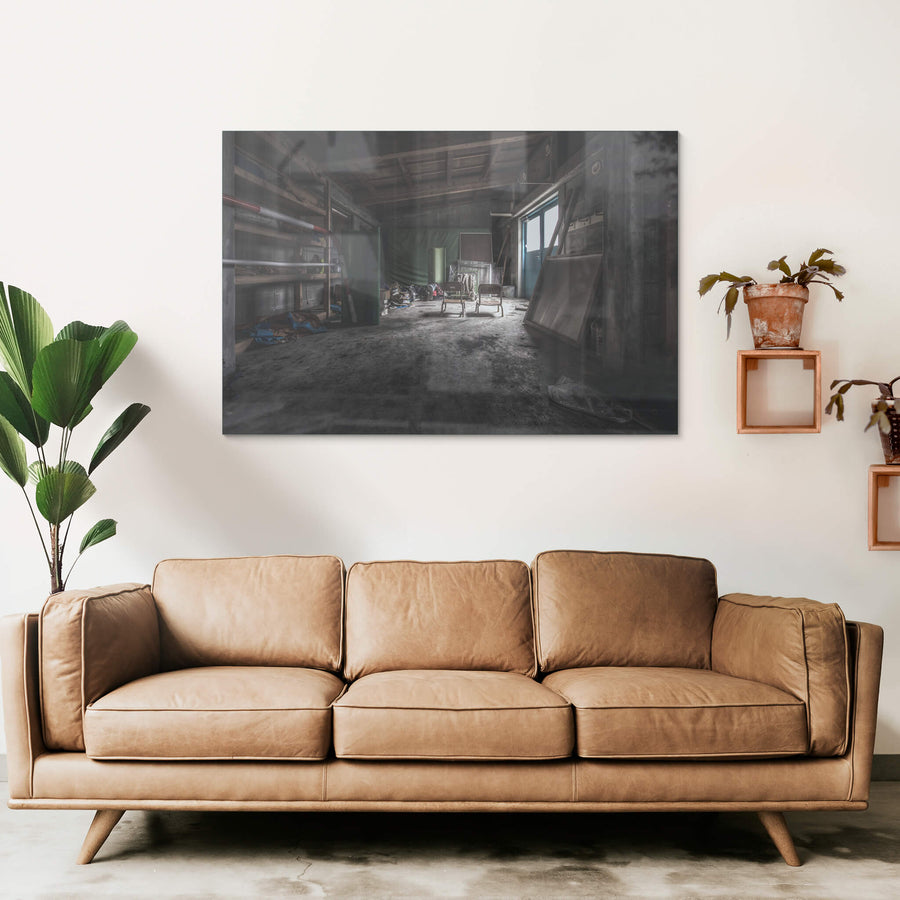
A dim storage room inside a decaying reinforced-concrete school building. On a dusty concrete floor, 2 metal chairs sit flanked by wooden shelving stacked with sporting equipment, comic books, and an accordion. A long red and white striped pole leans against the left shelving, and a large green padded mat covers much of the back wall. Light draws through a doorway on the right.
Edition
Open edition
Open edition Printed to order, no fixed quantity. Each print is hand-signed by the photographer.
Limited edition A fixed number of prints exist. Once sold, the edition closes permanently. Each print is individually numbered and signed.
$100.00 AUD
Size
Type
Colour
✓
Signed, numbered, with COA. Made to order in 5 to 10 business days (unframed). Shipped in protective packaging with edition certificate, paper-stock reference and a printed care guide.
The sports storage room at the former Yubari Municipal Asahi Elementary School in Yubari, Hokkaido, holds the equipment of a school that existed for only eight years. On a dusty concrete floor, 2 metal chairs sit flanked by wooden shelving stacked with sporting equipment, comic books and an accordion. A long red and white striped pole leans against the left shelving, and a large green padded mat covers much of the back wall. Light draws through a doorway on the right. Nothing has been moved. The room reads less like abandonment and more like an expectation that someone would return. The building that contains this room opened on 1 April 1975, a new reinforced-concrete three-storey structure built on the demolished site of the predecessor Yubari Daini (Second) Elementary School. It consolidated three schools, Yubari Daini, Teibi, and Fukuzumi, at a moment when Yubari's coal economy was already in serious decline. Opening enrolment was 351 students across 13 classes. By 31 March 1983, even that consolidated school had too few children to justify staying open. It merged with Yubari First Elementary to form Yubari Elementary School, and the building was vacated. The school's brief lifespan reflects a city in contraction. At its 1960 census peak, Yubari held 107,972 people across 24 operational coal mines. By the time Asahi Elementary opened, the mines were closing in sequence. By the time it closed, the population had already begun the long fall toward the 6,000-range figure of today. In 1983 the building was converted to a public lodging and group training facility. It opened as Family School Fureai. Classrooms were repurposed with tatami mat flooring; communal bathing facilities and training rooms were added. The building accepted guests until 2006, when Yubari City's fiscal crisis, a debt accumulation of approximately ¥35.3 billion, became public. Family School Fureai was not among the facilities transferred to a successor operator. It was left as it stood. The sports equipment in this photograph has been in that room since before the building's last guests checked out. It records a school that closed before most of its students had finished primary education, and a city still paying down the debts of the decades that followed.
04·FROM THE FIELD NOTES
A dim storage room inside a decaying reinforced-concrete school building.
Brett Patman
The series
Family School Fureai
30
photographs
Family School Fureai was a lodging and training facility in the former Yubari Municipal Asahi Elementary School in Yubari, Hokkaido, Japan, open from 1983 until the city listed it for suspension on 28 September 2006. Its name ran across the white three-storey building on a blue sign: 宿泊施設 ファミリースクール ふれあい, Lodging Facility Family School Fureai. Inside, tatami was laid in rooms that kept their chalkboards, two bathing rooms had tiled tubs, one blue and one pink, and the gymnasium had an arched glazed end wall.
The anatomy view shows what this finish is as a physical object: paper margin, mat band, frame depth, acrylic profile. The comparison strip shows how each size sits relative to the others at true scale. Click a size or a finish to update both.