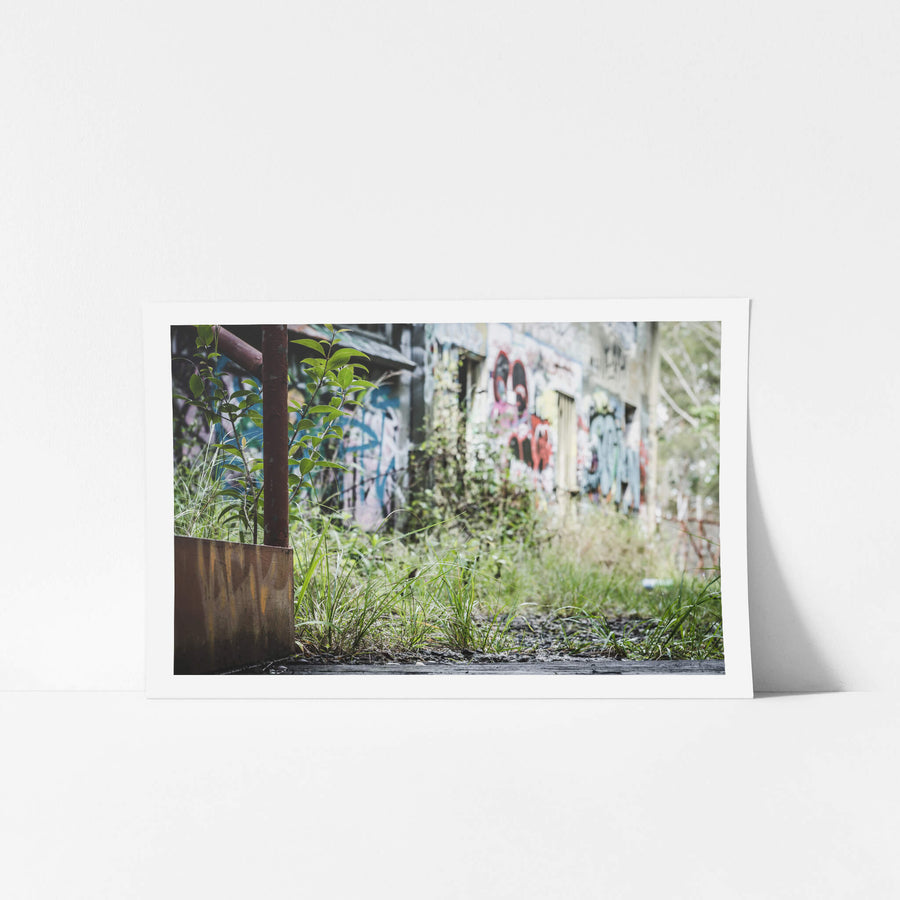
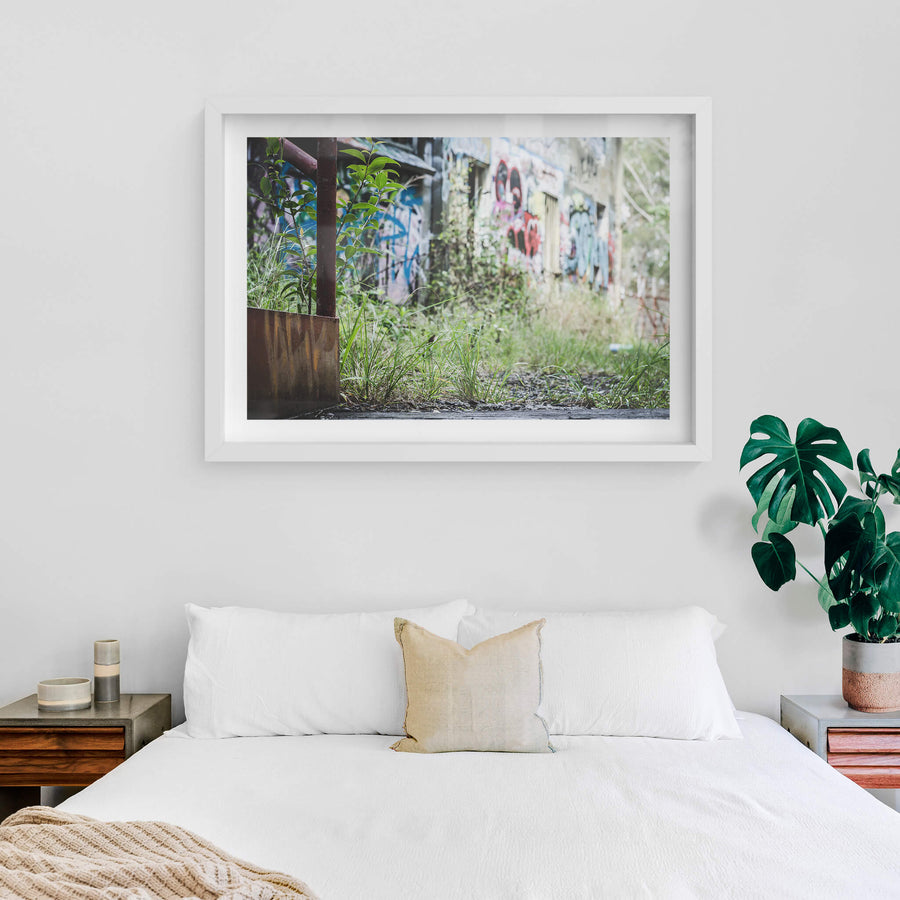
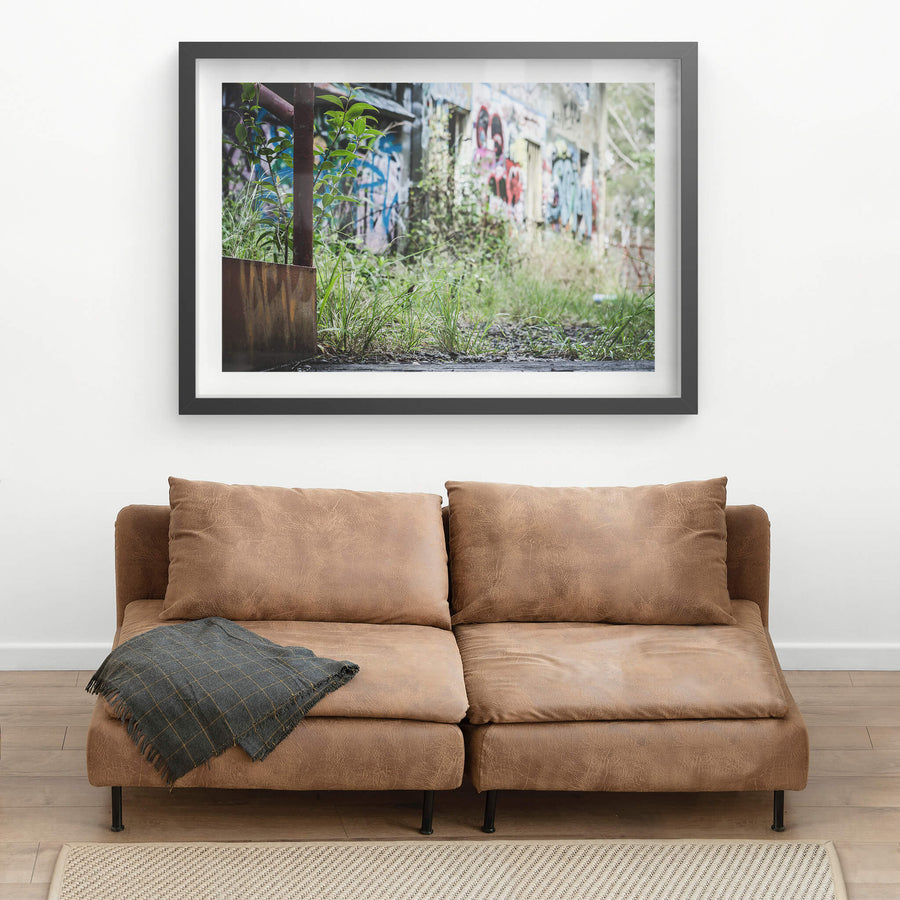
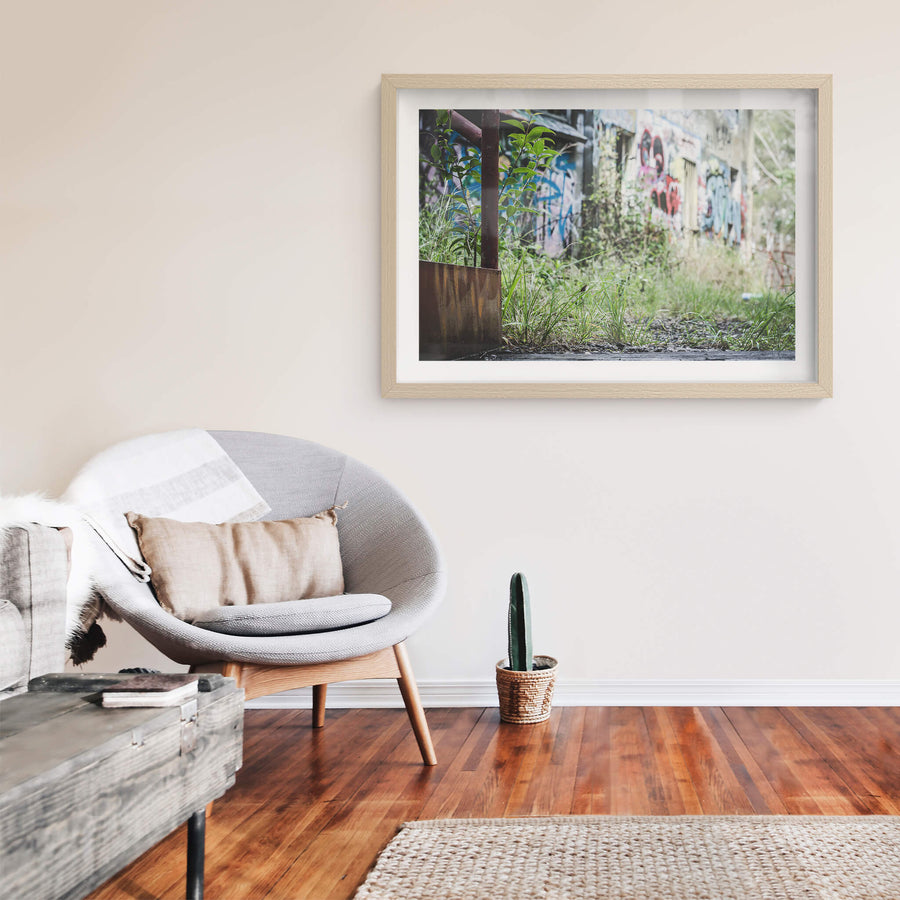
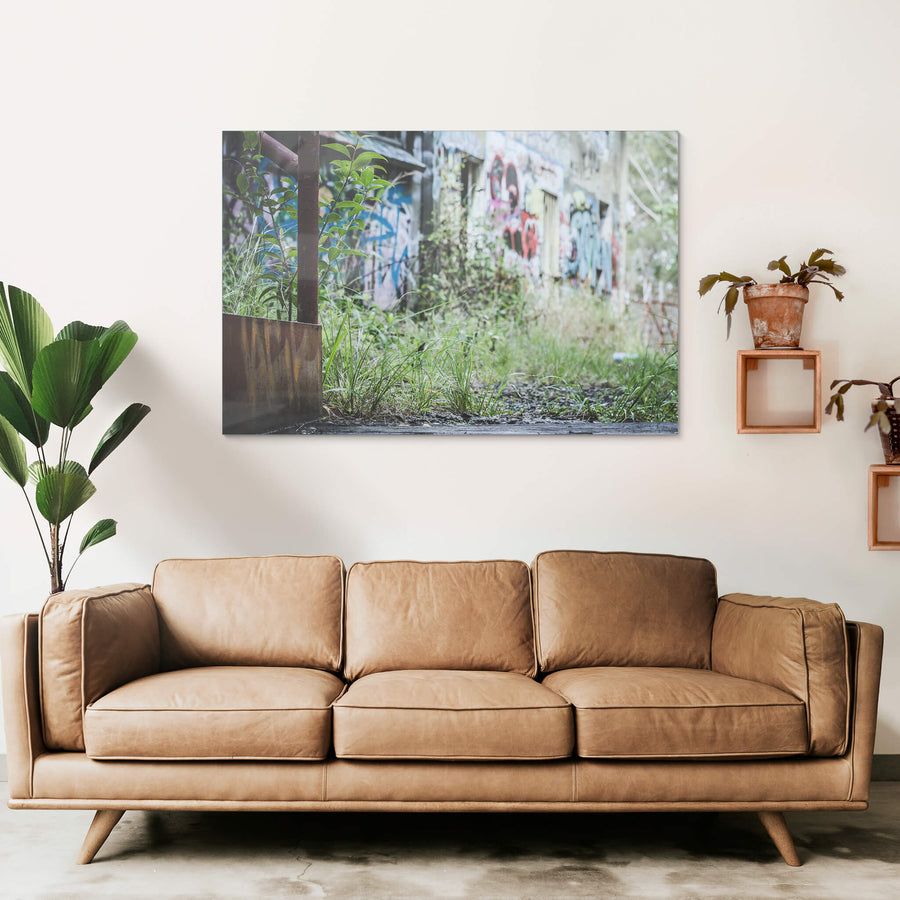
A bright green sapling pushes up beside a rust-stained metal pole, rooted in dark soil between a weathered timber plank and patches of new grass. Behind it a wall layered in blue and red spray paint blurs into the distance. The frame catches the gap between the amenities block and the main processing building at Hornsby Quarry, at ground level.
Edition
Open edition
Open edition Printed to order, no fixed quantity. Each print is hand-signed by the photographer.
Limited edition A fixed number of prints exist. Once sold, the edition closes permanently. Each print is individually numbered and signed.
$100.00 AUD
Size
Type
Colour
✓
Signed, numbered, with COA. Made to order in 5 to 10 business days (unframed). Shipped in protective packaging with edition certificate, paper-stock reference and a printed care guide.
A bright green sapling pushes up beside a rust-stained metal pole, rooted in dark soil between a weathered timber plank and patches of new grass. Behind it a wall layered in blue and red spray paint blurs into the distance. The frame catches the gap between the amenities block and the main processing building at ground level. The quarry void at Hornsby reaches approximately 120 metres deep at the southern face and spans roughly 300 metres across, cut through a Jurassic diatreme that geologists now rank as the largest volcanic neck in the Sydney area. Quarrying at Hornsby Quarry began around 1905 when the Higgins family started extracting dolerite from the site. The material, sold as blue metal, was the primary source of crushed aggregate for road construction across northern Sydney for most of the twentieth century. Hornsby Shire Council recognised its strategic value as early as 1912 and purchased the operation outright. Ownership and operational control passed through Hornsby Blue Metal Limited, Farley and Lewers, and eventually CSR Construction Materials before quarrying ceased in 2002. After CSR notified Council on 22 March 2001 that it required the land to be acquired, the NSW Land and Environment Court determined a compensation amount of $26,508,771.28, and ownership passed to Hornsby Shire Council in 2003. This photograph records the site in 2015, more than a decade into Council ownership, the ground quiet and the industrial infrastructure standing without purpose. The rock exposed by a century of extraction is itself the geological record: volcanic breccia, columnar jointing, dolerite and surrounding sandstone visible in the quarry's eastern face. The void beyond these buildings is the same void that geologists would later classify, in a 2022 assessment by Ian Percival, as an internationally significant geoheritage reference site. This frame was made before the NorthConnex spoil delivery of 2017 to 2019 began filling that void with more than one million cubic metres of tunnel spoil. By February 2025, bulk earthworks on the site were complete. The quarry floor beyond no longer exists in the form this photograph shows.
04·FROM THE FIELD NOTES
A bright green sapling pushes up beside a rust-stained metal pole, rooted in dark soil between a weathered timber plank and patches of new grass.
Brett Patman
The series
Graffiti & Urban Decay
54
photographs
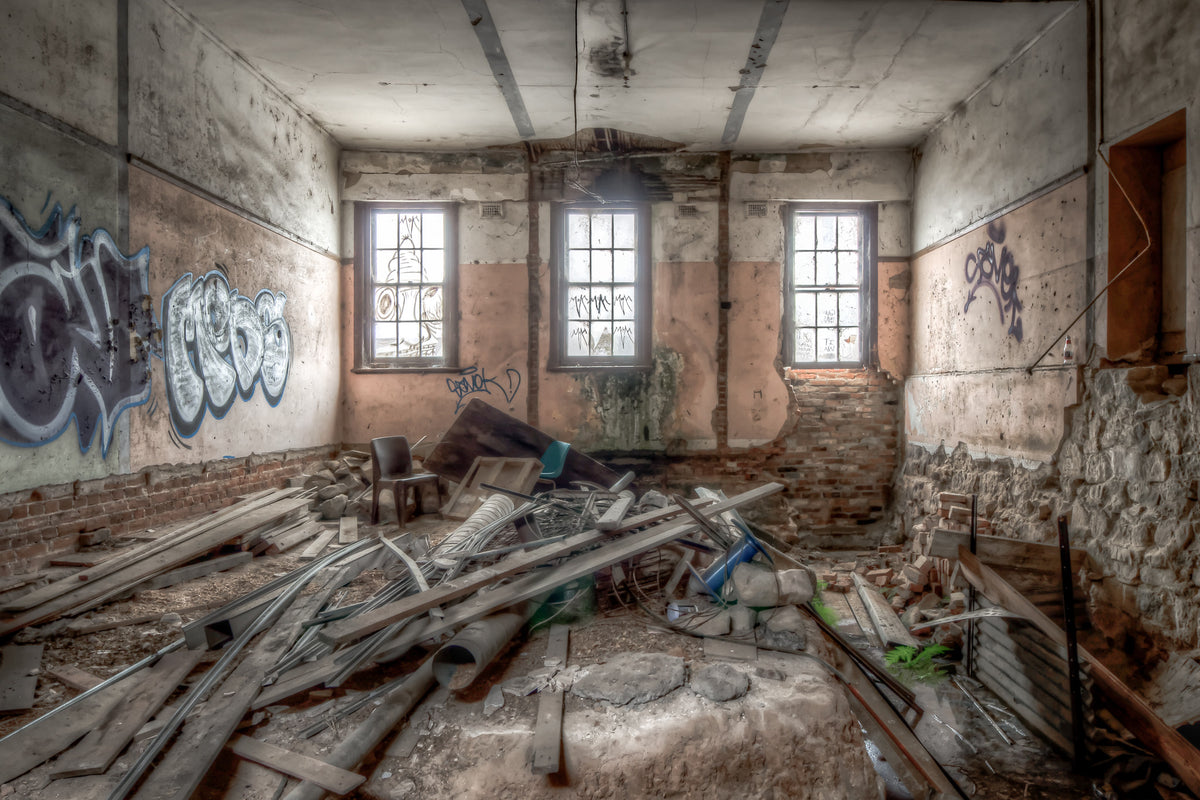
Buildings don't stay empty. Once the owners leave, somebody else arrives. Walls that were blank become a record of who came through and when. Graffiti isn't vandalism on these surfaces , it's the only remaining evidence that anyone cared enough to be here.Urban spaces mid-collapse. The gap between what a building was built for and what it became.
The anatomy view shows what this finish is as a physical object: paper margin, mat band, frame depth, acrylic profile. The comparison strip shows how each size sits relative to the others at true scale. Click a size or a finish to update both.