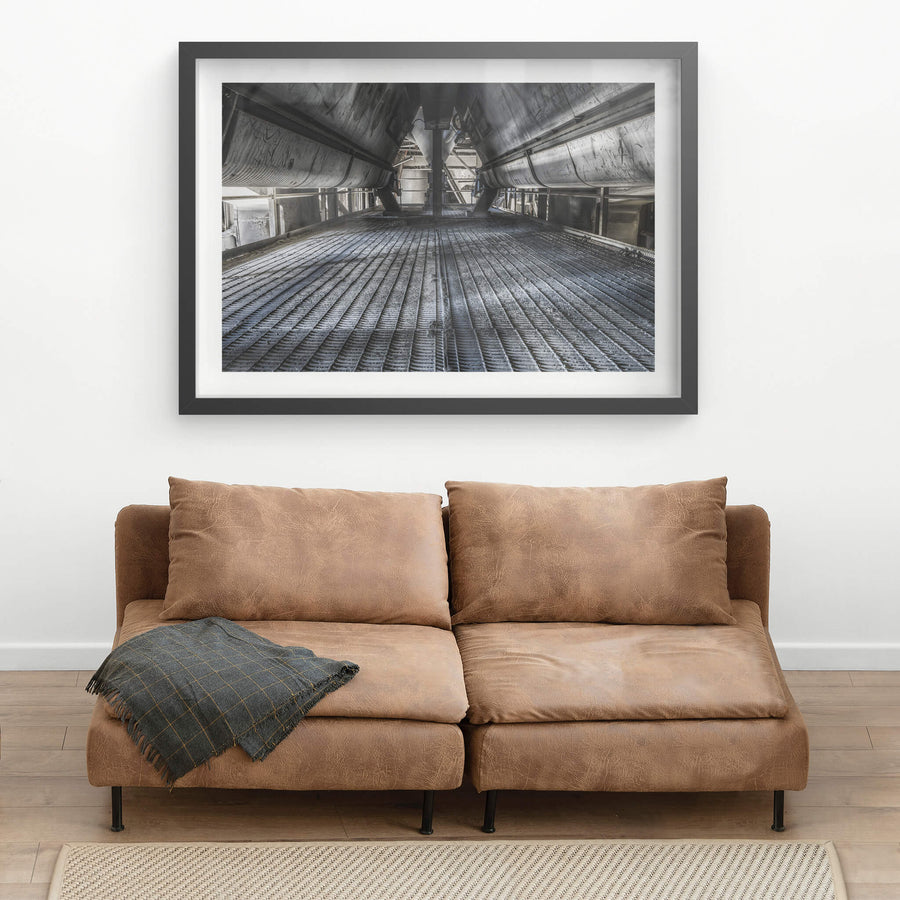
Dust Screws

Provenance

Camera
NIKON D7000
Lens
14.0-24.0 mm f/2.8
Settings
17mm · f/8.0 · 10s · ISO 100
Paper
Ilford Galerie Smooth Cotton Rag 310 gsm

Screw conveyors suspended above the floor of Kandos Cement Works. These carried fine dust away from the precipitators and returned it to the process for reuse. The plant produced cement from 1916 until Cement Australia closed it in September 2011.

Edition
Open edition

Open edition
Printed to order, no fixed quantity. Each print is hand-signed by the photographer.

Limited edition
A fixed number of prints exist. Once sold, the edition closes permanently. Each print is individually numbered and signed.

$100.00 AUD
Size
Type
Colour
Signed, numbered, with COA. Made to order in 10 to 20 business days (framed). Shipped in protective packaging with edition certificate, paper-stock reference and a printed care guide.
See certificate sample →

Shipping Free shipping over $250. Ships worldwide, rates calculated at checkout.

Returns Damaged in transit? We replace it. Full policy →

Ships within 10 business days · signed & numbered

In situ
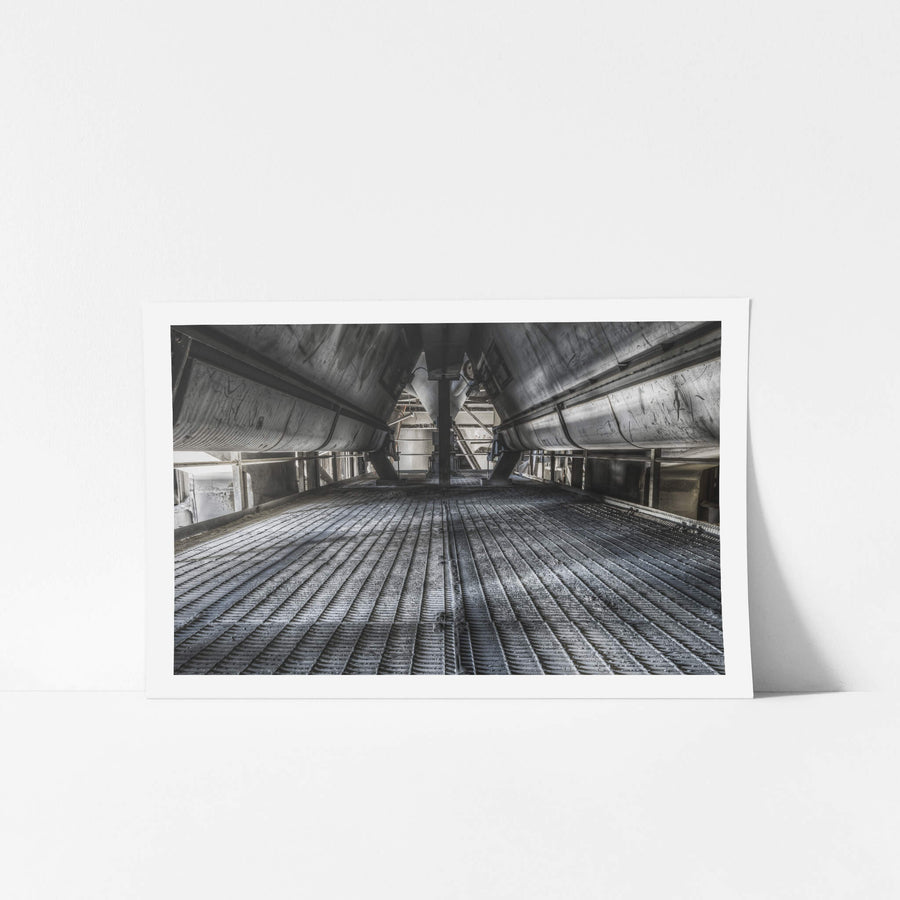
Dust Screws at Kandos Cement Works, two massive screw conveyors run parallel overhead, their steel housings converging.Dust Screws at Kandos Cement Works, two massive screw conveyors run parallel overhead, their steel housings converging.Dust Screws at Kandos Cement Works, two massive screw conveyors run parallel overhead, their steel housings converging.Dust Screws at Kandos Cement Works, two massive screw conveyors run parallel overhead, their steel housings converging.Dust Screws at Kandos Cement Works, two massive screw conveyors run parallel overhead, their steel housings converging.
01 PROVENANCE

Print datasheet

Title
Dust Screws
Series
Kandos Cement Works
Catalogue
KCW-012
Process
Giclée
Captured
13 February 2016
Camera
NIKON D7000
Lens
14.0-24.0 mm f/2.8
Aperture
f/8.0
Shutter
10s s
ISO
100
Focal length
17 mm
Paper
Ilford Galerie Smooth Cotton Rag 310 gsm
Paper size
290 × 200 mm
Location
Kandos, New South Wales, Australia
Recognised by
Highly Commended in Multimedia at the 2016 National Trust of Australia (NSW) Heritage Awards
02 LOCATION

Kandos, New South Wales, Australia

Map · Mapbox · OpenStreetMap

03 THE STORY

About this print

A row of dust screws runs underneath the bag filter at Kandos Cement Works, collecting the dust caught by the filter bags above and feeding it back into the cement stream. Each screw is housed in a steel trough roughly half a metre across, with a hinged inspection lid and a row of bolted access plates along the length. The drive motors sit at one end on small concrete pedestals, coupled to the screw shafts through reduction gearboxes. The whole assembly is bracketed off the floor at chest height. A pale grey crust of cement dust covers the upper surfaces of the troughs and the supporting steelwork. Light from the high windows of the bay catches the row of motors and pools on the floor below.

Dust screws are an unglamorous but essential part of any cement-handling circuit. The plant's bag filters collect cement dust from the extraction air, and the dust drops out of the filter housings into the screws below, which then carry it laterally to a discharge point where it rejoins the cement stream. The system runs continuously while the plant is operating. At Kandos the dust screws ran across the operational life of the cement mills and bag filters they served. The works closed in September 2011 after 95 years of cement production. Cement Australia's reasons cited at closure were dated, inefficient technology and high fixed costs, and the considerable distance from the Sydney market. The screws have not moved since.

04 FROM THE FIELD NOTES

Two massive screw conveyors run parallel overhead, their steel housings converging toward a central support column. The view is from below, shot at floor level across metal grating caked in pale cement dust. Grey light catches the curved undersides of the conveyors and the handrails lining each side. Everything is coated in a fine powder. The air here would taste of calcium and grit.

Brett Patman

Kandos Cement Works

The series

Kandos Cement Works

2016 · 40 photographs

The town's first name was Candos, an acronym of the directors' surnames at the NSW Cement Lime and Coal Company. They bought 100 acres from local farmer John Lloyd Junior for £2,000 in 1913 and had surveyor James Dawson lay out the township. The Postmaster General ruled the name change to Kandos in 1915, and by August 1916 the kilns at the new cement works were firing.

View all in this series →

05 SIZE GUIDE

Print sizes

The anatomy view shows what this finish is as a physical object: paper margin, mat band, frame depth, acrylic profile. The comparison strip shows how each size sits relative to the others at true scale. Click a size or a finish to update both.

Anatomy · true ratio
TypeSizeWidthHeight
08 BY POST · NO SPAM

Read the full story

Articles when they're published. The history behind a place. The day of a shoot. The work between prints. No marketing, no schedule.

You're subscribed.