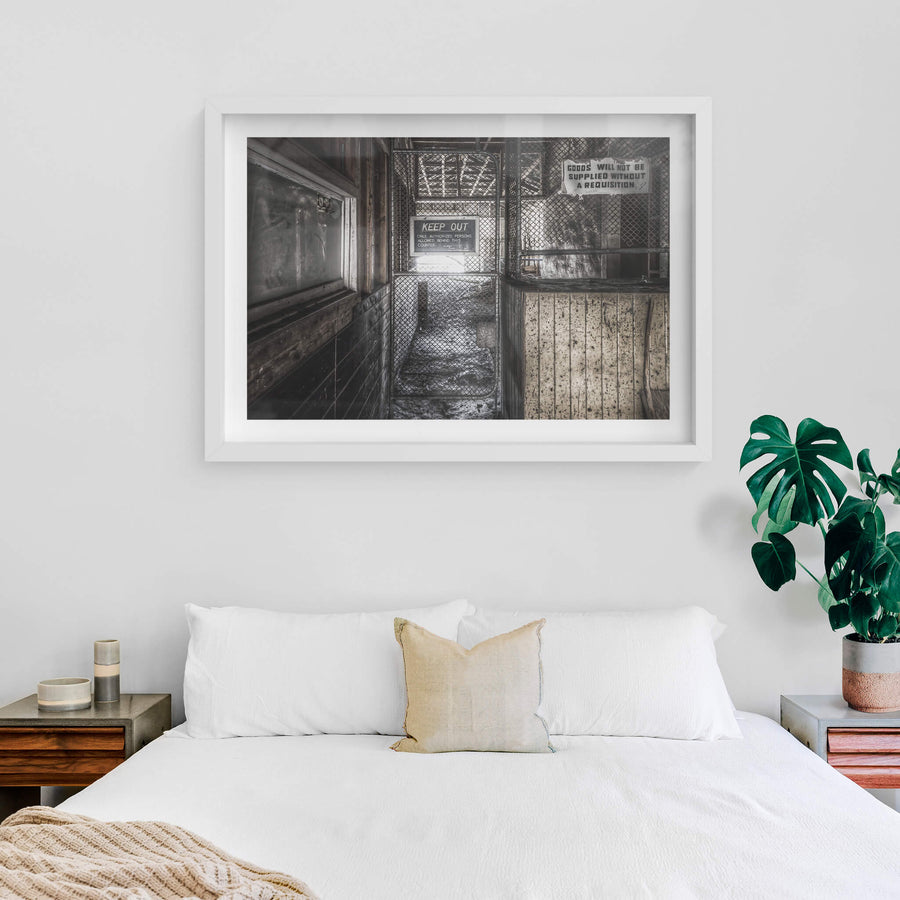
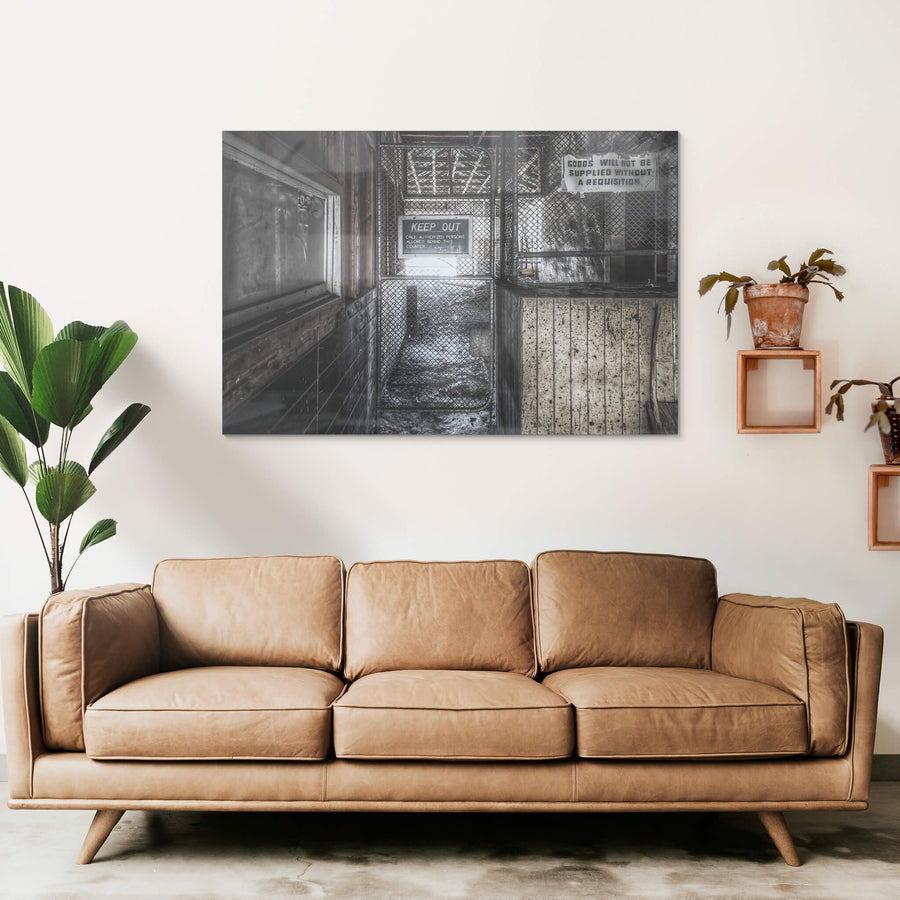
Store Counter

Provenance

Camera
NIKON D7000
Lens
14.0-24.0 mm f/2.8
Settings
14mm · f/8.0 · 1/15 · ISO 100
Paper
Ilford Galerie Smooth Cotton Rag 310 gsm

The store counter at Kandos Cement Works, where workers collected parts and consumables during operation. It was relocated from its original position near the rail line due to occupational health and safety concerns. The plant operated from 1916 until September 2011.

Edition
Open edition

Open edition
Printed to order, no fixed quantity. Each print is hand-signed by the photographer.

Limited edition
A fixed number of prints exist. Once sold, the edition closes permanently. Each print is individually numbered and signed.

$100.00 AUD
Size
Type
Colour
Signed, numbered, with COA. Made to order in 10 to 20 business days (framed). Shipped in protective packaging with edition certificate, paper-stock reference and a printed care guide.
See certificate sample →

Shipping Free shipping over $250. Ships worldwide, rates calculated at checkout.

Returns Damaged in transit? We replace it. Full policy →

Ships within 10 business days · signed & numbered

In situ

Store Counter at Kandos Cement Works, the former store counter, once a critical stop for workers collecting parts.Store Counter at Kandos Cement Works, the former store counter, once a critical stop for workers collecting parts.Store Counter at Kandos Cement Works, the former store counter, once a critical stop for workers collecting parts.Store Counter at Kandos Cement Works, the former store counter, once a critical stop for workers collecting parts.Store Counter at Kandos Cement Works, the former store counter, once a critical stop for workers collecting parts.
01 PROVENANCE

Print datasheet

Title
Store Counter
Series
Kandos Cement Works
Catalogue
KCW-037
Process
Giclée
Captured
13 February 2016
Camera
NIKON D7000
Lens
14.0-24.0 mm f/2.8
Aperture
f/8.0
Shutter
1/15 s
ISO
100
Focal length
14 mm
Paper
Ilford Galerie Smooth Cotton Rag 310 gsm
Paper size
290 × 200 mm
Location
Kandos, New South Wales, Australia
Recognised by
National Trust of Australia (NSW), 2016 Heritage Award, Multimedia
02 LOCATION

Kandos, New South Wales, Australia

Map · Mapbox · OpenStreetMap

03 THE STORY

About this print

The store counter at Kandos Cement Works sits in the parts store, a long room lined with floor-to-ceiling shelving. The counter is timber, varnished darker than the shelving behind it. A wire-cage divider separates the counter from the storage area. A weighing scale sits on the counter, brass-cased, the kind that was standard in industrial parts stores from the 1950s onward. Hand-written labels are still pinned to the shelves behind the counter. A typewriter sits at the back end of the counter, paper still in the platen. The desk lamp above it has the original parchment shade.

Every cement works of this scale ran its own internal parts store. Bearings, gaskets, fittings, electrical components, and hand tools were all kept on site and issued to fitters and electricians as they needed them. The counter at Kandos was the issue point. A worker would come in with a job number, ask for what they needed, and the storeman would fill the request from the shelves. The system ran on paper, signed off by hand, weighed if relevant, recorded in a logbook. The plant closed in September 2011. The store was locked at the same time. The typewriter, the scale, and the labelled shelves have stayed in place.

04 FROM THE FIELD NOTES

The former store counter, once a critical stop for workers collecting parts and consumables, had to be relocated due to occupational health and safety concerns. Positioned near the rail line, it saw a steady flow of tradesmen, engineers, and the occasional unfortunate apprentice tasked with collecting a left-handed screwdriver, sky hooks, or the elusive long weight.

Brett Patman

Kandos Cement Works

The series

Kandos Cement Works

2016 · 40 photographs

Kandos Cement Works ran for ninety-five years in the central west of New South Wales, from August 1916 to September 2011. The town was named after the works, an acronym of the original director surnames forced into its current spelling by the Postmaster General in 1915. The plant was the sole cement supplier to the Sydney Harbour Bridge between 1928 and 1932.

View all in this series →

05 SIZE GUIDE

Print sizes

The anatomy view shows what this finish is as a physical object: paper margin, mat band, frame depth, acrylic profile. The comparison strip shows how each size sits relative to the others at true scale. Click a size or a finish to update both.

Anatomy · true ratio
TypeSizeWidthHeight
08 BY POST · NO SPAM

Read the full story

Articles when they're published. The history behind a place. The day of a shoot. The work between prints. No marketing, no schedule.

You're subscribed.