Blind

Provenance

Camera
NIKON D850
Lens
14.0-24.0 mm f/2.8
Settings
14mm · f/8.0 · 1.6s · ISO 100
Paper
Ilford Galerie Smooth Cotton Rag 310 gsm

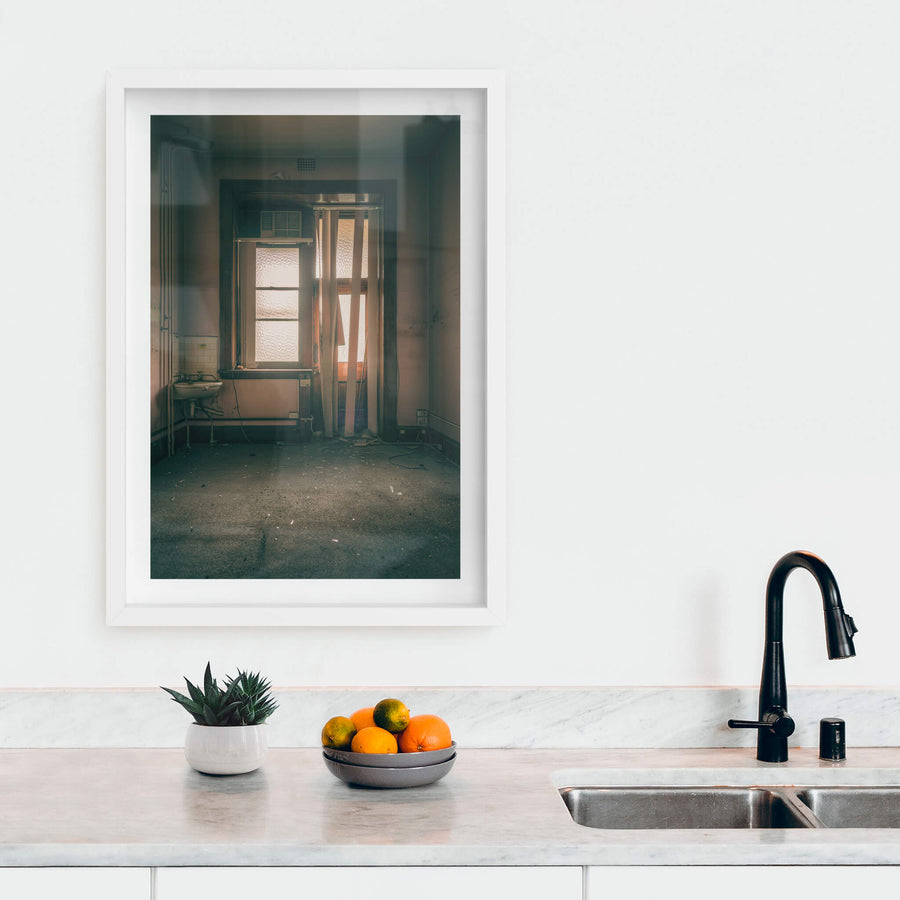
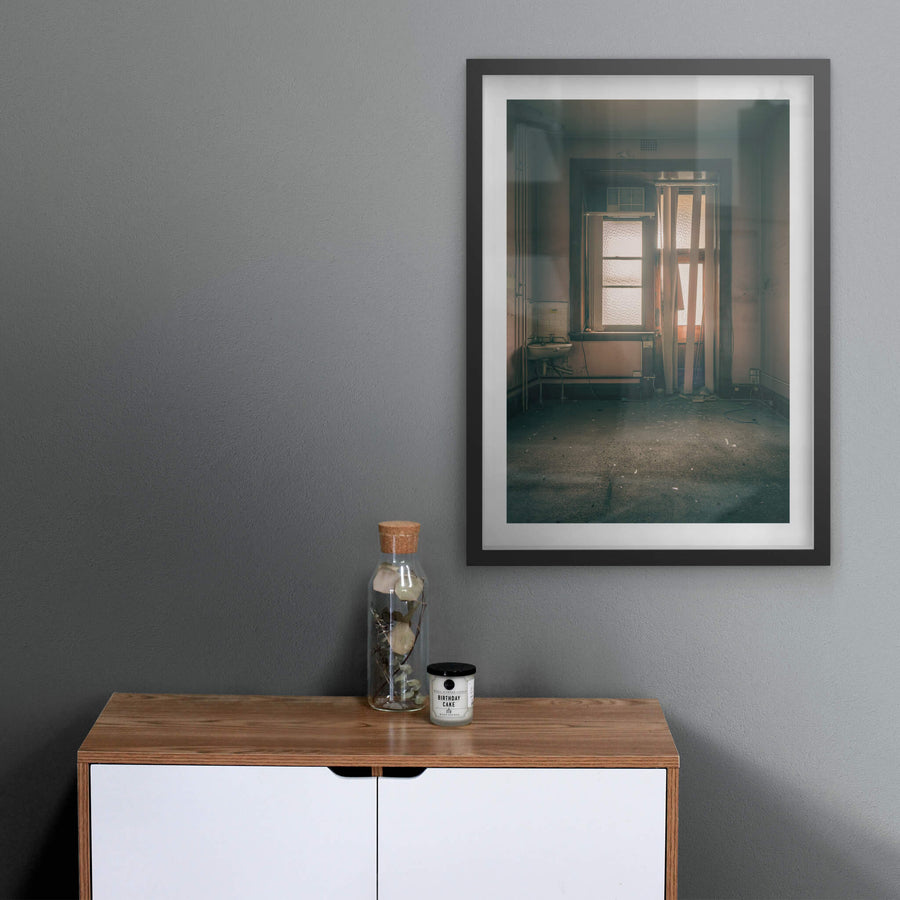
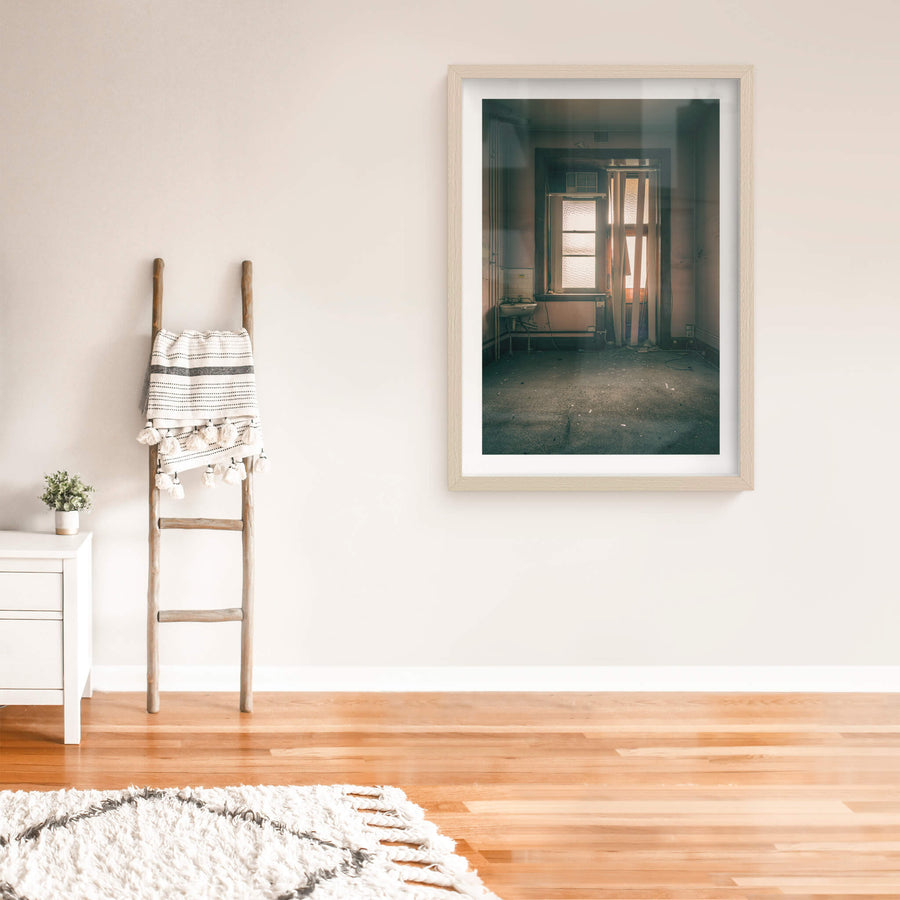
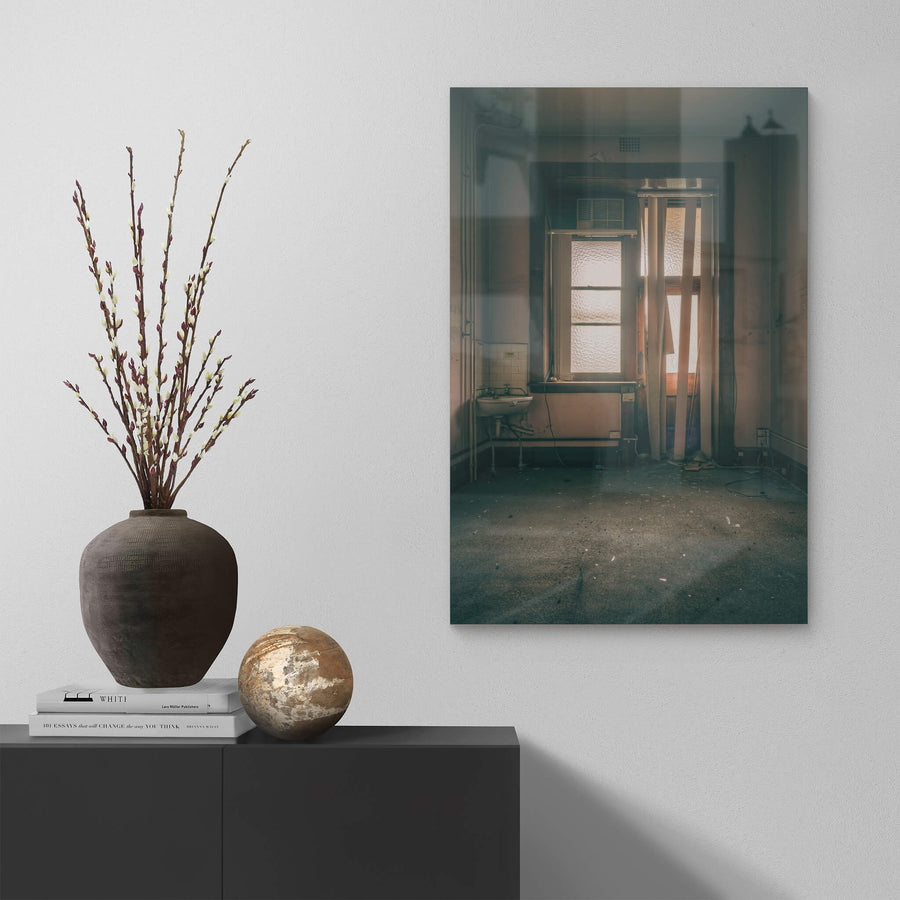
A Venetian blind hangs at an angle in a window frame, several slats bent or misaligned. The slats are coated in a uniform layer of dust. Natural light filters through the blind from outside. The surrounding wall surface is plain and undecorated. No furnishings are visible beyond the blind itself.

Edition
Open edition

Open edition
Printed to order, no fixed quantity. Each print is hand-signed by the photographer.

Limited edition
A fixed number of prints exist. Once sold, the edition closes permanently. Each print is individually numbered and signed.

$100.00 AUD
Size
Type
Colour
Signed, numbered, with COA. Made to order in 5 to 10 business days (unframed). Shipped in protective packaging with edition certificate, paper-stock reference and a printed care guide.
See certificate sample →

Shipping Free shipping over $250. Ships worldwide, rates calculated at checkout.

Returns Damaged in transit? We replace it. Full policy →

Ships within 10 business days · signed & numbered

In situ
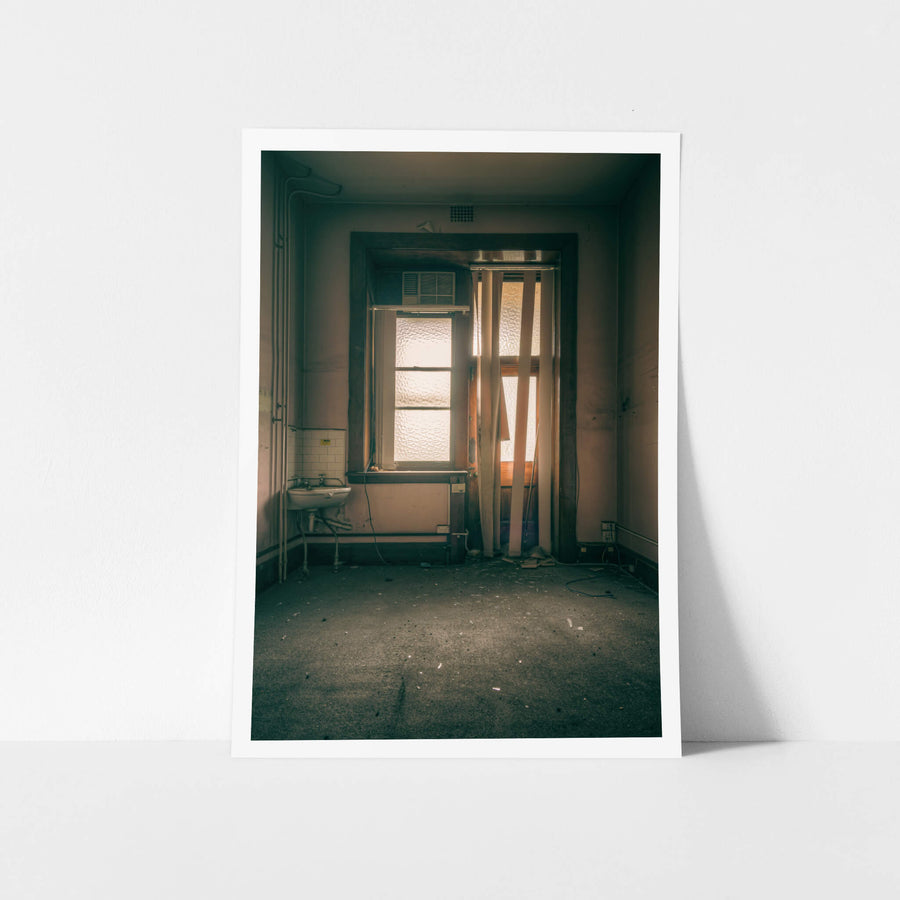
Blind at Lewisham Hospital, a small room, stripped back to its bones.Blind at Lewisham Hospital, a small room, stripped back to its bones.Blind at Lewisham Hospital, a small room, stripped back to its bones.Blind at Lewisham Hospital, a small room, stripped back to its bones.Blind at Lewisham Hospital, a small room, stripped back to its bones.
01 PROVENANCE

Print datasheet

Title
Blind
Series
Lewisham Hospital
Catalogue
LHO-005
Process
Giclée
Captured
28 January 2019
Camera
NIKON D850
Lens
14.0-24.0 mm f/2.8
Aperture
f/8.0
Shutter
1.6s s
ISO
100
Focal length
14 mm
Paper
Ilford Galerie Smooth Cotton Rag 310 gsm
Paper size
290 × 200 mm
Location
Lewisham, New South Wales, Australia
Recognised by
Highly Commended in Multimedia at the 2016 National Trust of Australia (NSW) Heritage Awards
02 LOCATION

Lewisham, New South Wales, Australia

Map · Mapbox · OpenStreetMap

03 THE STORY

About this print

A Venetian blind hangs askew in a window of the novitiate building at Lewisham Hospital, its slats bent out of alignment and coated in a uniform layer of dust. No one straightened it when the building was vacated, and no one has straightened it since. It is the kind of detail that accumulates when a place stops being tended to: unremarkable at the time, and then, years later, precisely the thing that records the absence. The novitiate building is the principal subject of the Lost Collective photographic series at this site, its cellular interior shaped around the rhythms of religious life rather than the ward architecture of the hospital proper. It is where women entered the Little Company of Mary and trained as nurses before taking their place in the wider institution. The Little Company of Mary first arrived at Lewisham in 1885, when six sisters came ashore in Sydney with five pounds between them. Within two years they had established a convent on land donated by Cardinal Patrick Francis Moran, the Archbishop of Sydney. The Children's Hospital of the Holy Child opened on 9 June 1889, the first hospital the order founded in Australia. Over the following decades the complex grew in stages: a general hospital wing in 1900, a new convent in 1908, a further hospital wing in 1911, and the Byzantine Revival Chapel of the Maternal Heart of Mary in 1927. From 1912, when male patients were admitted for the first time, the hospital operated as a general institution, treating patients without distinction of creed, race, or background. By 1949, cumulative records showed 140,757 in-patients and 950,691 outpatient attendances since 1890. The Little Company of Mary vacated the site in 1986 after nearly a century of continuous operation. The Society of St Vincent de Paul took ownership in 1987, and the hospital formally closed around 1988. The complex was redeveloped as aged care facilities. The chapel remains an active parish. This photograph was made in 2019.

04 FROM THE FIELD NOTES

A Venetian blind hangs askew in a window of the novitiate building at Lewisham Hospital, its slats grey with accumulated dust. The Little Company of Mary, the Catholic nursing order known as the Blue Nuns, operated the hospital complex on West Street, Lewisham from 1889 until they vacated in 1986. The Society of St Vincent de Paul took ownership the following year, and the hospital formally closed around 1988. What remains in rooms like this one is ordinary and specific: a blind that nobody straightened, in a building that once trained nurses and admitted women to a religious vocation.

Brett Patman

Lewisham Hospital

The series

Lewisham Hospital

2019 · 26 photographs

Lewisham Hospital was opened on 9 June 1889 by Cardinal Patrick Francis Moran, on the site where the Little Company of Mary, the Blue Nuns, had established their Sydney convent in 1887. Originally named the Children's Hospital of the Holy Child, it admitted women and children only until male patients were accepted from 1912. Over the following decades it became one of Sydney's main general hospitals and nurse training schools. It closed in 1988, a century of Catholic healthcare on one block of West Street, Lewisham. The Lost Collective photographs are of the novitiate building, the wing where new entrants to the order were trained, which sits within the broader hospital, convent, and grounds complex. The historic complex is listed as a local heritage item under the Inner West LEP (formerly Marrickville LEP 2011), within the Lewisham North Precinct. The convent chapel, in a revival Byzantine style with a 1927 Möller pipe organ, still stands on the site.

View all in this series →

05 SIZE GUIDE

Print sizes

The anatomy view shows what this finish is as a physical object: paper margin, mat band, frame depth, acrylic profile. The comparison strip shows how each size sits relative to the others at true scale. Click a size or a finish to update both.

Anatomy · true ratio
TypeSizeWidthHeight
08 BY POST · NO SPAM

Read the full story

Articles when they're published. The history behind a place. The day of a shoot. The work between prints. No marketing, no schedule.

You're subscribed.