Strawn Floor Room

Provenance

Camera
NIKON D850
Lens
14.0-24.0 mm f/2.8
Settings
14mm · f/8.0 · 1/5 sec · ISO 100
Paper
Ilford Galerie Smooth Cotton Rag 310 gsm

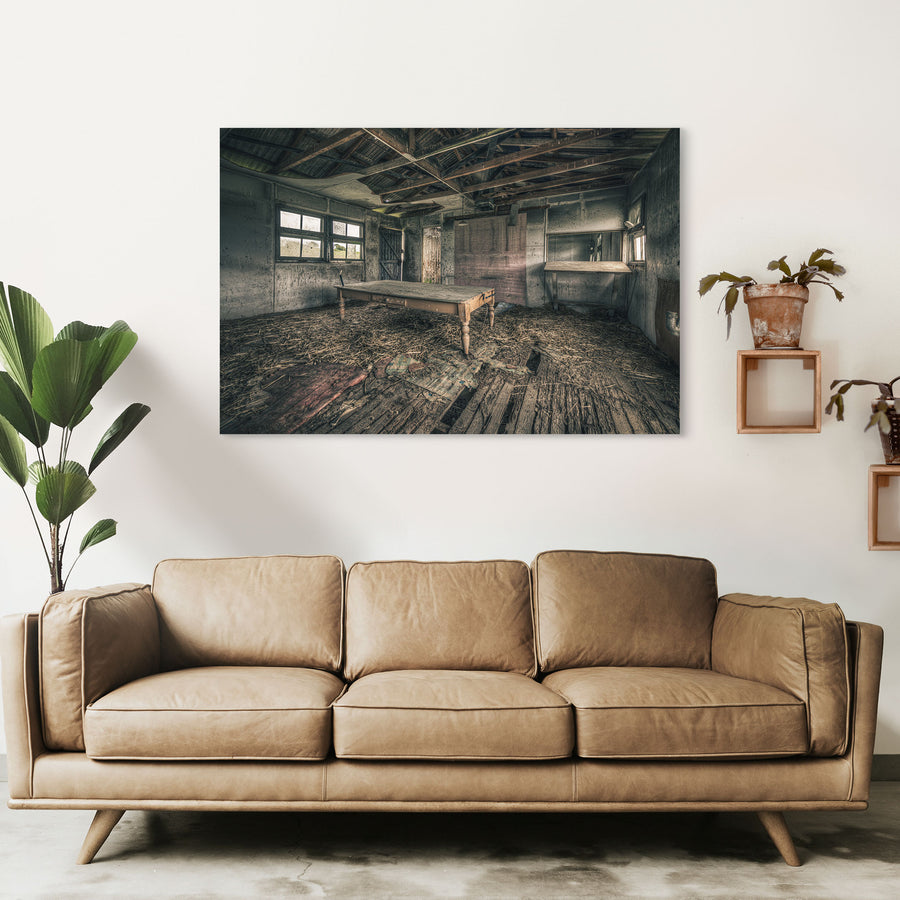
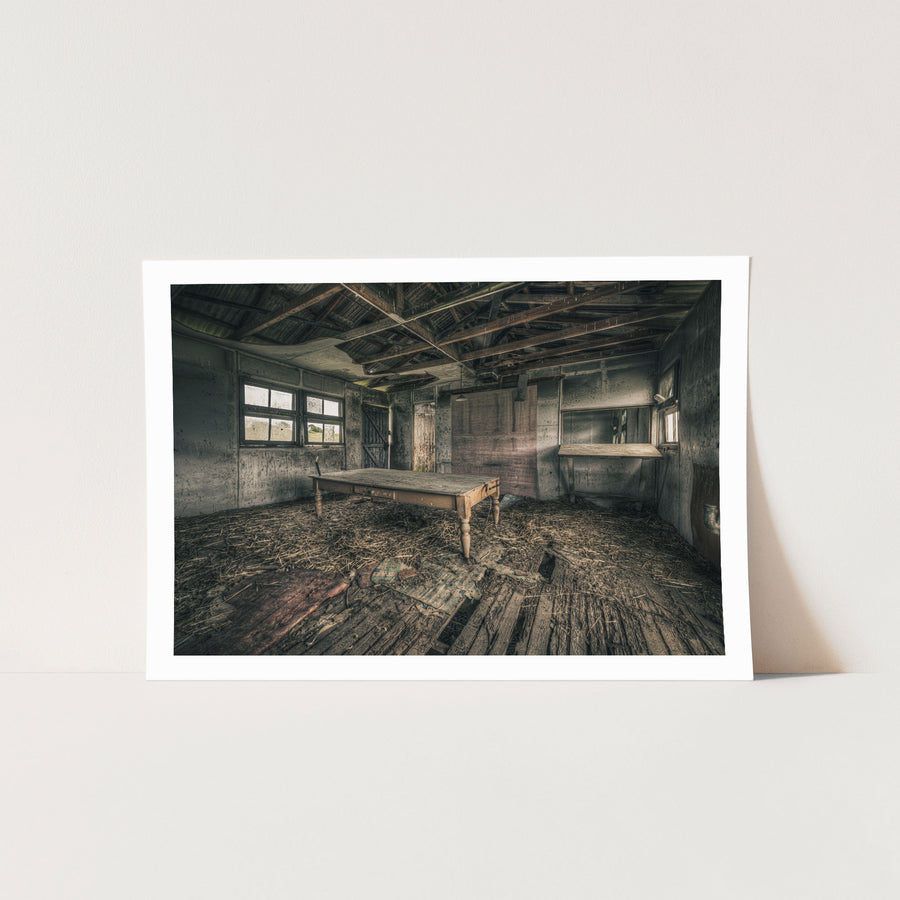
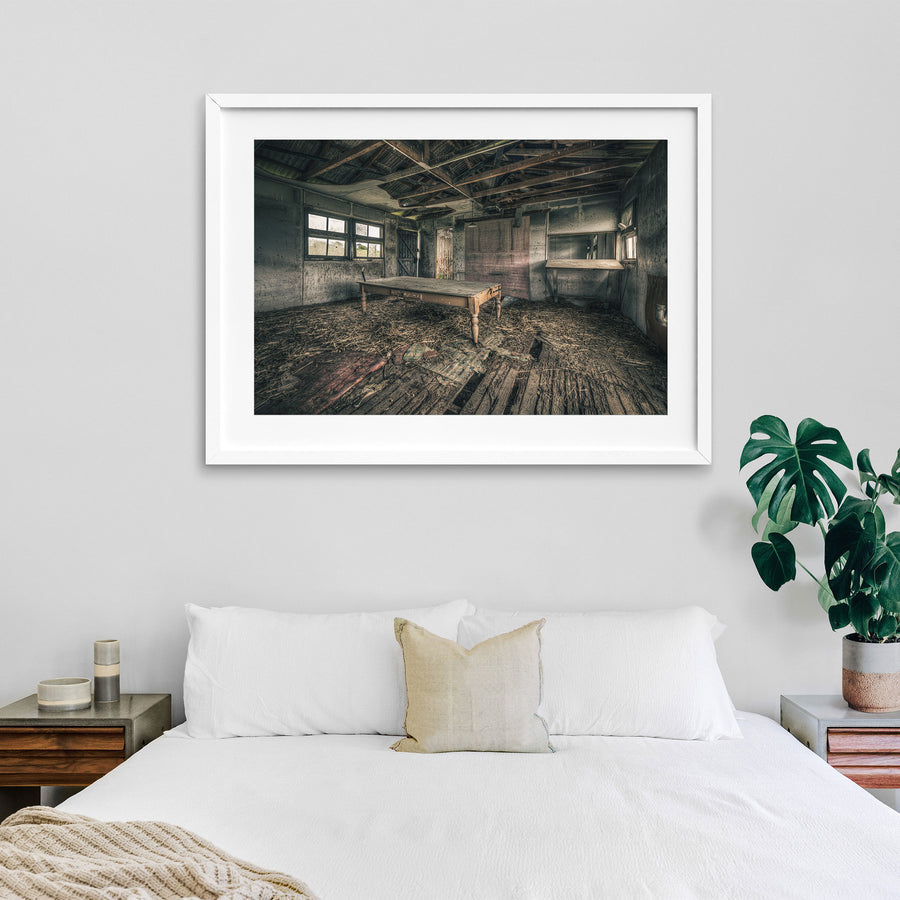
A long timber table with turned legs occupies the centre of the room. The floor is covered in loose straw and broken floorboards. Multi-pane windows line the left wall. A plank door stands closed at the far end, with a wall shelf mounted beside it. Roof framing is exposed overhead. The surfaces are bare and unrestored.

Edition
Open edition

Open edition
Printed to order, no fixed quantity. Each print is hand-signed by the photographer.

Limited edition
A fixed number of prints exist. Once sold, the edition closes permanently. Each print is individually numbered and signed.

$100.00 AUD
Size
Type
Colour
Signed, numbered, with COA. Made to order in 10 to 20 business days (framed). Shipped in protective packaging with edition certificate, paper-stock reference and a printed care guide.
See certificate sample →

Shipping Free shipping over $250. Ships worldwide, rates calculated at checkout.

Returns Damaged in transit? We replace it. Full policy →

Ships within 10 business days · signed & numbered

In situ
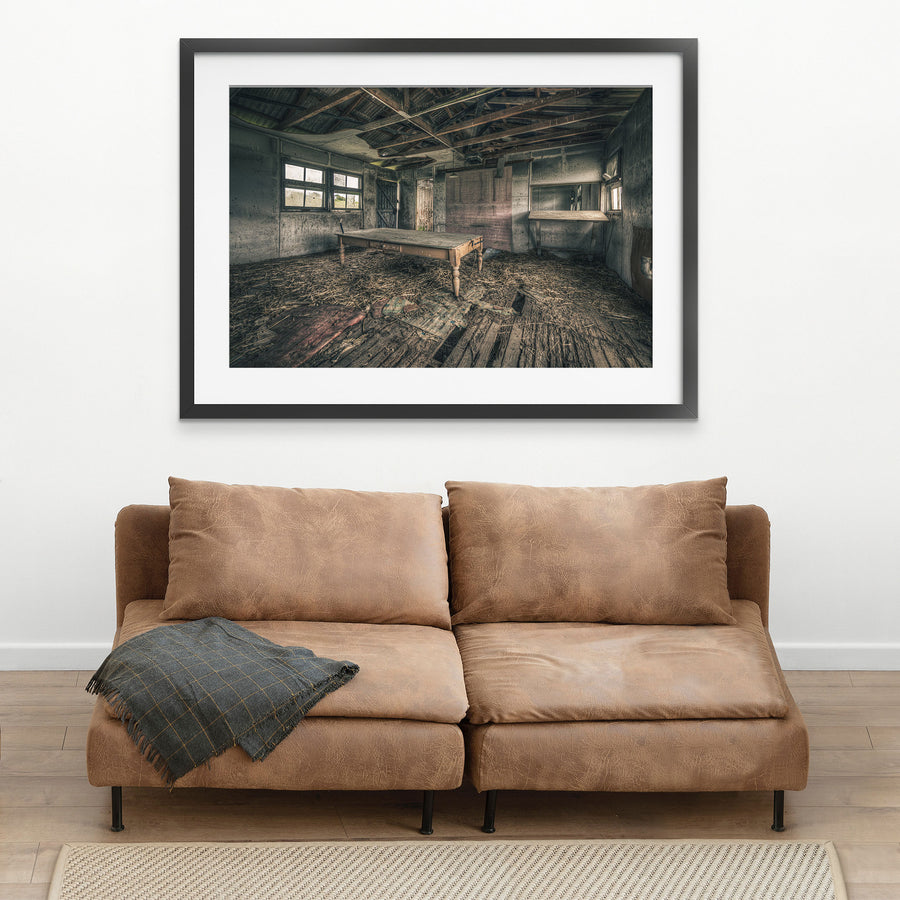
A long timber table with turned legs on a straw-strewn floor of broken boards, with multi-pane windows and an open plank door visible in a derelict interior at Jembaicumbene, New South Wales.A long timber table with turned legs on a straw-strewn floor of broken boards, with multi-pane windows and an open plank door visible in a derelict interior at Jembaicumbene, New South Wales.A long timber table with turned legs on a straw-strewn floor of broken boards, with multi-pane windows and an open plank door visible in a derelict interior at Jembaicumbene, New South Wales.A long timber table with turned legs on a straw-strewn floor of broken boards, with multi-pane windows and an open plank door visible in a derelict interior at Jembaicumbene, New South Wales.A long timber table with turned legs on a straw-strewn floor of broken boards, with multi-pane windows and an open plank door visible in a derelict interior at Jembaicumbene, New South Wales.
01 PROVENANCE

Print datasheet

Title
Strawn Floor Room
Series
Mill Pond Farm
Process
Giclée
Captured
21 January 2022
Camera
NIKON D850
Lens
14.0-24.0 mm f/2.8
Aperture
f/8.0
Shutter
1/5 sec s
ISO
100
Focal length
14 mm
Paper
Ilford Galerie Smooth Cotton Rag 310 gsm
Location
Jembaicumbene, NSW, Australia
Recognised by
Highly Commended in Multimedia at the 2016 National Trust of Australia (NSW) Heritage Awards
02 LOCATION

Jembaicumbene, NSW, Australia

Map · Mapbox · OpenStreetMap

03 THE STORY

About this print

A long timber table with turned legs sits at the centre of the room, its surface bare, the floor around it scattered with straw and broken boards. Multi-pane windows along the left wall let in a flat, even light. A plank door stands at the far end of the space with a wall shelf beside it, and the roof framing above is fully exposed, the building open to itself. The mill at Jembaicumbene was built in 1859 by Charles Dransfield, a Yorkshire wool miller turned gold-country wheat farmer who had made his fortune in the Braidwood district during the previous decade. The construction used brick manufactured on the property and granite quarried from the farm's own land, with massive hardwood beams cut from the nearby Budawang Ranges. The building was designed by Sydney surveyor C.E. Langley, and the engineering works including the steam engine were supplied by P.N. Russell and Co. of Sydney, then one of the largest engineering firms in colonial Australia. The mill opened in January 1860 under the name the Jembaicumbene Steam Flour Mills. At the time, more than 1,000 miners were working Jembaicumbene Creek below the property, including approximately 600 Chinese miners. The four-storey structure housed flour milling, a sawmill, a quartz crushing battery for gold extraction, and a bakery. By 1885, all milling operations had ceased, and the steam engine and fittings were removed at some point after closure. What remains is the building itself: its thick walls, its heavy beams, its windows still in place. The room photographed here in 2022 holds almost nothing. A table, some straw, daylight through the glass. The Jembaicumbene Steam Flour Mills is described as the most substantial building surviving from the gold rush era in the district. This frame records what that survival looks like from the inside.

04 FROM THE FIELD NOTES

A timber table with turned legs sits on a floor of straw and split boards, lit by multi-pane windows set into thick walls. The roof framing is open above, the room otherwise stripped back to its bones. The mill at Jembaicumbene was built in 1859 by Charles Dransfield using brick made on the property and granite quarried from the farm, with massive hardwood beams cut from the nearby Budawang Ranges. It opened in January 1860 as the Jembaicumbene Steam Flour Mills, serving a creek-side settlement of more than 1,000 miners. By 1885 all milling had ceased.

Brett Patman

Mill Pond Farm

The series

Mill Pond Farm

2022 · 53 photographs

Mill Pond Farm sits in Jembaicumbene, near Braidwood, on land first worked as the region's earliest dairy in the 1830s. In 1859 a Yorkshire-born goldminer named Charles Dransfield built a four-storey Steam Flour Mill on the property, designed by Sydney architect Charles Langley. A 24-horsepower steam engine ground wheat, sawed timber, and crushed quartz to extract gold. The mill ran until 1885, when the railway arriving in Tarago undercut local flour prices, the financial depression hit, and repeated wheat rust outbreaks finished the run. The mill, stables, and dairy buildings sat unworked for nearly a century. Restoration is in progress.

View all in this series →

05 SIZE GUIDE

Print sizes

The anatomy view shows what this finish is as a physical object: paper margin, mat band, frame depth, acrylic profile. The comparison strip shows how each size sits relative to the others at true scale. Click a size or a finish to update both.

Anatomy · true ratio
TypeSizeWidthHeight
08 BY POST · NO SPAM

Read the full story

Articles when they're published. The history behind a place. The day of a shoot. The work between prints. No marketing, no schedule.

You're subscribed.