
Workshop
Provenance
- Camera
- NIKON D7000
- Lens
- AF-S Zoom-Nikkor 24-70mm f/2.8G ED
- Settings
- 36mm · f/8.0 · 0.8s · ISO 100
- Paper
- Ilford Galerie Smooth Cotton Rag 310 gsm
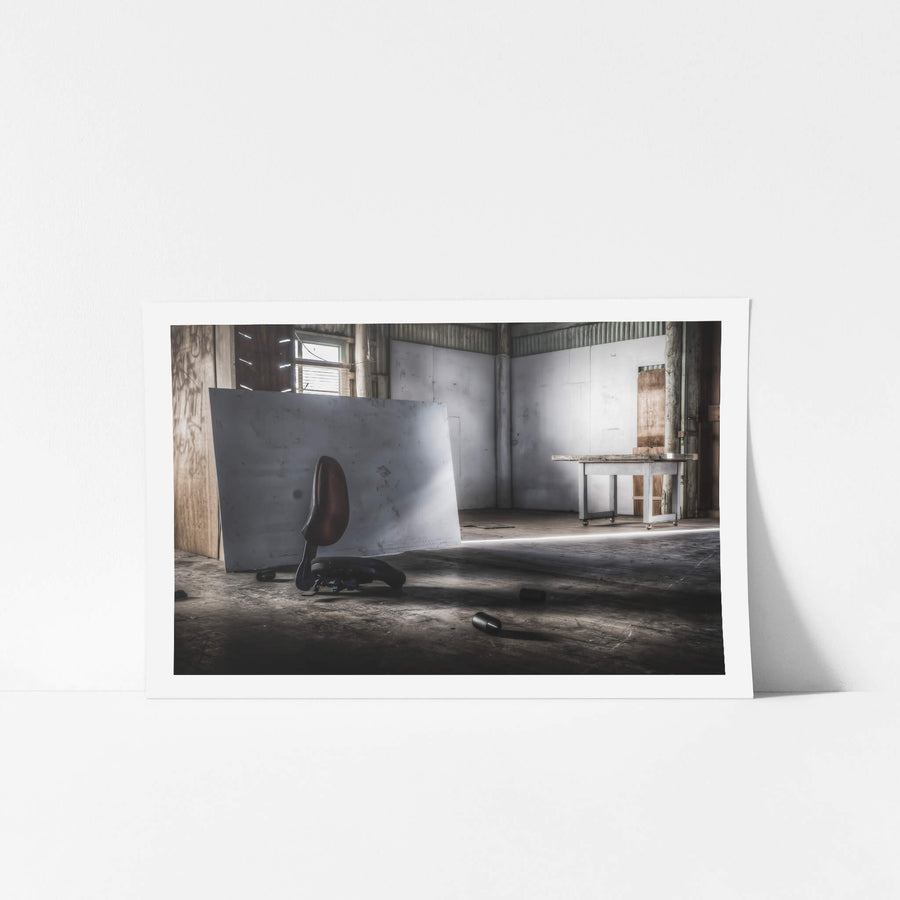
A red-backed office chair, broken off its base, leans against a large white panel near the far wall of the workshop at the Mungo Scott Flour Mill in Summer Hill, caught in a sharp horizontal beam of sunlight across the concrete floor. Two black cylinders sit in the foreground and a wheeled table with a timber top stands to the right. Graffitied planks line the left wall.
Open edition
Printed to order, no fixed quantity. Each print is hand-signed by the photographer.
Limited edition
A fixed number of prints exist. Once sold, the edition closes permanently. Each print is individually numbered and signed.
Shipping Free shipping over $250. Ships worldwide, rates calculated at checkout.
Returns Damaged in transit? We replace it. Full policy →
Ships within 10 business days · signed & numbered
In situ

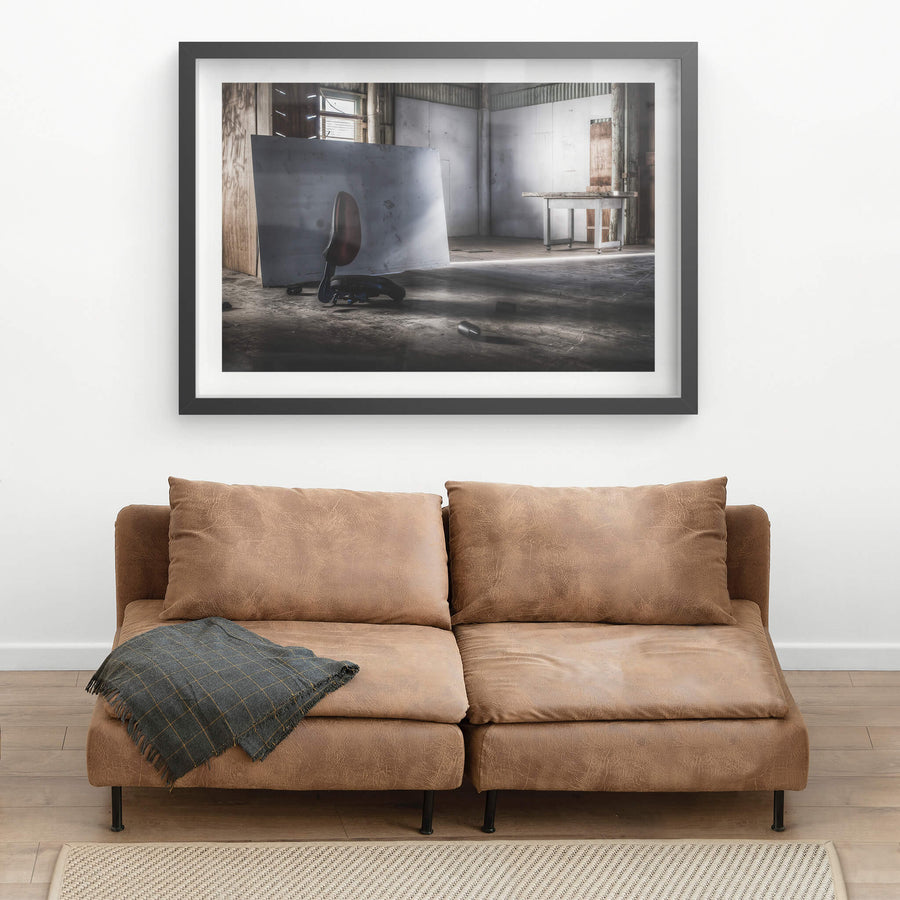
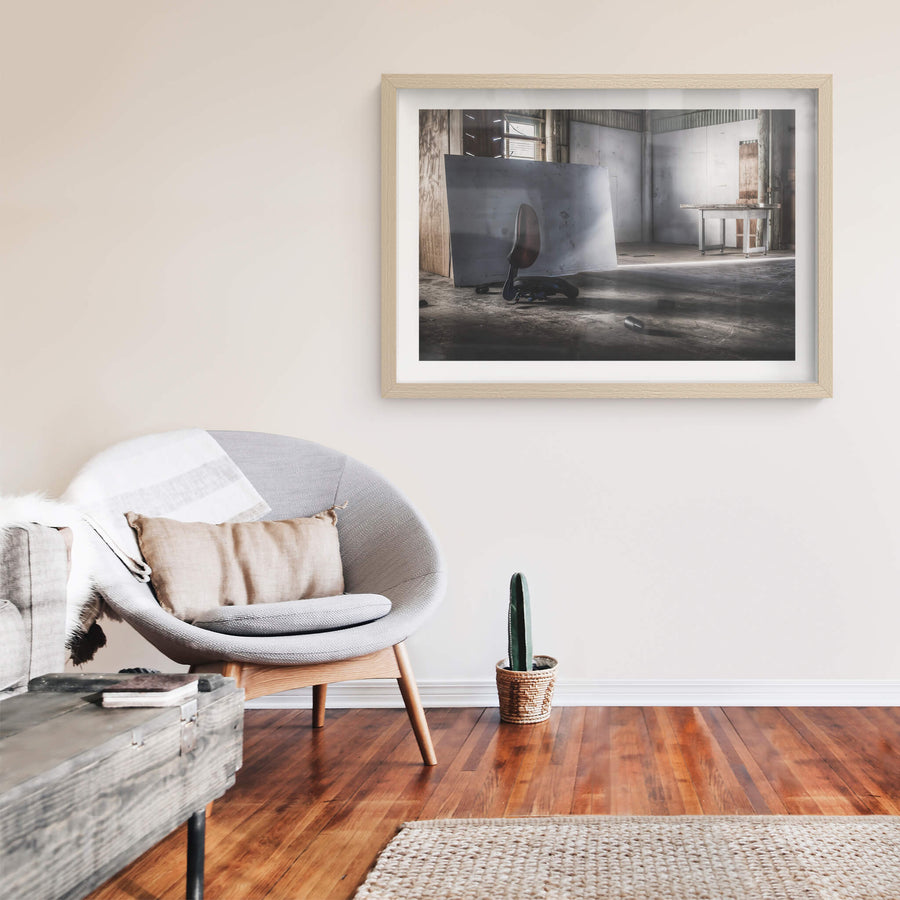

Print datasheet
- Title
- Workshop
- Series
- Mungo Scott Flour Mill
- Catalogue
- MSF-012
- Process
- Giclée
- Captured
- 11 May 2014
- Camera
- NIKON D7000
- Lens
- AF-S Zoom-Nikkor 24-70mm f/2.8G ED
- Aperture
- f/8.0
- Shutter
- 0.8s s
- ISO
- 100
- Focal length
- 36 mm
- Paper
- Ilford Galerie Smooth Cotton Rag 310 gsm
- Paper size
- 297 × 210 mm
- Location
- Summer Hill, New South Wales, Australia
- Authenticity
- C2PA verified provenance →
- Recognised by
- Highly Commended in Multimedia at the 2016 National Trust of Australia (NSW) Heritage Awards
Summer Hill, New South Wales, Australia
Map · Mapbox · OpenStreetMap
About this print
In the workshop of the Mungo Scott Flour Mill, a steel workbench on castors sits against the far wall, a sheet of metal propped against the partition beside it. A collapsed office chair sits behind the metal, on bare concrete beneath a corrugated iron ceiling. The mill opened in June 1922 and ran for nearly ninety years, supplying flour to Sydney's bakeries before operations ceased in 2009. This room, tucked within a load-bearing brick building of timber post-and-beam construction, held the tools and materials that kept the machinery turning.
Brett Patman

The series
Mungo Scott Flour Mill
Mungo Scott Flour Mill went up at Summer Hill around 1921 and began operating in June 1922, replacing the company's earlier mill on Sussex Street in the city. The site sat on the goods rail line between Wardell Road and Darling Harbour. A fire in 1927, attributed to sparks from passing trains igniting stored flour, did serious damage. Goodman Fielder later put up the concrete silos that mark the site from a distance. Allied Mills ran the operation until 2009. The 2.5-hectare site was vacant for almost a decade before EG Funds Management and Daiwa House Australia turned it into the Flour Mill mixed-use precinct, designed by Hassell, 360 apartments and townhouses across 11 buildings, with the heritage mill structures and silos retained at the centre.
Print sizes
The anatomy view shows what this finish is as a physical object: paper margin, mat band, frame depth, acrylic profile. The comparison strip shows how each size sits relative to the others at true scale. Click a size or a finish to update both.
| Type | Size | Width | Height |
|---|


