
Don Starboard Side Corridor
Provenance
- Camera
- NIKON D7000
- Lens
- 14.0-24.0 mm f/2.8
- Settings
- 24mm · f/8.0 · 10s · ISO 100
- Paper
- Ilford Galerie Smooth Cotton Rag 310 gsm
A long, narrow corridor runs through the interior of MV Cape Don, steel walls flanked by wooden doors on both sides and pipes and electrical conduits tracked along the ceiling. Mid-passage a metal basin sits on the floor catching a drip from above, a small puddle spreading beside it. At the far end a yellow jacket hangs beside a door, an illuminated exit sign above it.
Open edition
Printed to order, no fixed quantity. Each print is hand-signed by the photographer.
Limited edition
A fixed number of prints exist. Once sold, the edition closes permanently. Each print is individually numbered and signed.
Shipping Free shipping over $250. Ships worldwide, rates calculated at checkout.
Returns Damaged in transit? We replace it. Full policy →
Ships within 10 business days · signed & numbered
In situ

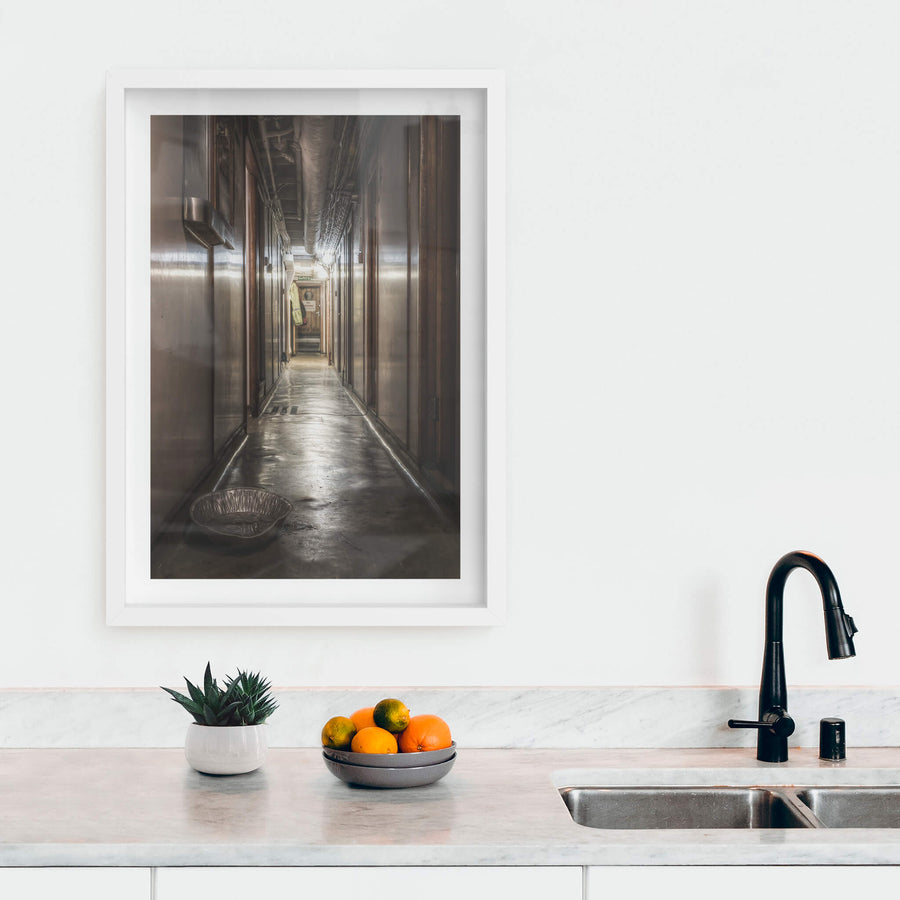
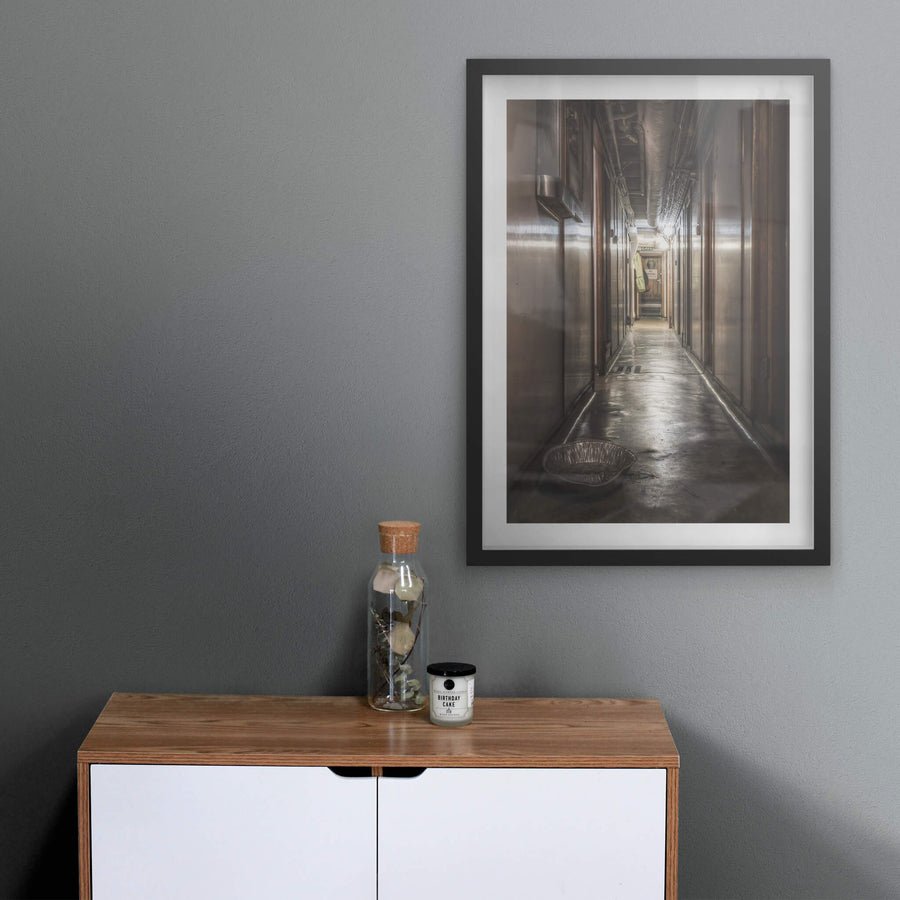
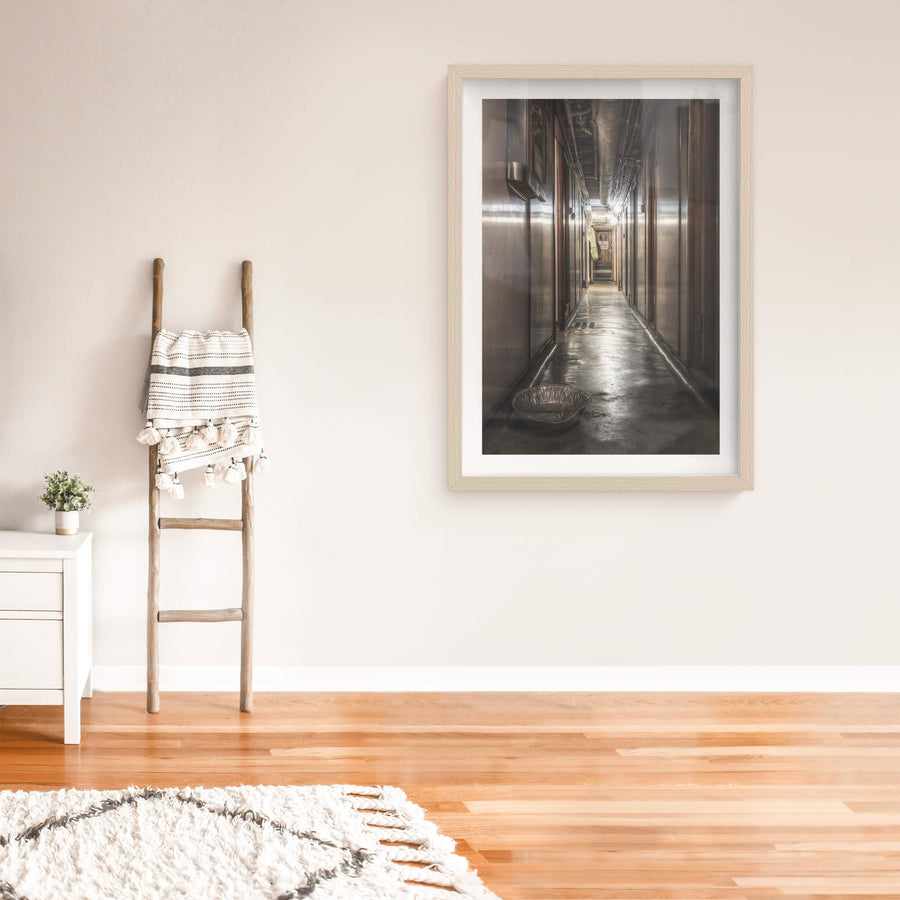

Print datasheet
- Title
- Don Starboard Side Corridor
- Series
- MV Cape Don
- Catalogue
- MCD-018
- Process
- Giclée
- Captured
- 30 January 2016
- Camera
- NIKON D7000
- Lens
- 14.0-24.0 mm f/2.8
- Aperture
- f/8.0
- Shutter
- 10s s
- ISO
- 100
- Focal length
- 24 mm
- Paper
- Ilford Galerie Smooth Cotton Rag 310 gsm
- Paper size
- 297 × 210 mm
- Location
- Balls Head, New South Wales, Australia
- Authenticity
- C2PA verified provenance →
- Recognised by
- Highly Commended in Multimedia at the 2016 National Trust of Australia (NSW) Heritage Awards
Balls Head, New South Wales, Australia
Map · Mapbox · OpenStreetMap
About this print
The starboard side corridor of MV Cape Don connects crew cabins on one side with bathrooms and storerooms on the other. Built at the State Dockyard, Newcastle, and completed in January 1963, Cape Don carried a complement of 39 personnel through 27 years of Commonwealth Lighthouse Service operations, servicing lighthouses, lightships, and buoys around the Australian coastline. Retired from government service in 1990, the vessel is now berthed at Balls Head Bay, Waverton, and is the sole surviving vessel of the entire CLS fleet.
Brett Patman

The series
MV Cape Don
MV *Cape Don* is a former Commonwealth Lighthouse Service tender, designed by the Australian Shipping Board and built at the State Dockyard in Newcastle. She was launched on 28 May 1962, commissioned in 1964, and worked the Australian coast until 1990, servicing lighthouses, lightships, and buoys across more than a quarter of a century. Her sister ships were *Cape Moreton* and *Cape Pillar*. Her log includes the 1973 recovery of two of HMS *Investigator*'s anchors from the Recherche Archipelago and the 1979 establishment of the first marine monitoring station in Bass Strait. Decommissioned in 1990, she is now moored at Berry's Bay, Waverton, where the Sea Heritage Foundation is restoring her as a museum and training ship.
Print sizes
The anatomy view shows what this finish is as a physical object: paper margin, mat band, frame depth, acrylic profile. The comparison strip shows how each size sits relative to the others at true scale. Click a size or a finish to update both.
| Type | Size | Width | Height |
|---|


