
Steering Gear
Provenance
- Camera
- NIKON D7000
- Lens
- 14.0-24.0 mm f/2.8
- Settings
- 14mm · f/8.0 · 15s · ISO 100
- Paper
- Ilford Galerie Smooth Cotton Rag 310 gsm
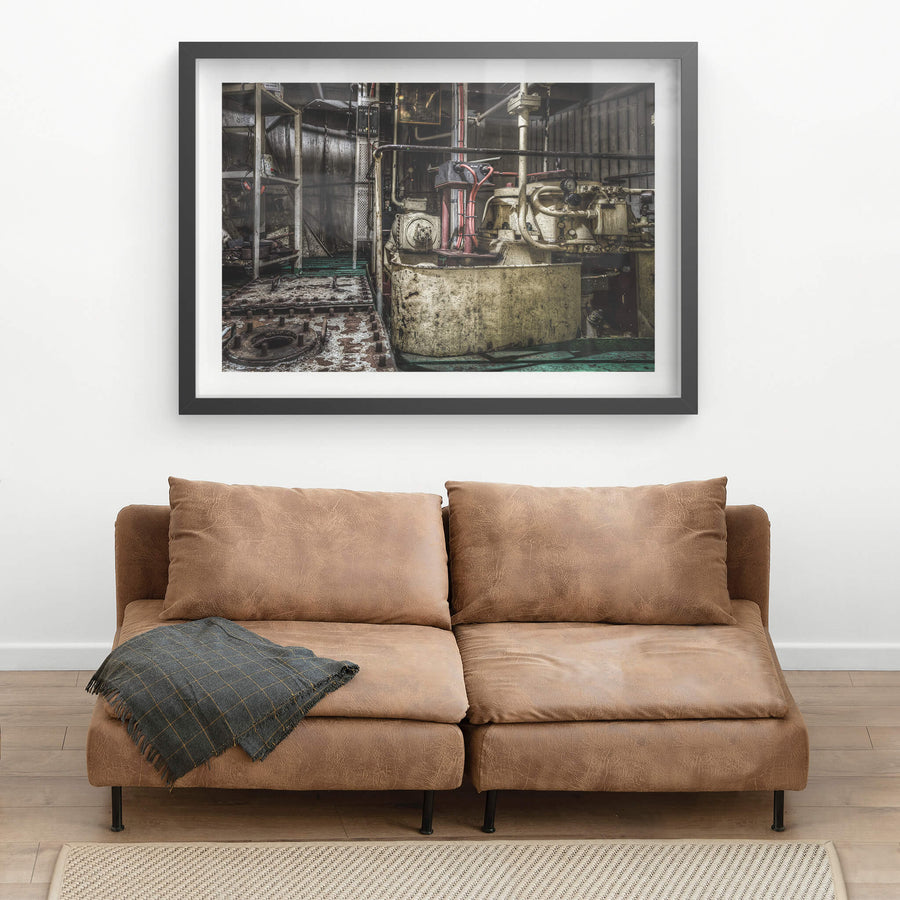
Rusted floor plates studded with bolts surround a circular deck opening in the foreground of one of the machinery compartments aboard MV Cape Don. Beyond it stands a large cream-coloured cylindrical machine ranked with gauges and exposed piping, with a black control box and red electrical conduits mounted above. A white shelving unit to the left holds scattered tools, orange earmuffs and a 'No Pain' sign on the top shelf. The vessel's steering gear was built by Brown Brothers of Scotland.
Open edition
Printed to order, no fixed quantity. Each print is hand-signed by the photographer.
Limited edition
A fixed number of prints exist. Once sold, the edition closes permanently. Each print is individually numbered and signed.
Shipping Free shipping over $250. Ships worldwide, rates calculated at checkout.
Returns Damaged in transit? We replace it. Full policy →
Ships within 10 business days · signed & numbered
In situ




Print datasheet
- Title
- Steering Gear
- Series
- MV Cape Don
- Catalogue
- MCD-013
- Process
- Giclée
- Captured
- 30 January 2016
- Camera
- NIKON D7000
- Lens
- 14.0-24.0 mm f/2.8
- Aperture
- f/8.0
- Shutter
- 15s s
- ISO
- 100
- Focal length
- 14 mm
- Paper
- Ilford Galerie Smooth Cotton Rag 310 gsm
- Paper size
- 297 × 210 mm
- Location
- Balls Head, New South Wales, Australia
- Authenticity
- C2PA verified provenance →
- Recognised by
- Highly Commended in Multimedia at the 2016 National Trust of Australia (NSW) Heritage Awards
Balls Head, New South Wales, Australia
Map · Mapbox · OpenStreetMap
About this print
The steering gear room of MV Cape Don houses the Brown Brothers of Scotland hydraulic unit that converts bridge commands into rudder movement. The vessel was launched at the State Dockyard, Newcastle on 28 May 1962, one of three Cape Class sisters built for the Commonwealth Lighthouse Service. She served 27 years on Australian coastlines before retirement in 1990, and now rests at Balls Head Bay, Waverton, under active conservation by the Sea Heritage Foundation.
Brett Patman

The series
MV Cape Don
MV *Cape Don* is a former Commonwealth Lighthouse Service tender, designed by the Australian Shipping Board and built at the State Dockyard in Newcastle. She was launched on 28 May 1962, commissioned in 1964, and worked the Australian coast until 1990, servicing lighthouses, lightships, and buoys across more than a quarter of a century. Her sister ships were *Cape Moreton* and *Cape Pillar*. Her log includes the 1973 recovery of two of HMS *Investigator*'s anchors from the Recherche Archipelago and the 1979 establishment of the first marine monitoring station in Bass Strait. Decommissioned in 1990, she is now moored at Berry's Bay, Waverton, where the Sea Heritage Foundation is restoring her as a museum and training ship.
Print sizes
The anatomy view shows what this finish is as a physical object: paper margin, mat band, frame depth, acrylic profile. The comparison strip shows how each size sits relative to the others at true scale. Click a size or a finish to update both.
| Type | Size | Width | Height |
|---|


