
Gift Shop
Provenance
- Camera
- NIKON D810
- Lens
- 14.0-24.0 mm f/2.8
- Settings
- 14mm · f/8.0 · 1/500 · ISO 100
- Paper
- Ilford Galerie Smooth Cotton Rag 310 gsm
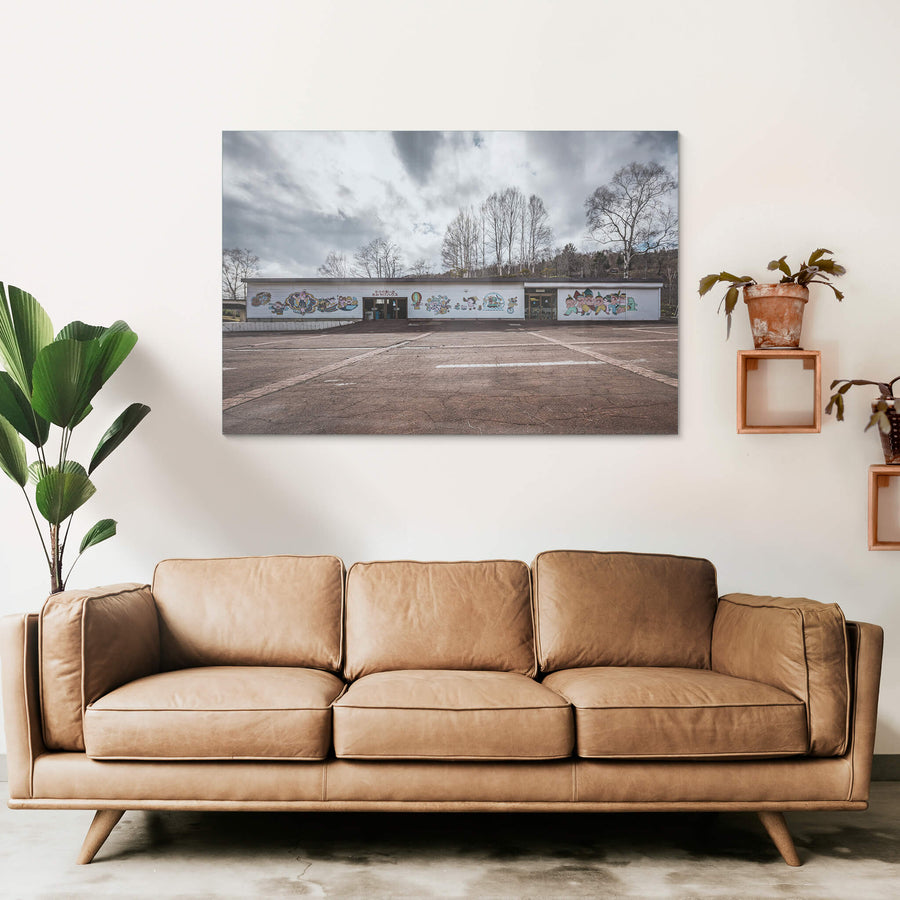
Cartoon murals cover the white rendered facade of a long, flat-roofed souvenir shop at Sekitan no Rekishi Mura in Yubari, the central entrance still marked by a sign reading たびの思い出 おみやげハウス. Bare deciduous trees rise above the roofline against a low, dark overcast sky. Cracked asphalt fills the foreground, the faint painted bay lines still visible across the empty car park.
Open edition
Printed to order, no fixed quantity. Each print is hand-signed by the photographer.
Limited edition
A fixed number of prints exist. Once sold, the edition closes permanently. Each print is individually numbered and signed.
Shipping Free shipping over $250. Ships worldwide, rates calculated at checkout.
Returns Damaged in transit? We replace it. Full policy →
Ships within 10 business days · signed & numbered
In situ


Print datasheet
- Title
- Gift Shop
- Series
- Streetscapes of Yubari
- Catalogue
- SYU-010
- Process
- Giclée
- Captured
- 28 April 2016
- Camera
- NIKON D810
- Lens
- 14.0-24.0 mm f/2.8
- Aperture
- f/8.0
- Shutter
- 1/500 s
- ISO
- 100
- Focal length
- 14 mm
- Paper
- Ilford Galerie Smooth Cotton Rag 310 gsm
- Paper size
- 297 × 210 mm
- Location
- Yubari, Hokkaido, Japan
- Authenticity
- C2PA verified provenance →
- Recognised by
- Highly Commended in Multimedia at the 2016 National Trust of Australia (NSW) Heritage Awards
Yubari, Hokkaido, Japan
Map · Mapbox · OpenStreetMap
About this print
A gift shop sits on the edge of an empty car park in Yubari, its white walls painted with cartoon murals that were once meant to draw visitors in from the road. The birch trees behind the roofline are bare, the sky heavy. Yubari staked its future on tourism after its last coal mine closed in 1990, building theme parks, ski resorts, and souvenir infrastructure across the city. When that bet collapsed along with the city's finances in 2007, the streetscape was left holding the evidence: closed shops, cracked car parks, and cheerful signage with nowhere left to point.
Brett Patman

The series
Streetscapes of Yubari
Yubari is a city in central Hokkaido, Japan, that grew up around its coal mines. Work to open the first mine began in April 1890, Yubari became a city in April 1943, and at one time it had 24 mines, large and small. Its registered population peaked at 116,908 in April 1960, and the last mine, Mitsubishi's Minami-Oyubari, closed in March 1990. The photographs, taken in 2016, are streetscapes across the city: shuttered shopfronts, hand-painted film signboards and the buildings of the Coal Mining History Village.
Print sizes
The anatomy view shows what this finish is as a physical object: paper margin, mat band, frame depth, acrylic profile. The comparison strip shows how each size sits relative to the others at true scale. Click a size or a finish to update both.
| Type | Size | Width | Height |
|---|


