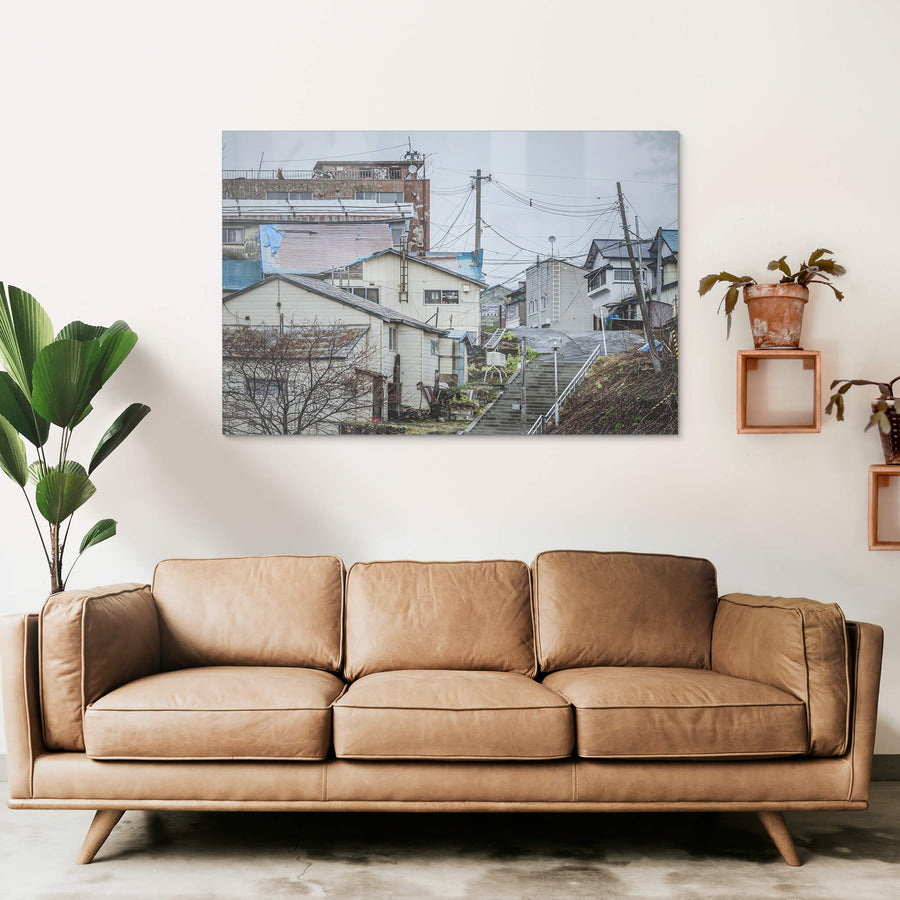
Haikara-zaka rises steeply through a dense press of weathered timber and corrugated-clad houses, a concrete staircase with a white metal railing tracing the slope past utility poles and a tangle of overhead wires. A blue tarp covers part of one roofline near the centre of the frame, and a bare deciduous tree fills the lower foreground. The slope leads up towards the city centre.
Edition
Open edition
Open edition Printed to order, no fixed quantity. Each print is hand-signed by the photographer.
Limited edition A fixed number of prints exist. Once sold, the edition closes permanently. Each print is individually numbered and signed.
$100.00 AUD
Size
Type
Colour
✓
Signed, numbered, with COA. Made to order in 5 to 10 business days (unframed). Shipped in protective packaging with edition certificate, paper-stock reference and a printed care guide.
Haikara-zaka is the slope that leads up toward the centre of Yubari City, in the Sorachi basin of central Hokkaido, roughly 60 kilometres east of Sapporo. The street's name carries a certain irony: "haikara" is a Japanese term derived from the English "high collar," used to describe something fashionable or Western-influenced. The slope rises steeply through a dense press of weathered timber and corrugated-clad houses, a concrete staircase with a white metal railing tracing the climb past utility poles and a tangle of overhead wires. A blue tarp covers part of one roofline near the centre of the frame, and a bare deciduous tree fills the lower foreground. Yubari was incorporated as a city on 1 April 1943, combining the existing town and surrounding settlements during wartime to increase coal output. At its peak in 1960, the national census recorded 107,972 residents. Between 24 and 30 mines operated across the basin at mid-century, employing a coal-mining workforce that reached approximately 19,500 at its height in 1953. The last coal mine, Mitsubishi Minami-Oyubari, closed on 30 March 1990, ending a century of extraction that had built every shopfront, housing block, and public building visible in the series. The city filed for fiscal rehabilitation on 6 March 2007 with debts of approximately 35.3 billion yen, becoming the only city in modern Japan to do so. In the years that followed, public toilets were closed permanently as a cost-cutting measure, services were consolidated, and the population continued to fall. By March 2026, approximately 5,707 residents remained. The architecture visible along Haikara-zaka is typical of Yubari's residential fabric: post-war Hokkaido vernacular, timber-frame construction with corrugated steel cladding and painted facades. Hokkaido winters deliver several metres of snowfall; in unoccupied buildings, the accumulated weight buckles roofs and drives water into timber frames, reshaping the streetscape year on year. What the 2016 photograph records is a hillside in the middle of that slow process, the houses still holding their form but packed against a slope emptied of the activity that once defined it.
04·FROM THE FIELD NOTES
Haikara-zaka rises steeply through a dense press of weathered timber and corrugated-clad houses.
Brett Patman
The series
Streetscapes of Yubari
2018 · 54
photographs
Yūbari is a coal-mining city in central Hokkaido. Founded in 1943, its population peaked at around 120,000 in the 1960s and now sits at about 6,400. The colliery closed in the 1980s. The city's attempt to recover through tourism failed; in 2007 it became the first Japanese municipality to declare bankruptcy, owing 35.3 billion yen. These streetscapes were taken between the houses, shops, and schools the town no longer needs - most empty, some half-collapsed, some still in use by the people who stayed.
The anatomy view shows what this finish is as a physical object: paper margin, mat band, frame depth, acrylic profile. The comparison strip shows how each size sits relative to the others at true scale. Click a size or a finish to update both.