Jirochofuji And Mabutanohaha

Provenance

Camera
NIKON D810
Lens
14.0-24.0 mm f/2.8
Settings
17mm · f/8.0 · 1/500 · ISO 100
Paper
Ilford Galerie Smooth Cotton Rag 310 gsm

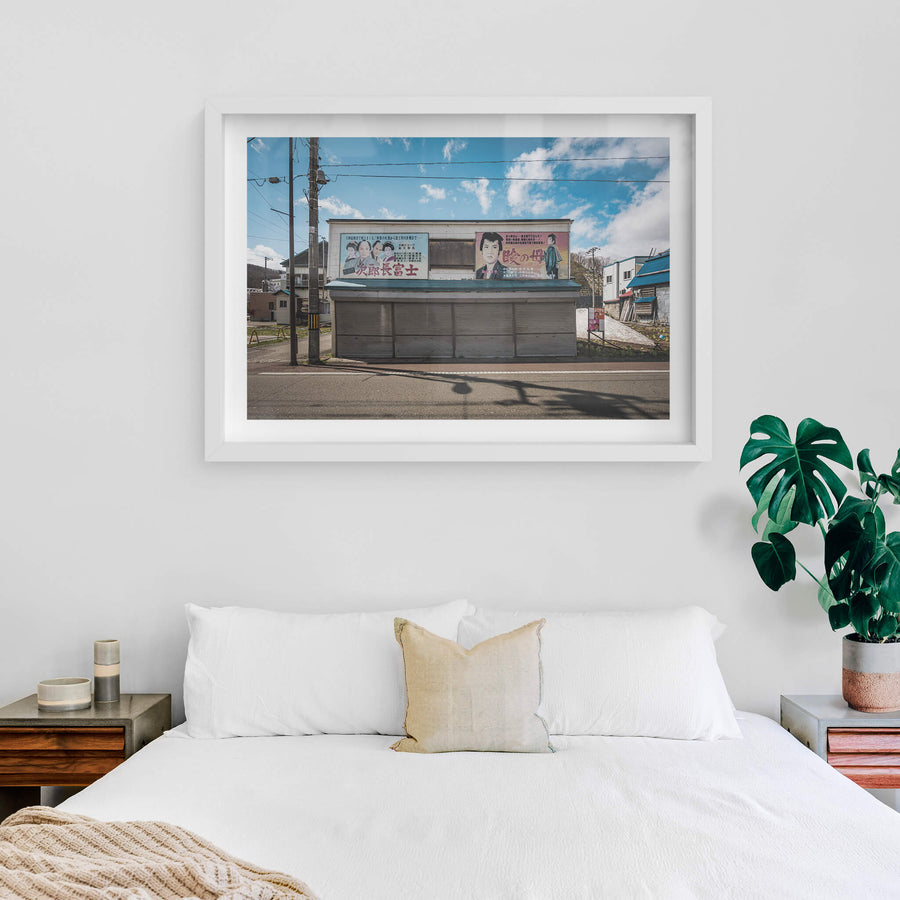
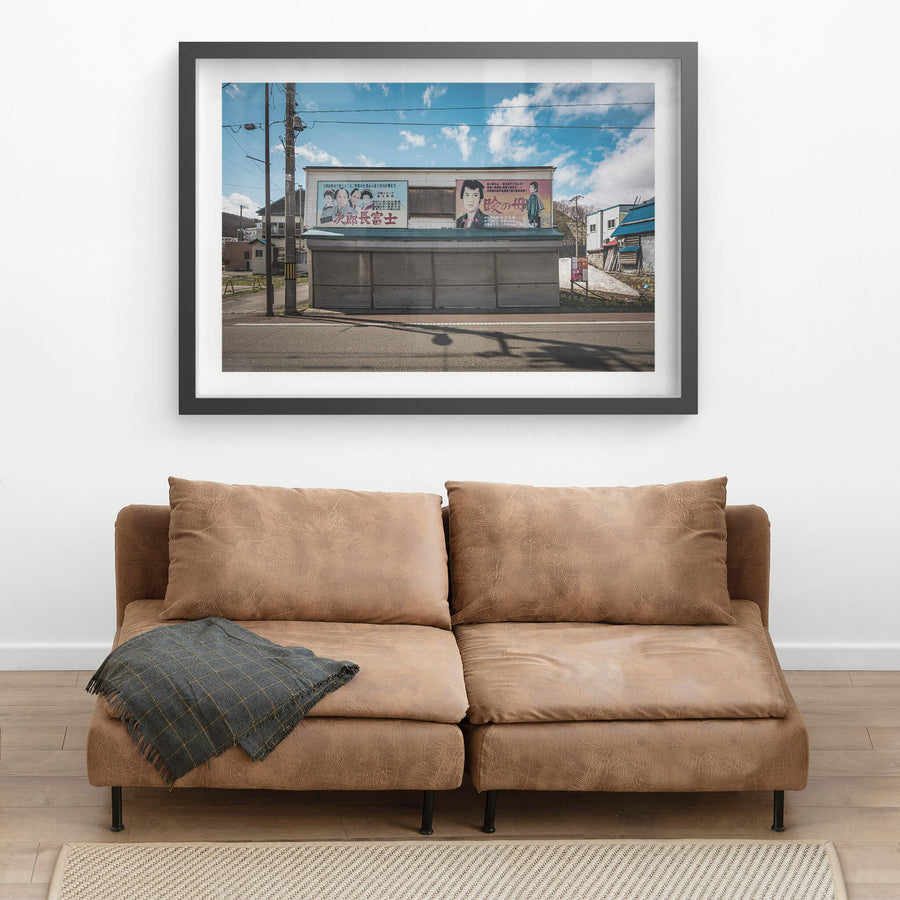
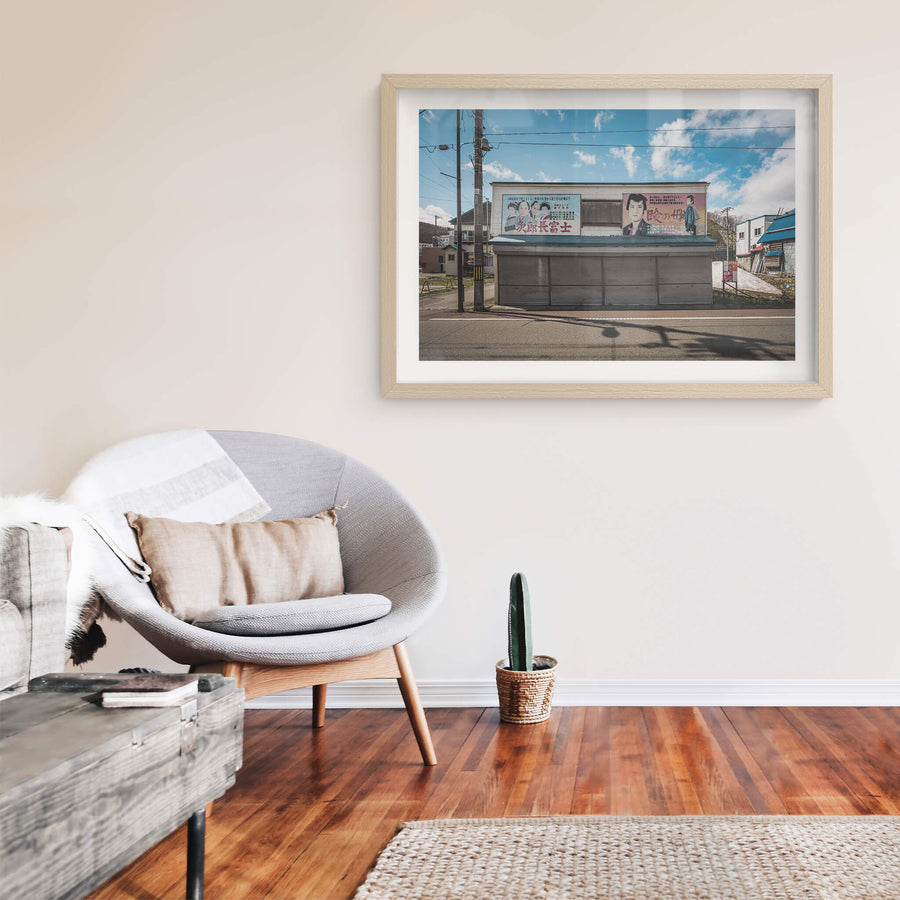
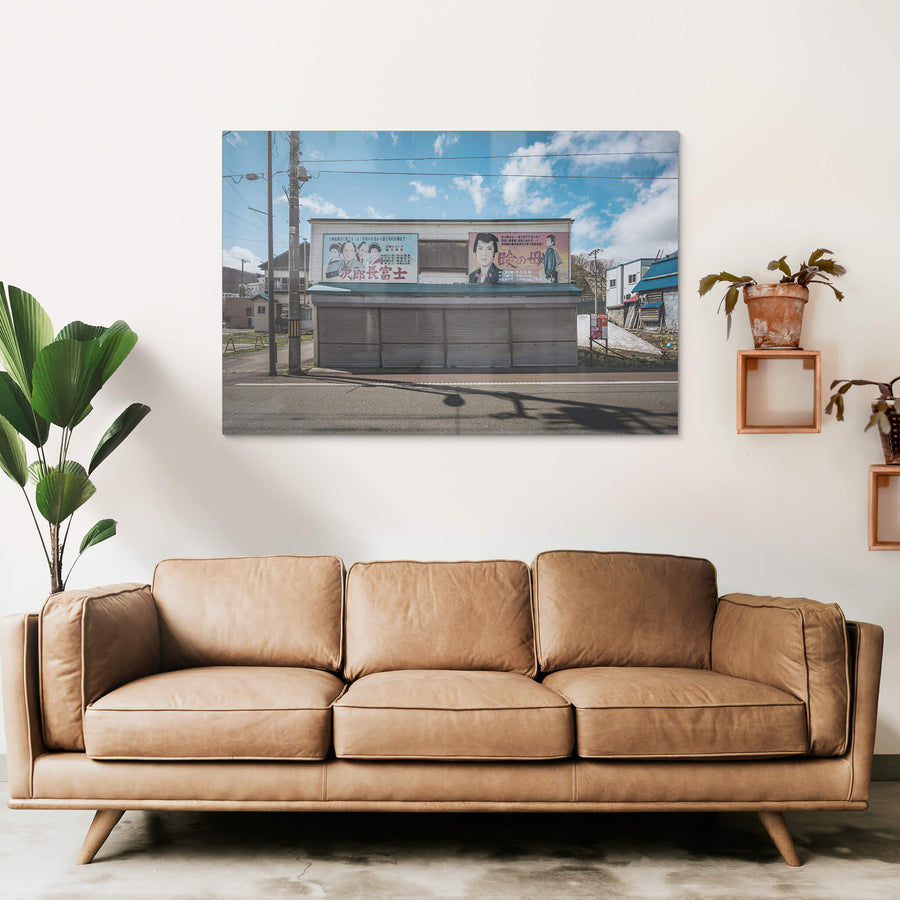
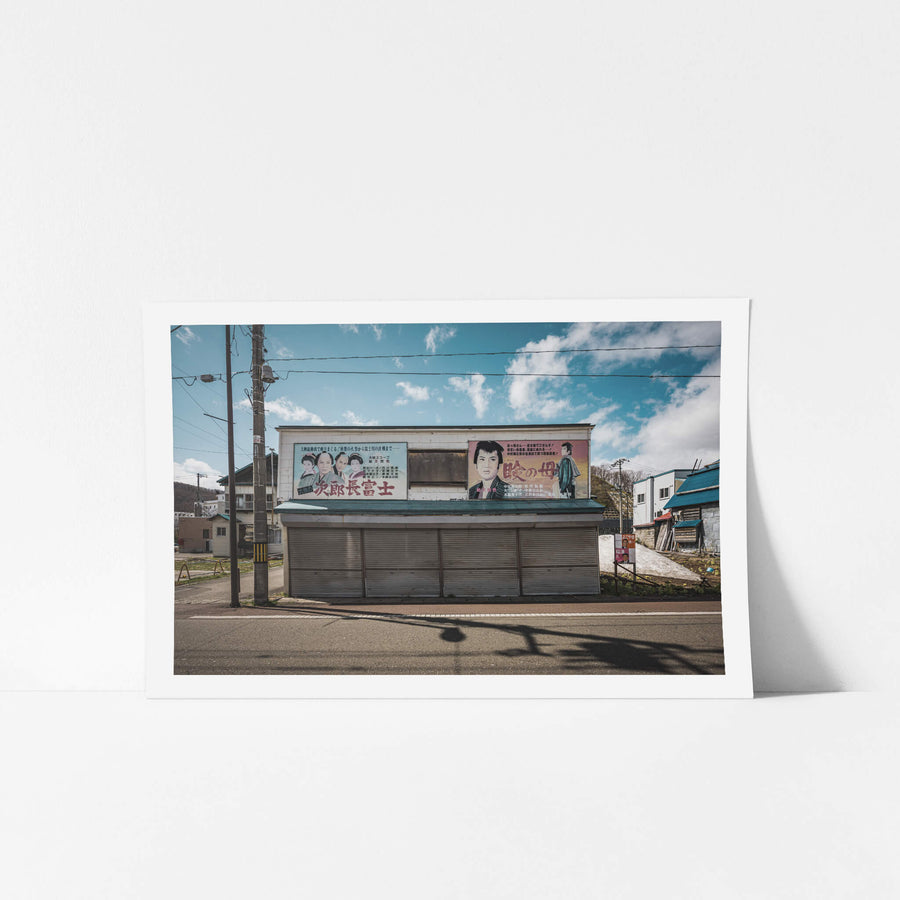
Paired hand-painted billboards for the films Jirochou Fuji and Mabuta no Haha fill the upper facade of a shuttered shopfront on the Yubari Kinema Kaido, the city's hand-painted cinema street. Corrugated roll-down shutters cover the full width of the ground level, and a utility pole throws a long diagonal shadow across the asphalt. Overhead wires cross the frame.

Edition
Open edition

Open edition
Printed to order, no fixed quantity. Each print is hand-signed by the photographer.

Limited edition
A fixed number of prints exist. Once sold, the edition closes permanently. Each print is individually numbered and signed.

$100.00 AUD
Size
Type
Colour
Signed, numbered, with COA. Made to order in 5 to 10 business days (unframed). Shipped in protective packaging with edition certificate, paper-stock reference and a printed care guide.
See certificate sample →

Shipping Free shipping over $250. Ships worldwide, rates calculated at checkout.

Returns Damaged in transit? We replace it. Full policy →

Ships within 10 business days · signed & numbered

In situ
Jirochofuji And Mabutanohaha at Streetscapes of Yubari, unframed print displayed in situ on a wall.Jirochofuji And Mabutanohaha at Streetscapes of Yubari, white-framed print displayed in situ on a wall.Jirochofuji And Mabutanohaha at Streetscapes of Yubari, black-framed print displayed in situ on a wall.Jirochofuji And Mabutanohaha at Streetscapes of Yubari, raw timber-framed print displayed in situ on a wall.Jirochofuji And Mabutanohaha at Streetscapes of Yubari, glass print displayed in situ on a wall.
01 PROVENANCE

Print datasheet

Title
Jirochofuji And Mabutanohaha
Series
Streetscapes of Yubari
Catalogue
SYU-015
Process
Giclée
Captured
28 April 2016
Camera
NIKON D810
Lens
14.0-24.0 mm f/2.8
Aperture
f/8.0
Shutter
1/500 s
ISO
100
Focal length
17 mm
Paper
Ilford Galerie Smooth Cotton Rag 310 gsm
Paper size
290 × 200 mm
Location
Yubari, Hokkaido, Japan
Recognised by
Highly Commended in Multimedia at the 2016 National Trust of Australia (NSW) Heritage Awards
02 LOCATION

Yubari, Hokkaido, Japan

Map · Mapbox · OpenStreetMap

03 THE STORY

About this print

Paired hand-painted billboards fill the upper facade of a shuttered shopfront on the Yubari Kinema Kaido, the city's hand-painted cinema street. They advertise the films Jirochou Fuji and Mabuta no Haha. Corrugated roll-down shutters cover the full width of the ground level, a utility pole throws a long diagonal shadow across the asphalt, and overhead wires cross the frame. The painted surfaces are worn, marked by decades of Hokkaido winters and the particular kind of neglect that comes after a city has lost most of its reason to stay occupied. Coal was discovered in the Yubari basin in 1888, when geologist Ichitaro Ban, a protege of American surveyor Benjamin Smith Lyman, identified the major seam that would define the city. Mining commenced between 1890 and 1892 under the Hokkaido Colliery and Railway Company, and the industry grew for most of the century that followed. The workforce across the city's mines peaked at close to 19,500 miners in 1953. At that point, Yubari was a functioning industrial city of more than 100,000 people. Japan's shift from coal to oil began around 1960 and the mines closed one by one through the following three decades. The last, Mitsubishi Minami-Oyubari Mine, closed on 30 March 1990. In the years between peak population and closure, the city lost more than 80,000 residents. By the 2000 national census, 14,791 people remained. In 2007, Yubari filed for fiscal rehabilitation with a debt of approximately 35.3 billion yen. In 2010, the national census recorded 10,922 residents. What the photograph records is the weight of that arc on a shopfront that closed and a pair of painted boards that stayed up. The billboards are still there. The city around them, its mines sealed, its workforce dispersed, its tourism gamble long since spent, continues in a reduced form. As of March 2026, approximately 5,707 people remain.

04 FROM THE FIELD NOTES

Paired hand-painted billboards for the films Jirochou Fuji and Mabuta no Haha fill the upper facade of a shuttered shopfront on the Yubari Kinema Kaido.

Brett Patman

Streetscapes of Yubari

The series

Streetscapes of Yubari

2018 · 54 photographs

Yūbari is a coal-mining city in central Hokkaido. Founded in 1943, its population peaked at around 120,000 in the 1960s and now sits at about 6,400. The colliery closed in the 1980s. The city's attempt to recover through tourism failed; in 2007 it became the first Japanese municipality to declare bankruptcy, owing 35.3 billion yen. These streetscapes were taken between the houses, shops, and schools the town no longer needs - most empty, some half-collapsed, some still in use by the people who stayed.

View all in this series →

05 SIZE GUIDE

Print sizes

The anatomy view shows what this finish is as a physical object: paper margin, mat band, frame depth, acrylic profile. The comparison strip shows how each size sits relative to the others at true scale. Click a size or a finish to update both.

Anatomy · true ratio
TypeSizeWidthHeight
08 BY POST · NO SPAM

Read the full story

Articles when they're published. The history behind a place. The day of a shoot. The work between prints. No marketing, no schedule.

You're subscribed.