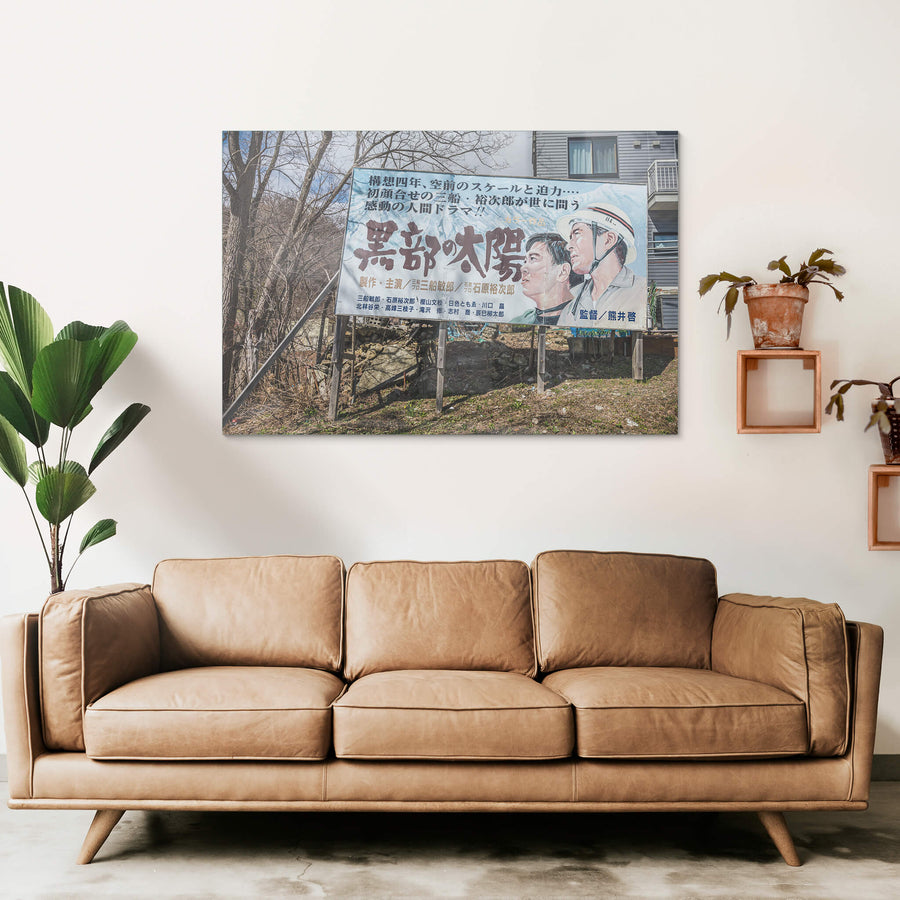
Painted portraits of Toshiro Mifune and Yujiro Ishihara fill a large hand-painted billboard on a grassy slope in Yubari, advertising the 1968 film Kurobe no Taiyo alongside the director's name in faded Japanese text. Wooden support posts lean into the hillside, half buried in overgrown grass and scattered rocks. A grey residential building is visible through bare trees at the upper right.
Edition
Open edition
Open edition Printed to order, no fixed quantity. Each print is hand-signed by the photographer.
Limited edition A fixed number of prints exist. Once sold, the edition closes permanently. Each print is individually numbered and signed.
$100.00 AUD
Size
Type
Colour
✓
Signed, numbered, with COA. Made to order in 5 to 10 business days (unframed). Shipped in protective packaging with edition certificate, paper-stock reference and a printed care guide.
Painted portraits of Toshiro Mifune and Yujiro Ishihara fill a large hand-painted billboard on a grassy slope in Yubari, Hokkaido, advertising the 1968 film Kurobe no Taiyo alongside the director's name in faded Japanese text. Wooden support posts lean into the hillside, half buried in overgrown grass and scattered rocks. A grey residential building is visible through bare trees at the upper right. Yubari sits in central Hokkaido, approximately 60 kilometres east of Sapporo. Coal was discovered in the basin in 1888, and mining began in earnest by the early 1890s under the Hokkaido Colliery and Railway Company. At the 1960 national census, the city recorded a population of 107,972, supported by as many as 30 operating mines and a workforce that peaked at around 19,500 miners in 1953. The energy policy shift from coal to oil that began in 1960 set the decline in motion. Mine closures followed through the 1970s and 1980s, and Mitsubishi Minami-Oyubari Mine, the last coal operation in Yubari, closed on 30 March 1990, ending a century of extraction. The city attempted to replace coal with tourism through the 1980s and 1990s, borrowing to build theme parks, hotels, and a film festival. The Yubari International Fantastic Film Festival launched in February 1990. The debt those investments accumulated, combined with falling tax revenue and a population that kept leaving, produced a fiscal crisis. Yubari filed for rehabilitation on 6 March 2007, carrying approximately 35.3 billion yen in debt, and became the only city in modern Japan to do so. By the 2010 census, the population stood at 10,922. The streets photographed here in 2016 reflect that arithmetic: buildings still standing, signs still attached, but the activity that once filled them long gone. Yubari's post-industrial streetscape is as much the product of Hokkaido's winters as its economics. Unheated through successive cold seasons, timber-frame structures absorb the weight of accumulated snow, buckle, and slowly give way. The ones that remain upright carry the evidence of that pressure in their walls and rooflines. Brett photographed this signboard in 2016 as part of the Streetscapes of Yubari series, documenting the city's commercial and residential fabric before further winters and further consolidation change it again.
04·FROM THE FIELD NOTES
Painted portraits of Toshiro Mifune and Yujiro Ishihara fill a large hand-painted billboard on a grassy slope in Yubari.
Brett Patman
The series
Streetscapes of Yubari
2018 · 54
photographs
Yūbari is a coal-mining city in central Hokkaido. Founded in 1943, its population peaked at around 120,000 in the 1960s and now sits at about 6,400. The colliery closed in the 1980s. The city's attempt to recover through tourism failed; in 2007 it became the first Japanese municipality to declare bankruptcy, owing 35.3 billion yen. These streetscapes were taken between the houses, shops, and schools the town no longer needs - most empty, some half-collapsed, some still in use by the people who stayed.
The anatomy view shows what this finish is as a physical object: paper margin, mat band, frame depth, acrylic profile. The comparison strip shows how each size sits relative to the others at true scale. Click a size or a finish to update both.