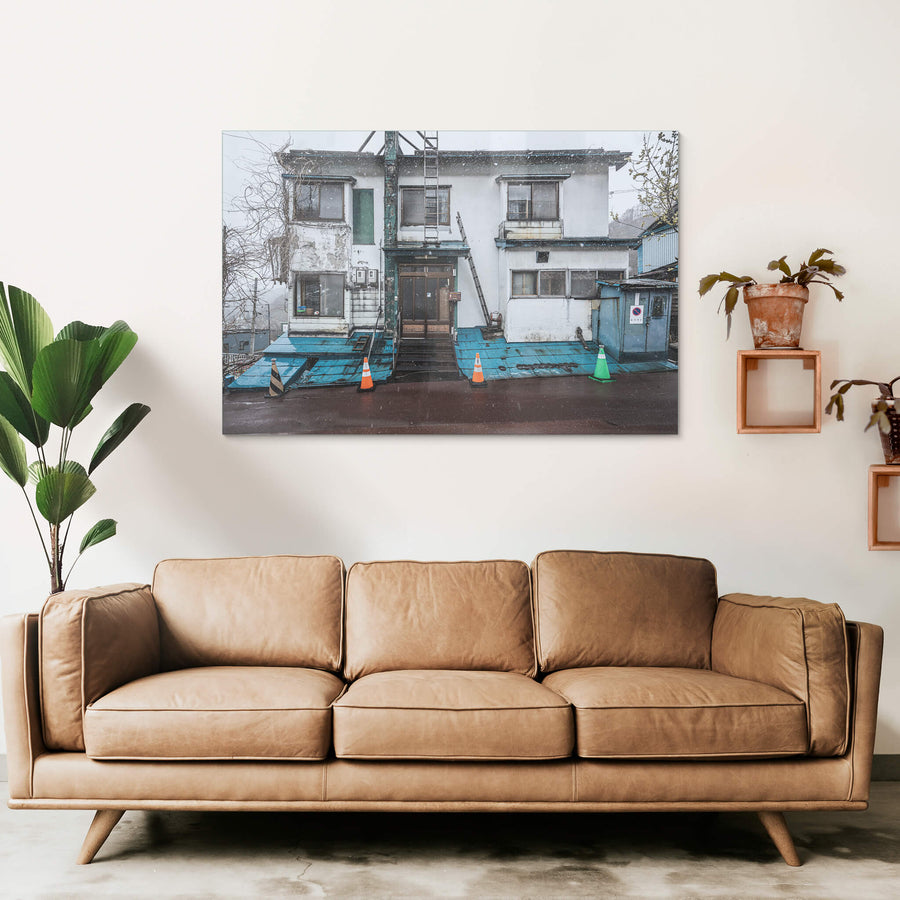
Three traffic cones, one striped black and yellow, one orange and one green, occupy the wet ground in front of a derelict white building at Hon-cho 4-chome, Yubari, its blue-tiled roof dusted with snow. Two ladders lean against the facade, and bare vines have taken hold along the left wall, pulling at peeling paint that reveals darker layers beneath. A small blue shed sits at the far right.
Edition
Open edition
Open edition Printed to order, no fixed quantity. Each print is hand-signed by the photographer.
Limited edition A fixed number of prints exist. Once sold, the edition closes permanently. Each print is individually numbered and signed.
$100.00 AUD
Size
Type
Colour
✓
Signed, numbered, with COA. Made to order in 5 to 10 business days (unframed). Shipped in protective packaging with edition certificate, paper-stock reference and a printed care guide.
Three traffic cones, one striped black and yellow, one orange and one green, occupy the wet ground in front of a derelict white building at Hon-cho 4-chome, Yubari, its blue-tiled roof dusted with snow. Two ladders lean against the facade, and bare vines have taken hold along the left wall, pulling at peeling paint that reveals darker layers beneath. A small blue shed sits at the far right. Yubari sits roughly 60 kilometres east of Sapporo in central Hokkaido. Coal was discovered in the basin in 1888, and mining commenced under the Hokkaido Colliery and Railway Company by the early 1890s. Over the following decades, the city grew into one of Hokkaido's largest industrial centres, recording a population of 107,972 at the 1960 national census. At the industry's mid-century peak, between 24 and 30 mines were operating across the basin, and the coal workforce across the city reached approximately 19,500 miners in 1953. The energy policy shift from coal to oil began in the 1960s. Mines closed through the following three decades, and the last, Mitsubishi Minami-Oyubari Mine, ceased production on 30 March 1990, ending a century of extraction. The population that had built up around the industry could not be replaced by anything else. By the 1990 census, the city had fewer than 21,000 residents. By 2020, fewer than 7,500. The March 2026 city estimate puts the figure at approximately 5,700. The residential buildings left behind are timber-frame structures clad in corrugated steel or painted weatherboards, most built between the 1920s and the 1960s for mining workers and their families. In occupied buildings, winter heating prevents snow loads from accumulating unchecked on roofs. In abandoned ones, several metres of Hokkaido snowfall bear down on the structure each year, buckling roofs and driving water into the timber frame. In this house, vegetation has taken a different role. The vines have worked along one wall from the outside, pulling at the paint rather than bringing the roof down. This photograph was made in 2016, when Yubari's population had already fallen below 10,000. The city had filed for fiscal rehabilitation in 2007 under a debt of approximately 35.3 billion yen. The streetscape that surrounds this house is one that had been contracting for decades before Brett photographed it.
04·FROM THE FIELD NOTES
Three traffic cones, one striped black and yellow, one orange and one green, occupy the wet ground in front of a derelict white building at Hon-cho 4-chome.
Brett Patman
The series
Streetscapes of Yubari
2018 · 54
photographs
Yūbari is a coal-mining city in central Hokkaido. Founded in 1943, its population peaked at around 120,000 in the 1960s and now sits at about 6,400. The colliery closed in the 1980s. The city's attempt to recover through tourism failed; in 2007 it became the first Japanese municipality to declare bankruptcy, owing 35.3 billion yen. These streetscapes were taken between the houses, shops, and schools the town no longer needs - most empty, some half-collapsed, some still in use by the people who stayed.
The anatomy view shows what this finish is as a physical object: paper margin, mat band, frame depth, acrylic profile. The comparison strip shows how each size sits relative to the others at true scale. Click a size or a finish to update both.