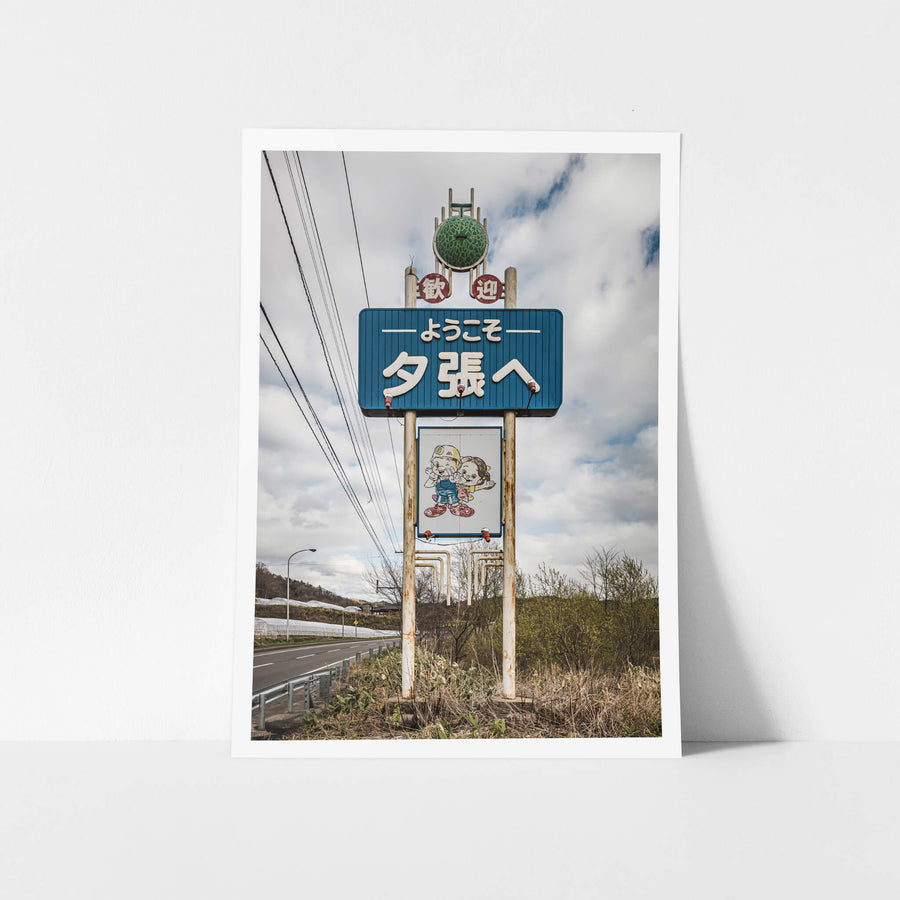
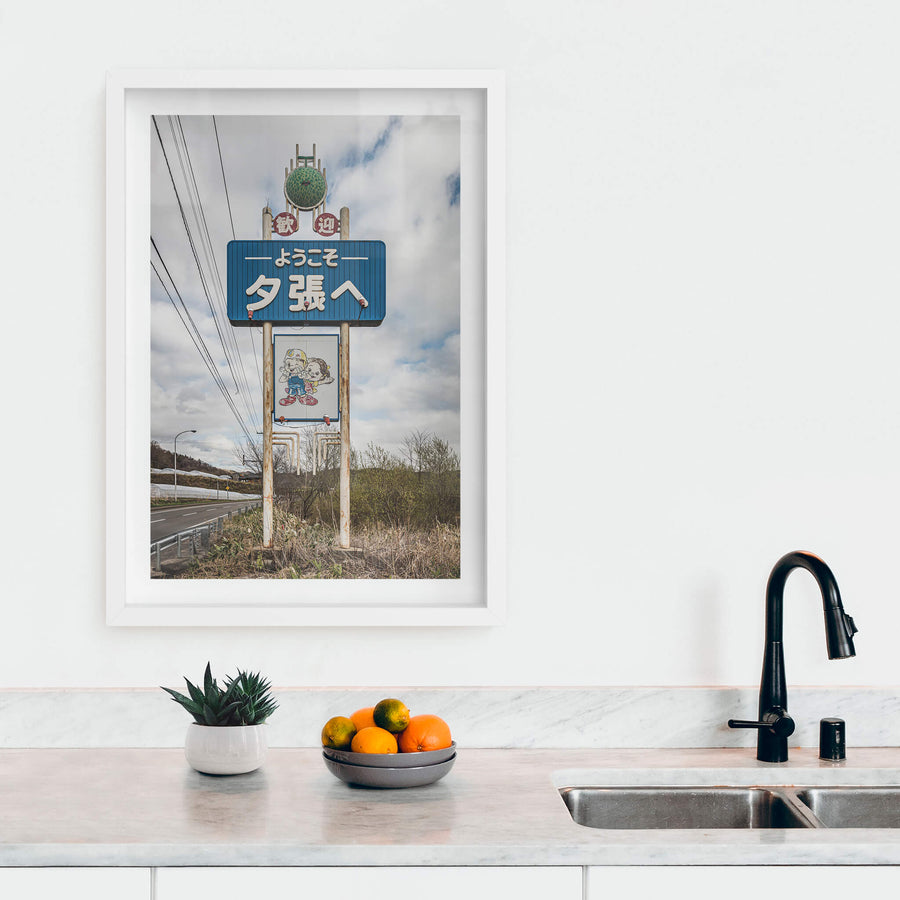
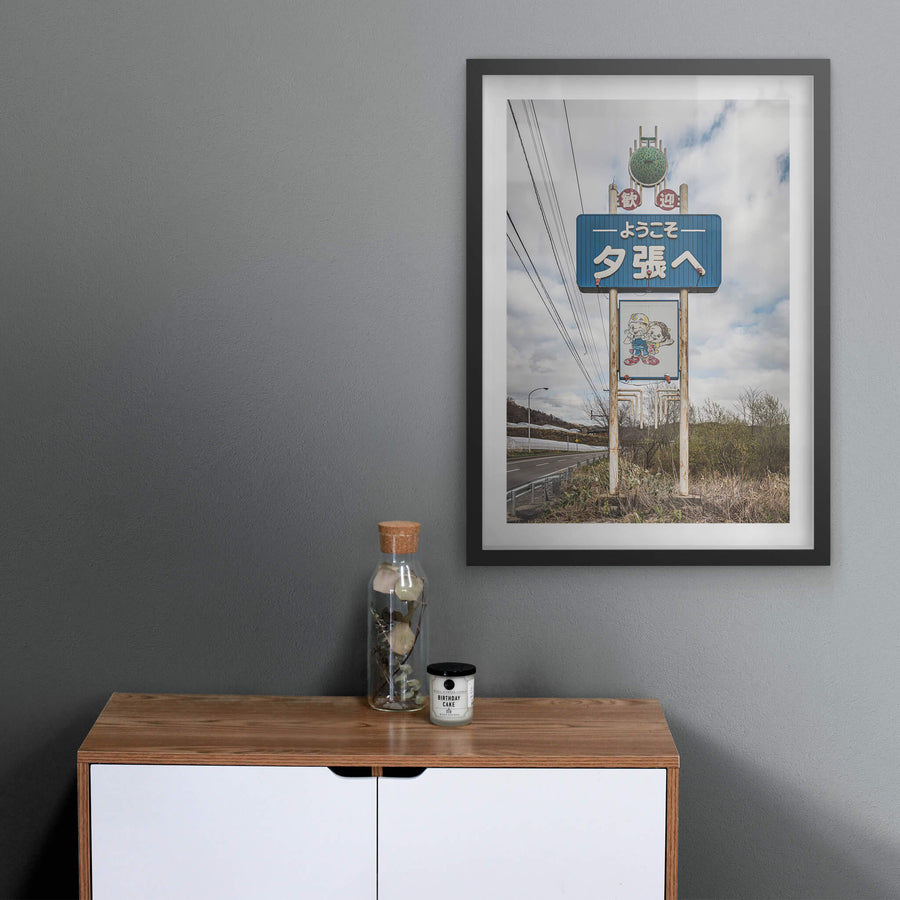
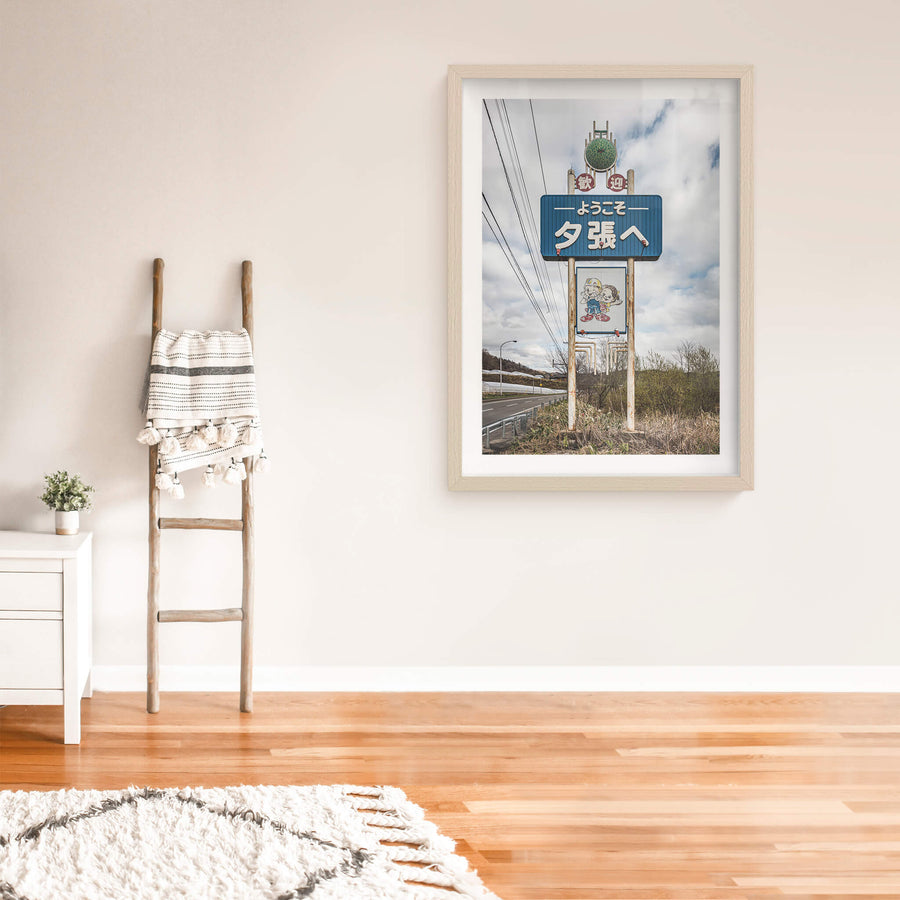
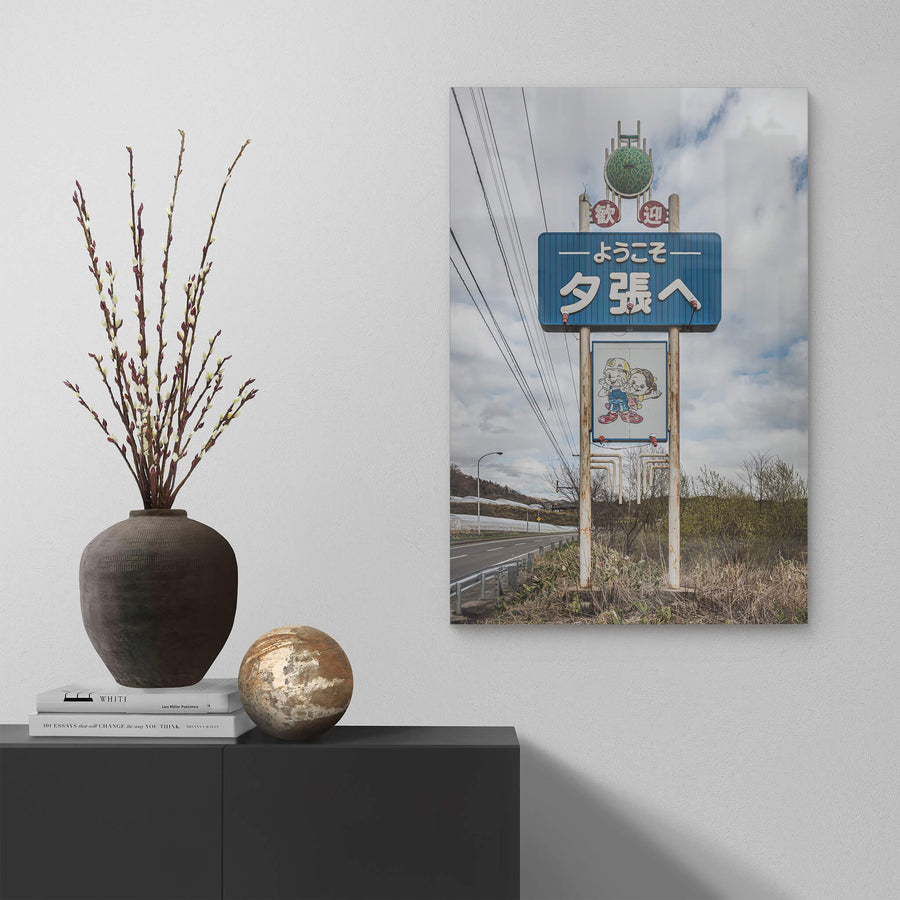
Blue roadside signage carries a greeting to the city in large white text, with red characters flanking a cartoon boy in a hard hat and a girl making a peace sign, both mascots from Sekitan no Rekishi Mura. A green melon sculpture crowns the rusted support poles above, marking the Yubari King melon grown in the surrounding district. Power lines cut diagonally across flat grey sky.
Edition
Open edition
Open edition Printed to order, no fixed quantity. Each print is hand-signed by the photographer.
Limited edition A fixed number of prints exist. Once sold, the edition closes permanently. Each print is individually numbered and signed.
$100.00 AUD
Size
Type
Colour
✓
Signed, numbered, with COA. Made to order in 5 to 10 business days (unframed). Shipped in protective packaging with edition certificate, paper-stock reference and a printed care guide.
Blue roadside signage carries a greeting to Yubari City in central Hokkaido in large white text, with red characters flanking a cartoon boy in a hard hat and a girl making a peace sign, both mascots from Sekitan no Rekishi Mura. A green melon sculpture crowns the rusted support poles above, marking the Yubari King melon grown in the surrounding district. Power lines cut diagonally across flat grey sky. Coal was discovered in the Yubari basin in 1888, and commercial extraction began under the Hokkaido Colliery and Railway Company in the early 1890s. The industry expanded steadily through the first half of the twentieth century, drawing workers from across Japan. Yubari was incorporated as a city on 1 April 1943. By 1953, roughly 19,500 miners were working across the city's operations. The 1960 national census recorded a population of 107,972. Then Japan's energy policy shifted from coal to oil. Mines closed across the Sorachi coalfields through the 1970s and 1980s, each closure taking workers and their families with it. The last coal mine in Yubari, Mitsubishi Minami-Oyubari Mine, closed on 30 March 1990, ending a century of extraction. The city attempted to replace coal with tourism, borrowing heavily to build theme parks, ski resorts, and hotels through the 1980s and 1990s. The bet did not pay off. On 6 March 2007, Yubari filed for fiscal rehabilitation under Japan's Local Finance Rehabilitation Act, carrying a debt of approximately 35.3 billion yen. It became the only city in modern Japan to do so. The entrance sign in this photograph was part of the infrastructure of a city that was still, formally, open. Yubari had living residents, a functioning government, melon farms operating in the southern plains, and a ski resort still drawing visitors. But the 2020 national census would record a population of 7,334, and the decline has continued since. The rust on the support poles is not decoration. Hokkaido winters deliver several metres of snowfall. In unheated or neglected structures, the weight and moisture of that snow buckle steel, rot timber, and work year on year until the building or the sign or the welcome itself is no longer readable.
04·FROM THE FIELD NOTES
Blue roadside signage carries a greeting to the city in large white text.
Brett Patman
The series
Streetscapes of Yubari
2018 · 54
photographs
Yūbari is a coal-mining city in central Hokkaido. Founded in 1943, its population peaked at around 120,000 in the 1960s and now sits at about 6,400. The colliery closed in the 1980s. The city's attempt to recover through tourism failed; in 2007 it became the first Japanese municipality to declare bankruptcy, owing 35.3 billion yen. These streetscapes were taken between the houses, shops, and schools the town no longer needs - most empty, some half-collapsed, some still in use by the people who stayed.
The anatomy view shows what this finish is as a physical object: paper margin, mat band, frame depth, acrylic profile. The comparison strip shows how each size sits relative to the others at true scale. Click a size or a finish to update both.