
Signage
Provenance
- Camera
- NIKON D850
- Lens
- 70.0-200.0 mm f/2.8
- Settings
- 200mm · f/8.0 · 1/200 · ISO 180
- Paper
- Ilford Galerie Smooth Cotton Rag 310 gsm
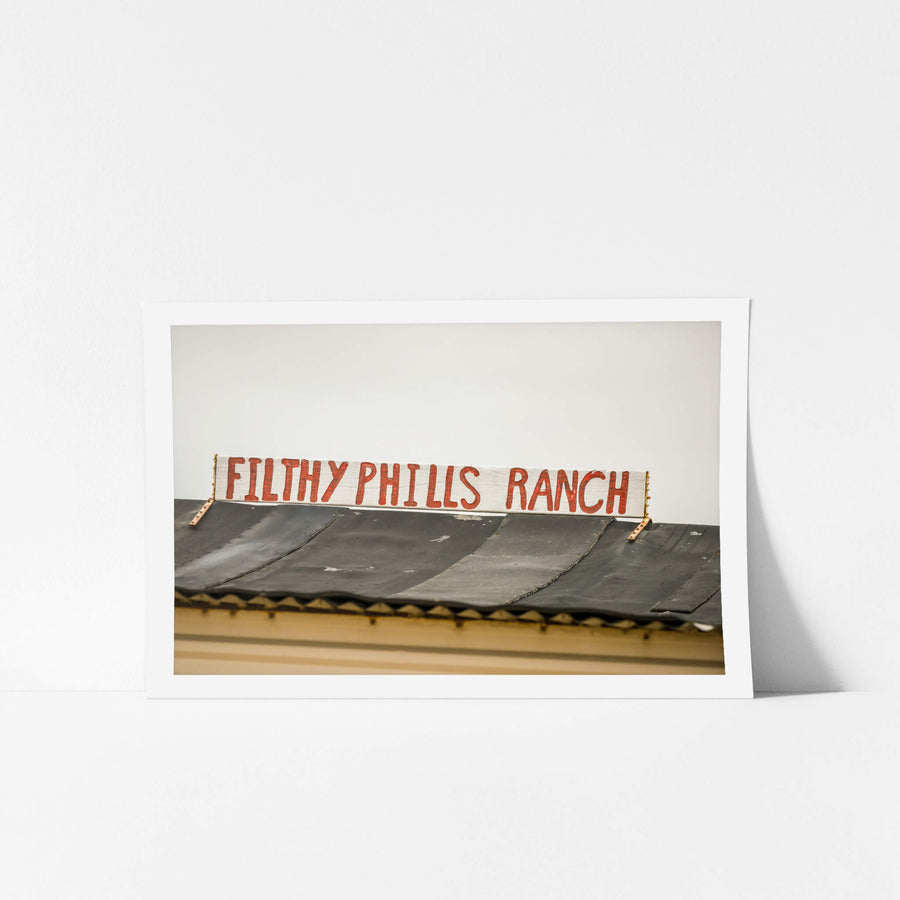
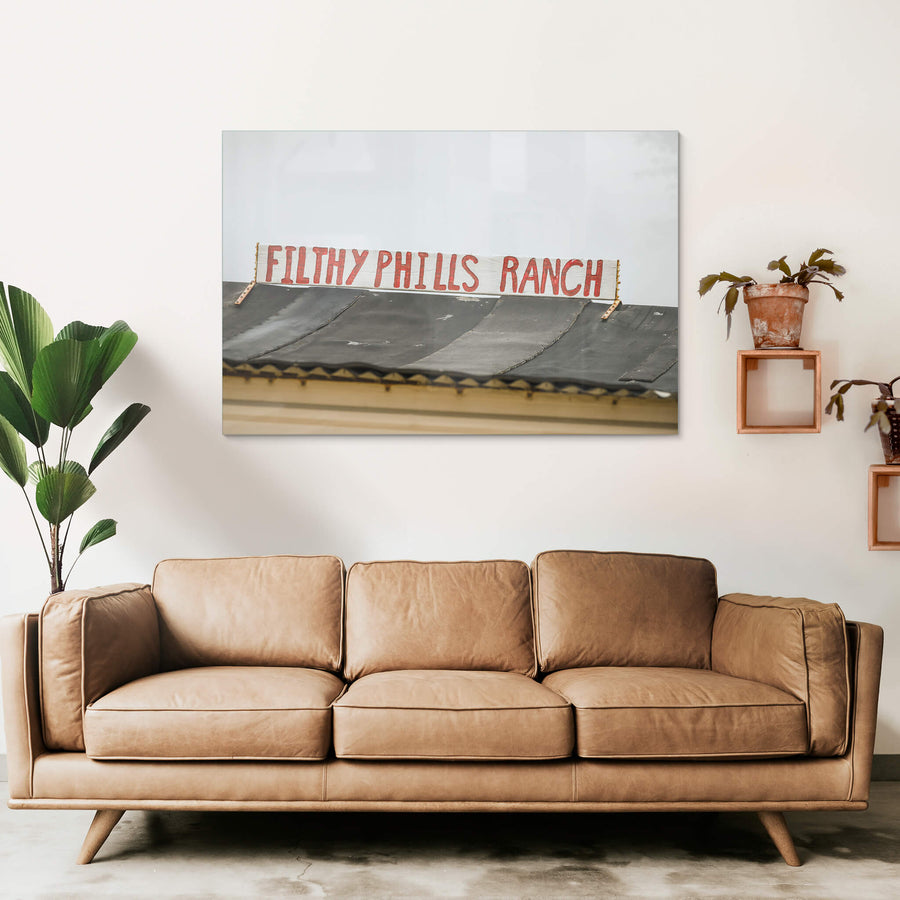
Faded red lettering on a weathered board reads Filthy Phills Ranch, fixed to a roofline at Tin City. This collection of shacks in the Stockton Bight sand dunes, New South Wales, began with two tin sheds erected in the late 19th century to hold provisions for shipwrecked sailors.
Open edition
Printed to order, no fixed quantity. Each print is hand-signed by the photographer.
Limited edition
A fixed number of prints exist. Once sold, the edition closes permanently. Each print is individually numbered and signed.
Shipping Free shipping over $250. Ships worldwide, rates calculated at checkout.
Returns Damaged in transit? We replace it. Full policy →
Ships within 10 business days · signed & numbered
In situ
Print datasheet
- Title
- Signage
- Series
- Tin City
- Catalogue
- TCI-015
- Process
- Giclée
- Captured
- 31 January 2018
- Camera
- NIKON D850
- Lens
- 70.0-200.0 mm f/2.8
- Aperture
- f/8.0
- Shutter
- 1/200 s
- ISO
- 180
- Focal length
- 200 mm
- Paper
- Ilford Galerie Smooth Cotton Rag 310 gsm
- Paper size
- 297 × 210 mm
- Location
- Anna Bay, New South Wales, Australia
- Authenticity
- C2PA verified provenance →
- Recognised by
- Highly Commended in Multimedia at the 2016 National Trust of Australia (NSW) Heritage Awards
Anna Bay, New South Wales, Australia
Map · Mapbox · OpenStreetMap
About this print
Faded red lettering on a weathered board reads Filthy Phills Ranch, fixed to a roofline at Tin City.
Brett Patman

The series
Tin City
Two tin sheds were put up on the Stockton Bight dunes in the late nineteenth century to hold provisions for sailors shipwrecked on the beach. During the Great Depression a group of squatters built a series of shacks around them. The settlement that grew became Tin City, on Worimi country, in the largest mobile coastal sand mass in the Southern Hemisphere.
Print sizes
The anatomy view shows what this finish is as a physical object: paper margin, mat band, frame depth, acrylic profile. The comparison strip shows how each size sits relative to the others at true scale. Click a size or a finish to update both.
| Type | Size | Width | Height |
|---|


