
Downtown
Provenance
- Camera
- NIKON D810
- Lens
- 14.0-24.0 mm f/2.8
- Settings
- 14mm · f/9.0 · 1/640 · ISO 100
- Paper
- Ilford Galerie Smooth Cotton Rag 310 gsm
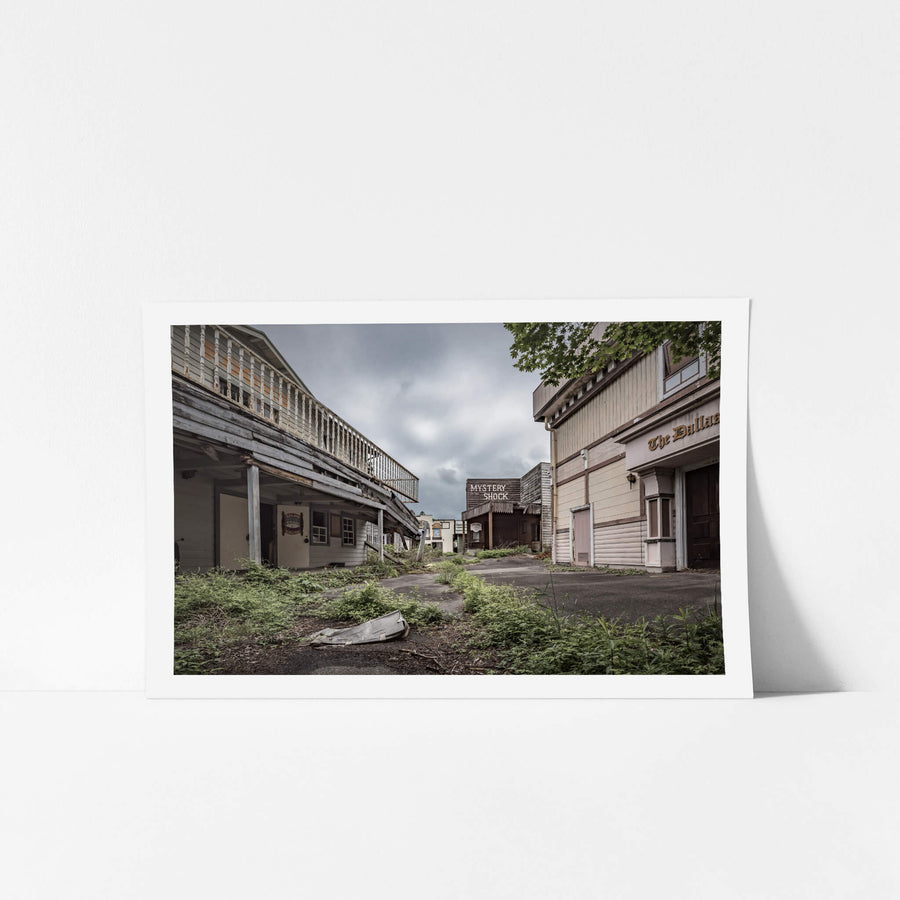
A row of weathered timber false-front facades runs the length of the park's main street. Dust coats the painted surfaces. Faded signs hang above doorways that stand open or empty. Natural light falls across the street from above, revealing peeling paint and settled grime on the building fronts.
Open edition
Printed to order, no fixed quantity. Each print is hand-signed by the photographer.
Limited edition
A fixed number of prints exist. Once sold, the edition closes permanently. Each print is individually numbered and signed.
Shipping Free shipping over $250. Ships worldwide, rates calculated at checkout.
Returns Damaged in transit? We replace it. Full policy →
Ships within 10 business days · signed & numbered
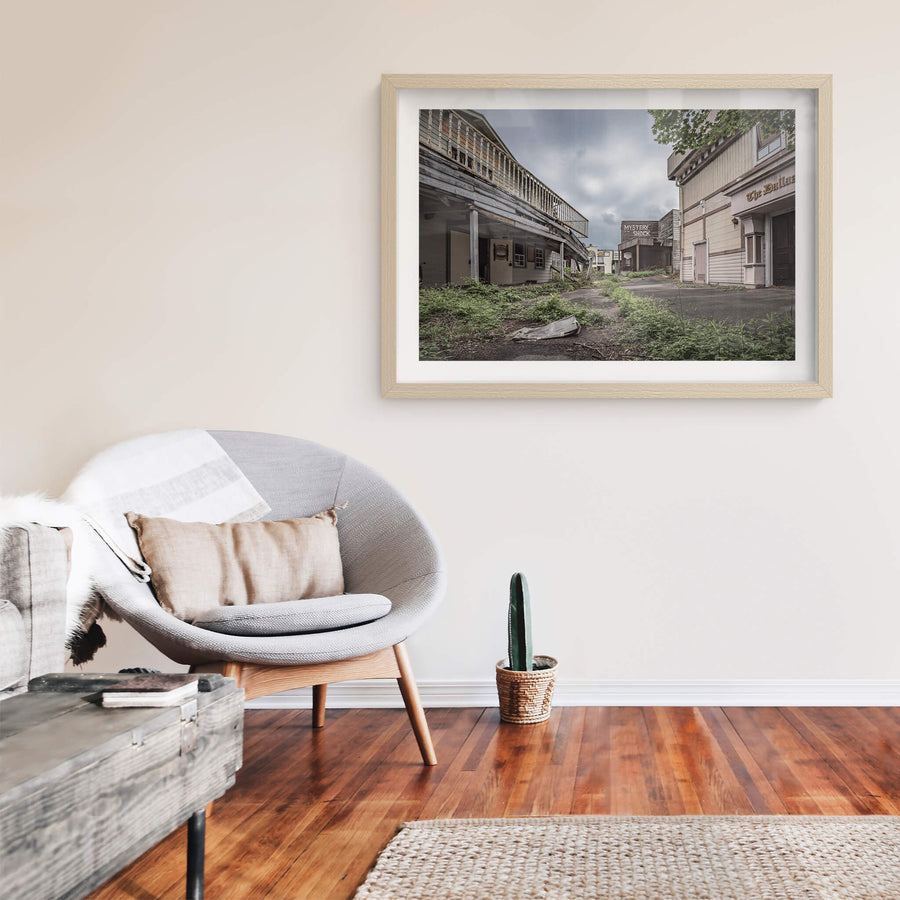
In situ



Print datasheet
- Title
- Downtown
- Series
- Western Village
- Catalogue
- WVI-018
- Process
- Giclée
- Captured
- 19 February 2014
- Camera
- NIKON D810
- Lens
- 14.0-24.0 mm f/2.8
- Aperture
- f/9.0
- Shutter
- 1/640 s
- ISO
- 100
- Focal length
- 14 mm
- Paper
- Ilford Galerie Smooth Cotton Rag 310 gsm
- Paper size
- 297 × 210 mm
- Location
- Nikko, Tochigi, Japan
- Authenticity
- C2PA verified provenance →
- Recognised by
- Highly Commended in Multimedia at the 2016 National Trust of Australia (NSW) Heritage Awards
Nikko, Tochigi, Japan
Map · Mapbox · OpenStreetMap
About this print
The main street of Western Village in Nikko was built with timber false-fronts replicating 1880s American frontier architecture: saloon, bank, barbershop, sheriff's office, chapel. Opened as Kinugawa Family Ranch by the Ōminami family, the park was rebranded in March 1982 and expanded steadily until the 1995 opening of American Dream Land. Debt acquired by Nissin Debt Collection led to a court order in September 2006 to auction the land and buildings. The park closed on 7 December 2006 and never reopened. By 2014, dust had settled across every surface.
Brett Patman

The series
Western Village
Western Village began life in the 1970s as Kinugawa Family Ranch, a family-owned country camp near Nikkō in Tochigi Prefecture. In 1982 it became a Western American themed amusement park: replica saloon, hotel, barbershop, bank, blacksmith, sheriff's office, chapel, two haunted houses, and a "Mystery Shock" with slanted interiors. Animatronic figures populated the buildings; live shows included whip cracking and apple-shooting. At its peak it drew close to a million visitors a year. Continuing investment outpaced revenue; the entrance fee was cut from ¥2,300 to ¥1,500 with little effect. In September 2006 the Utsunomiya District Court ordered an auction of the park's land and buildings on the application of the creditor Nissin Debt Collection. The animatronic figures are still in place.
Print sizes
The anatomy view shows what this finish is as a physical object: paper margin, mat band, frame depth, acrylic profile. The comparison strip shows how each size sits relative to the others at true scale. Click a size or a finish to update both.
| Type | Size | Width | Height |
|---|


