
Entertainment Hall Door
Provenance
- Camera
- NIKON D7000
- Lens
- 14.0-24.0 mm f/2.8
- Settings
- 24mm · f/8.0 · 0.4s · ISO 100
- Paper
- Ilford Galerie Smooth Cotton Rag 310 gsm
The faded green door of the Entertainment Hall at White Bay Power Station, standing ajar with light spilling through onto the worn timber floor. The walls inside carry the marks of water damage and a single bench remains along one of them. Beyond the doorway, rusted scaffolding clings to the outside of the building.
Open edition
Printed to order, no fixed quantity. Each print is hand-signed by the photographer.
Limited edition
A fixed number of prints exist. Once sold, the edition closes permanently. Each print is individually numbered and signed.
Shipping Free shipping over $250. Ships worldwide, rates calculated at checkout.
Returns Damaged in transit? We replace it. Full policy →
Ships within 10 business days · signed & numbered
In situ


Print datasheet
- Title
- Entertainment Hall Door
- Series
- White Bay Power Station
- Catalogue
- WBP-044
- Process
- Giclée
- Captured
- 13 November 2015
- Camera
- NIKON D7000
- Lens
- 14.0-24.0 mm f/2.8
- Aperture
- f/8.0
- Shutter
- 0.4s s
- ISO
- 100
- Focal length
- 24 mm
- Paper
- Ilford Galerie Smooth Cotton Rag 310 gsm
- Paper size
- 297 × 210 mm
- Location
- Rozelle, New South Wales, Australia
- Authenticity
- C2PA verified provenance →
- Recognised by
- Highly Commended in Multimedia at the 2016 National Trust of Australia (NSW) Heritage Awards
Rozelle, New South Wales, Australia
Map · Mapbox · OpenStreetMap
About this print
Light spills through the open doorway, cutting across the worn timber floor. The faded green door stands ajar, inviting in the breeze but no visitors.
Brett Patman
The series
White Bay Power Station
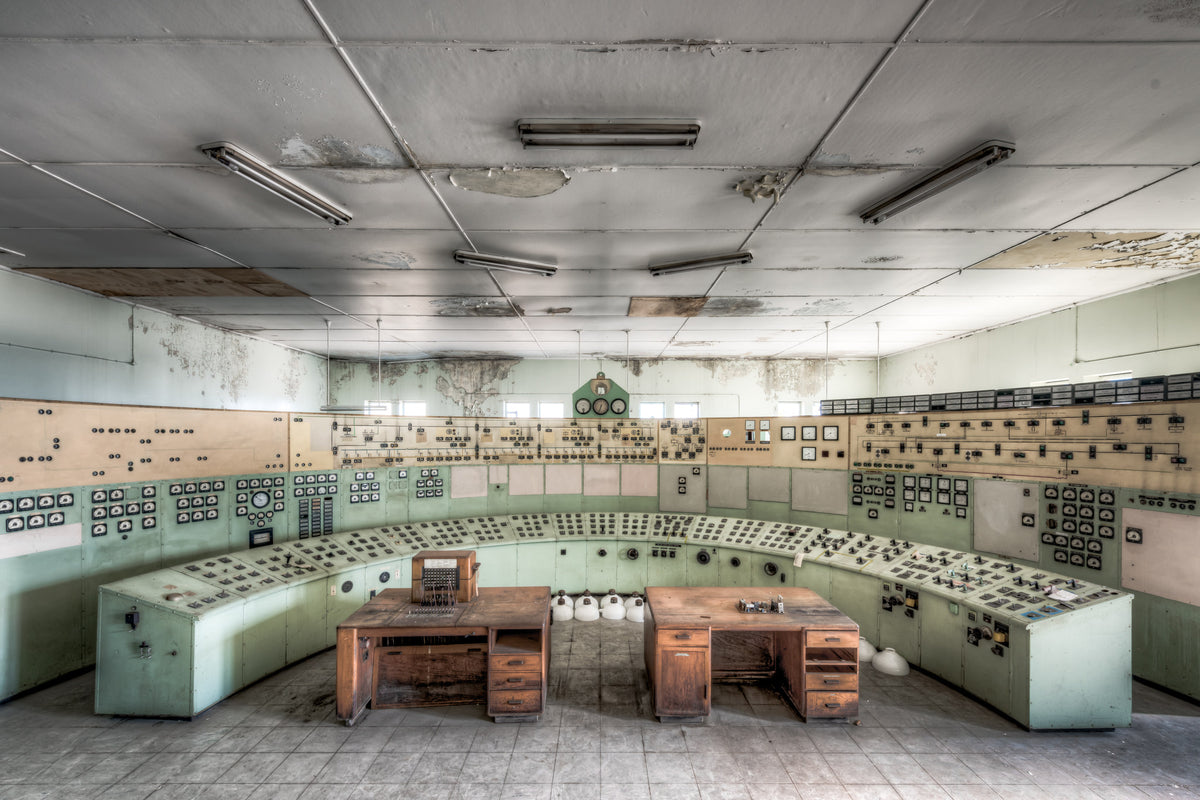
White Bay Power Station is a former coal-fired power station on Wanngal Country at Rozelle, at the head of White Bay on Sydney Harbour, built to power Sydney's trams and suburban trains and in service from May 1917 until December 1983. The New South Wales Department of Railways designed it in its own drawing office and began building in June 1912. The turbine hall, boilerhouse, switch house and control room stand on a 38,000 square metre site behind two steel chimney stacks, the main steelwork stamped with British manufacturers' names.
Print sizes
The anatomy view shows what this finish is as a physical object: paper margin, mat band, frame depth, acrylic profile. The comparison strip shows how each size sits relative to the others at true scale. Click a size or a finish to update both.
| Type | Size | Width | Height |
|---|


