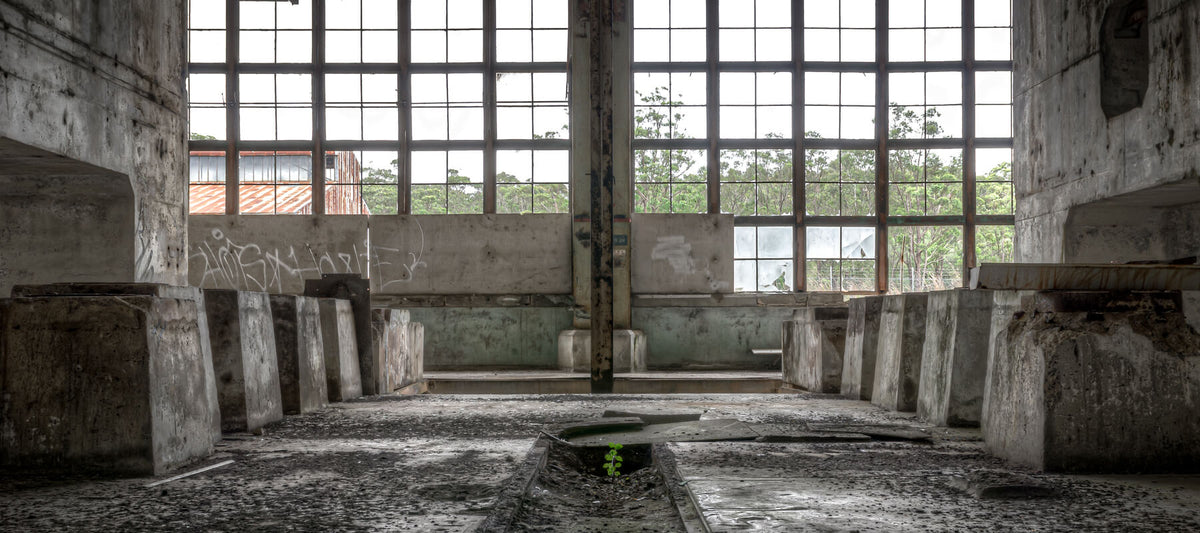
The turbine hall is the longest room I have stood in. Two hundred and twenty-eight metres, eleven storeys, the steel frame sitting on a concrete base and wrapped in triple-brick cladding. What is left inside is the structure, not the machines. The generating equipment was removed between 1995 and 1997. You walk through the volume the plant occupied, not the plant itself.

Wangi Power Station sits on the western shore of Lake Macquarie at Wangi Wangi. Civil works began in 1948 under the NSW Railways Department. The first pair of 50-megawatt turbo-alternator sets was ordered on 17 September that year. Construction continued through the early 1950s, with the building's riveted steel frame coming from Sir William Arrol and Co. in Glasgow, 8,359 tonnes of it, erected from August 1952.

Ownership transferred from Railways to the Electricity Commission of NSW on 1 January 1953 under the Electricity Commission Act 1950, though Railways remained the constructing authority. On the morning of 6 November 1957 the final A Station unit was synchronised to the grid. Premier Joseph Cahill officially opened the station on 7 November 1958 as the "Lake Macquarie (Wangi) Power Station". It was renamed Wangi Power Station in 1959.

There are two stations under one roof. A Station came first: three 50-megawatt units, stoker-fired, completed between 1957 and 1958. B Station followed: three 60-megawatt units, pulverised-coal fired, commissioned between 1958 and August 1960. B Station introduced the first hydrogen-cooled alternators in any Australian power station and was the first Australian power station to burn pulverised coal. The building holds the transition from one generation of coal-fired technology to the next.

Peak year was 1964: 2,439 gigawatt-hours generated, 1.2 million tonnes of coal consumed, around 400 employees on site. On 10 June 1964 the NSW grid went dark. Wangi played a major role in restoring power to the state because A Station's stoker-fired boilers had kept their fires alight through the shutdown.

A Station was retired on 7 March 1985. B Station closed on 31 October 1986. Formal decommissioning followed in 1989. The site has been in private hands since 1998, when Pacific Power sold the main building to I.J. McDonald Pty Ltd of Brisbane for a proposed apartment, motel, and cinema conversion. That project stalled after Ian McDonald's death. The company was in a winding-up process as of May 2018. The building waits.

The NSW State Heritage Register listed Wangi Power Station in April 1999. The heritage listing describes it as a rare example in Australia of a power station where architectural appearance and landscape setting were treated as integral to the design, not consequences of the engineering. The architect of record was Colin Smith of C.H. Smith and Johnson. The three reinforced concrete chimneys, 76 metres high, 16-sided, 6 metres internal diameter, are still standing.


