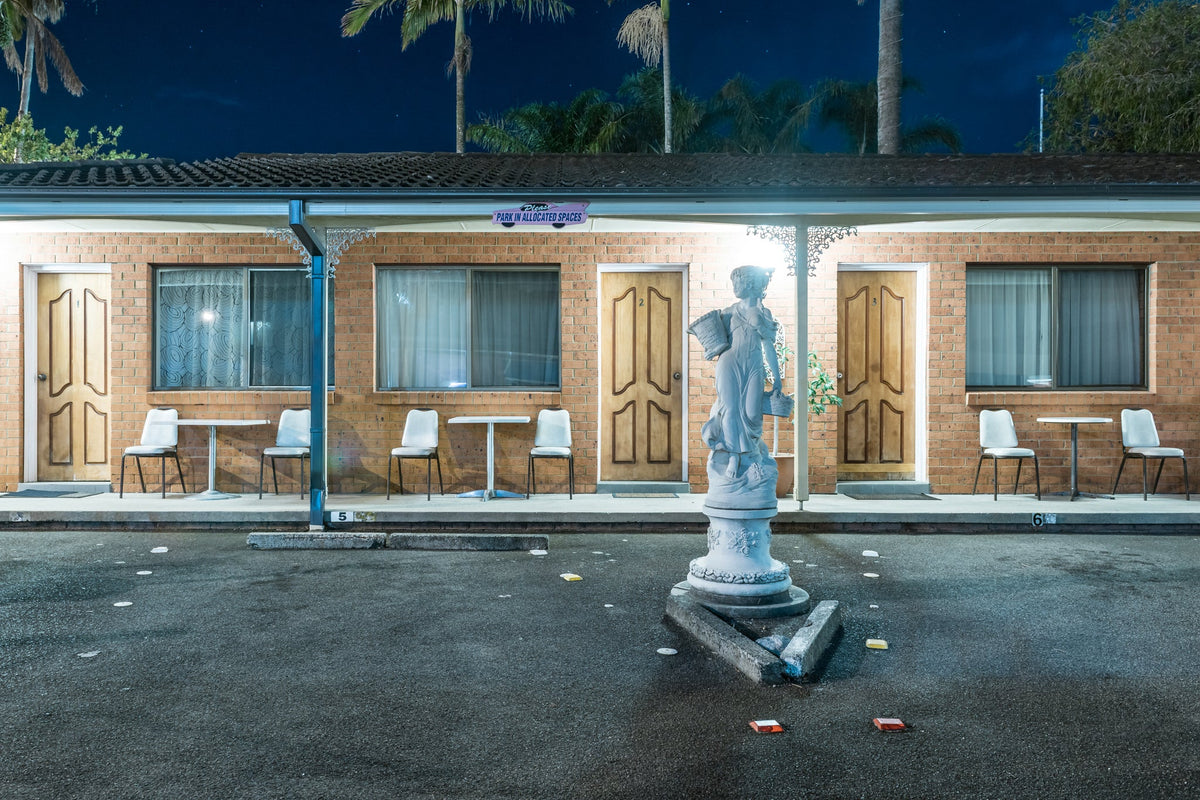
Hotel Motel 101 doesn't really fit Lost Collective.
Everything else I've shot since 2011 is either abandoned or has some kind of historical significance, with the exception of the landscape work. A collection of motels doesn't fit that brief, and I was aware of that going in. But the creative momentum was there in a way it hadn't been for a while. It covered more kilometres and involved more nights out than any other gallery I've put together, and somehow it felt like the easiest thing I'd worked on. When that kind of flow is there, you don't question it.
The idea
The seed came from watching Mindhunter on Netflix. Two FBI agents travelling across the United States in the late 1970s, staying in motels that somehow still look recognisable almost 40 years on. The cinematography makes you, or it made me anyway, somehow want to stay in one. That's what brought the idea to life.
I'd been thinking about motels as a subject for a while before that, but I couldn't pin down where the impulse came from. The through-line in most of what I do is taking a mundane or overlooked scene and making it something you want to pay attention to. The bleaker, the better. Motels aren't much of a stretch.
Signs, then rooms
My initial plan was to photograph motel signs. Something resembling the Holiday Inn Great Sign, which I didn't know existed before starting this project, though it seemed oddly familiar once I looked it up.

Those kinds of signs, or anything close to them, are rare in Australia in 2018. These two were among the few I found.


Most of what I found on the first night out looked like this.

I knew from that first night that the sign approach was going to add a lot of travel time for very little return. So the brief changed. Motel rooms themselves, photographed directly front-on. That's what Hotel Motel 101 became.
The list
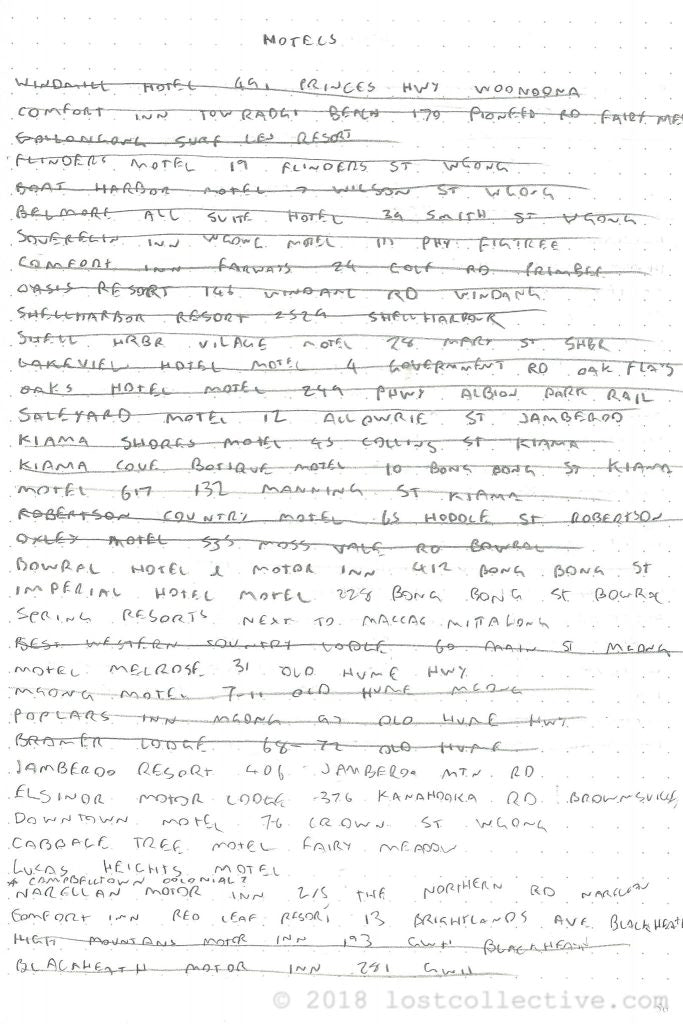
The process was simple to the point of being boring to describe. I typed "motel" into Google Maps and made a list of every one I could see, starting from the beginning of the Hume Highway at Ashfield and heading south to Casula.
The list started at less than half a page. After the first night out, I wasn't sure there was much in this project at all. But I kept going, and it grew. Eventually it ran to almost four pages, following loose routes through the Inner West, South Western Sydney, the Blue Mountains, the Central Coast, the Southern Highlands, and the Illawarra.



The conditions
Our son Jasper was less than one month old when I went out for the first night of this collection. By the time the whole project was finished, he was under two months. We weren't getting much sleep, so I did what any reasonable person would do: I got out of the house and was productive with the hours that were already lost anyway.
I'd also just bought a Nikon D850 that hadn't had much of a run yet. A good time to get to know it.
I don't do much night photography, which is odd because I genuinely enjoy it. There's something about being out at an unusual hour that keeps you sharp. This project was also a chance to try a couple of ideas I'd been sitting on.
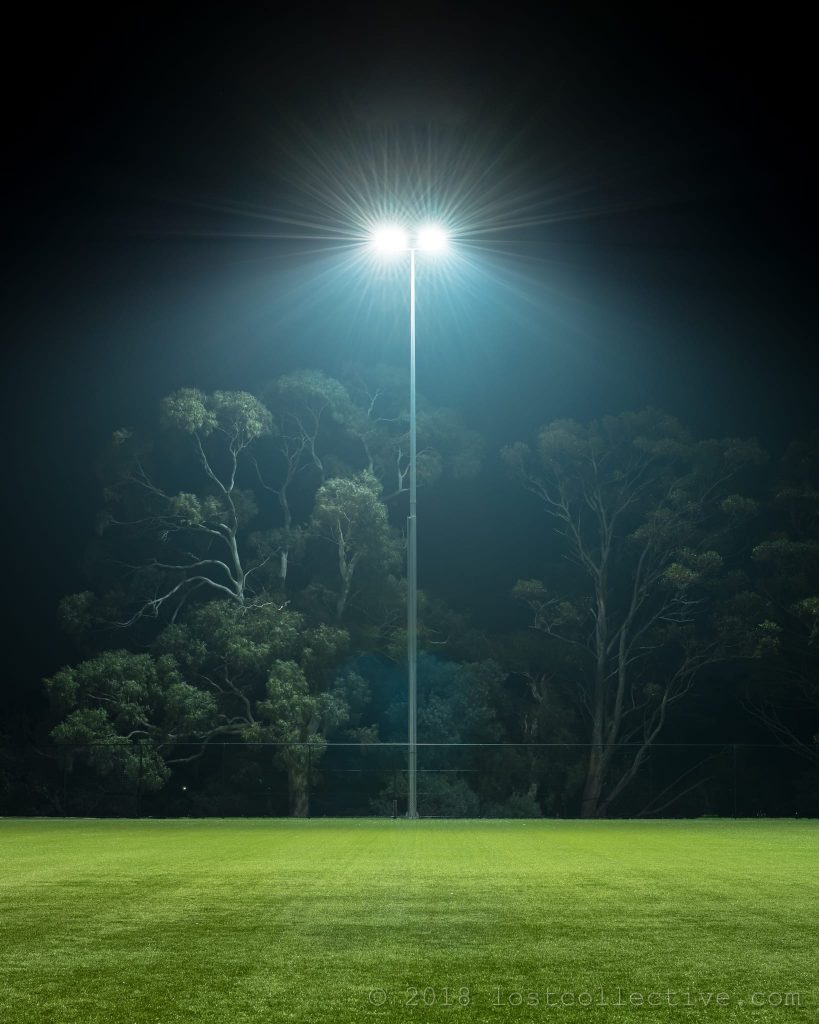
The first was a field light at night with a faint haze of light in the air. I'd had that image in my head since visiting Japan in 2016, when one of our hosts showed me a photo book by his friend Dan Holdsworth. One of Holdsworth's works was titled Megalith. Mine is nothing like his, but it is 100% the inspiration behind the photograph I ended up calling Nightlight.

The second idea was a phone box at night. I wanted a real sense of isolation in the image. I found it at the Lithgow Valley Motel.

The first night
The first motel I actually photographed for this collection was the Town & Country Motel in Strathfield. There were two others I'd tried earlier in the evening, both closer to my starting point on the Hume Highway, but there were too many people around. Sitting outside their rooms at midnight, smoking, having a drink. You can't set up a tripod in a motel carpark and point it at someone's room at half past midnight. So I came back to those later in the week.
This became a recurring issue throughout the project and the main reason I ended up out as late as I did. I'd start late, to find the 1am to 3am window when carparks were quieter and the motel lights were still on. Illuminated curtains behind a lit doorway turned out to make good shots.
At the Town & Country on that first night, a car pulled into the carpark towards the end of an exposure. I grabbed the tripod mid-shot.

The proper shot turned out like this.

What motels are actually used for
Something I came to understand in the process of making this collection is how common it is for motels to function as long-term accommodation.
From the first night out it was obvious that many of the places I was visiting had residents, not guests. Little giveaways: decorations on the walls you'd associate with someone's home. Flags. Posters. Furniture out on the landing.

Motels across Australia are also used as emergency accommodation by government housing agencies. People fleeing domestic violence. People facing homelessness. Parolees. Substance abuse. Families with children, in a room with a bar fridge and no kitchen. The NSW government spent $100 million on motel rooms used as emergency housing from 2000 to 2012 alone.
It's an issue that tends not to make much noise, partly because the people it affects have very little capacity to make noise, and partly because it happens in ordinary-looking places on ordinary roads. It probably stems from a lack of foresight and willingness to address the problem over decades by successive governments, but whatever the cause, it's not a great outcome for anyone except the people collecting the per-night rate.
The Grandstand in Warwick Farm is one of those motels.


The half-day rate sign out front gives you a reasonable sense of what you're dealing with before you look at anything else.

The owner also operates the Fontainebleau, further down the road. Also used for emergency accommodation.

It's hard to look at this from the outside and not feel like we're failing somewhere. Putting people in crisis, including children, into motel rooms with no kitchen, at a cost to government of tens of thousands of dollars a day, and expecting that situation to produce stability. I'm not claiming to have the answers, but surely we can do better than this.
An example of doing it differently
The Addison Project was a hotel in Kensington, Sydney, that was awaiting redevelopment. In the interim, the developer partnered with a number of organisations to provide 42 fully-furnished rooms, each with a bathroom and kitchenette, at no cost for homeless youth. OzHarvest set up a take-what-you-need, pay-what-you-can supermarket in the lobby, stocking only rescued food. Clothing rescue service Thread Together operated next to the building. Orange Sky Laundry, which ran the world's first mobile laundry service, visited once a week. Details reflect conditions at time of writing, 2018.
It's not a solution. But it represents a meaningful difference in the lives of the people it reached, and it points to what's possible when a building is sitting empty and the person who owns it decides to do something useful with that window. There are a few motels doing something similar on a smaller scale, usually without any announcement. The ones above were worth calling out.
Thirroul
My favourite motel in this collection is the Thirroul Beach Motel. It's also the only one I returned to for a second attempt at the shot.
The first visit was a Friday night. Every parking space was full, and I couldn't frame both levels of the building without losing part of the upper storey.

The pastel-coloured doors against the red brick, repeated across both levels, are a combination that works in a way that's easy to look at and hard to explain. So I came back on a Wednesday, hoping for fewer guests.
The second time, there were only a couple of cars at the far end of the building. And the sky had cleared. The first visit had been overcast. On the Wednesday night it was clear and full of stars, which made a significant difference to the image. I think this is the most visually appealing motel in the collection.
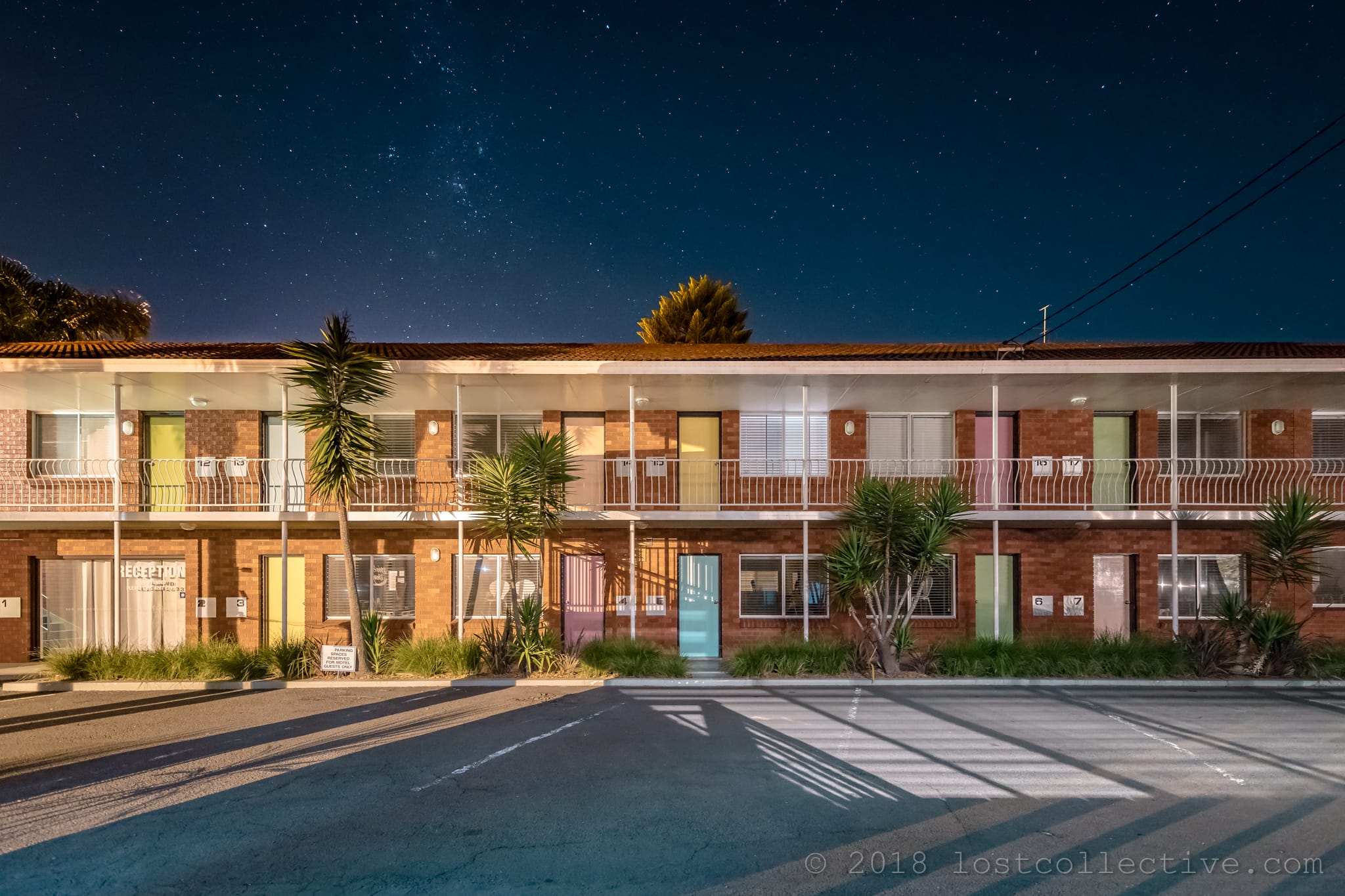
I had no idea, until I posted the image and people started commenting, that the Thirroul Beach Motel was where Brett Whiteley died of a heroin overdose in 1992. Room four. It appears in the photograph.

References
Features on the series. Suitcase Magazine, 1 May 2018; Vice, 20 May 2018; Broadsheet Sydney, 28 May 2018; BROAD Magazine, 26 July 2018.
On the references in this piece. Brett Whiteley died at the Thirroul Beach Motel in 1992; the connection is on the public record and is noted in the Broadsheet feature above. The Addison Project ran as described in 2018: ABC News, with OzHarvest, Thread Together and Orange Sky. The visual reference for Nightlight is Dan Holdsworth's Megalith.
Hotel Motel 101 was picked up by the following publishers:
∙ Vice
∙ Broad


