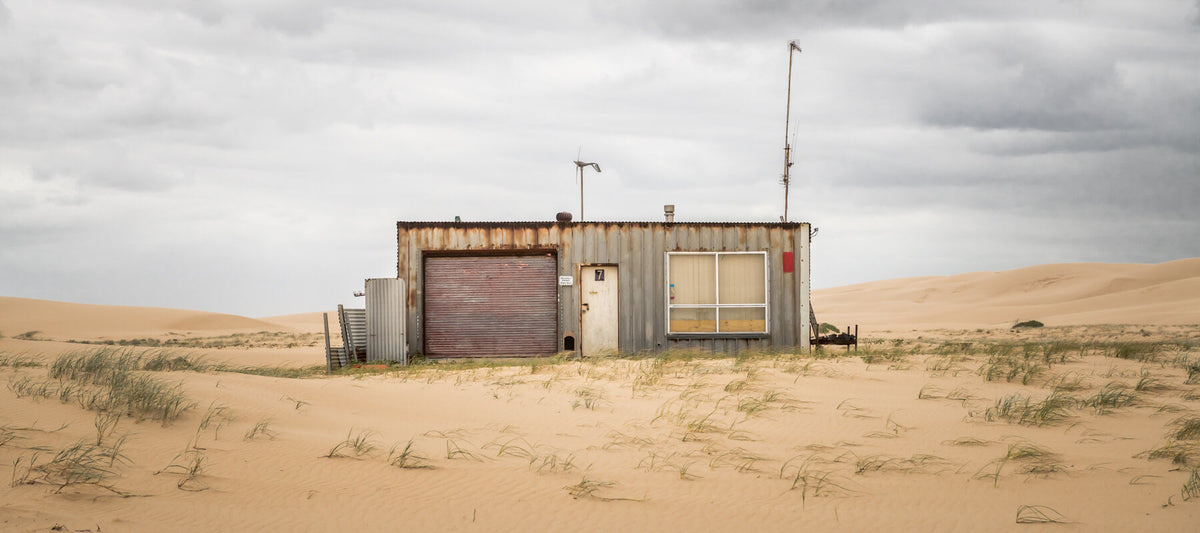
The sand is deep enough here that you sink past your ankles between shacks. Eleven of them left now, corrugated iron and driftwood and whatever else washed up after the war. They sit in the Stockton Bight dune field at Port Stephens, accessible only by NPWS-licensed 4WD or on foot across the dunes. No road. No services. No new building, ever again.

The first structures on this site were two tin provision sheds, put up in the late 19th century to hold supplies for the crews of ships wrecked on Stockton Beach. Wrecks were common here. The Cawarra in 1866, the Berbice in 1888, the Colonist in 1894, the Wendouree in 1898, the Lindus in 1899, the Adolphe in 1904. Fifty-nine ships eventually lost on Newcastle shores. The sheds were practical, not residential.

Settlement came later, during the Depression. Squatters built a series of tin shacks at the site through the 1930s, peaking at around 36 to 38 structures. During World War II the Army evicted them and set up a coastal camp. When the squatters returned after the war, their huts had been swallowed by sand. They rebuilt with driftwood and discarded military crates washed up on the beach.

Eleven shacks remain. The Worimi Conservation Lands Board of Management administers the licence system under the 2015 Plan of Management. The rules are simple: no new shacks, no rebuilding after destruction. A settlement that can only shrink. The shacks pass to family or friends; they cannot be sold.

This land sits on Worimi country. On 1 February 2007, the Worimi Local Aboriginal Land Council received freehold title and simultaneously leased the land back to the NSW Government. The Bight is now gazetted as three reserves under Part 4A of the National Parks and Wildlife Act 1974: Worimi National Park, Worimi State Conservation Area, and Worimi Regional Park, around 4,200 hectares total. The Board of Management runs the lands with 13 members, eight of them registered Worimi Aboriginal Owners.

The Stockton Bight dune field is, in the NPWS's wording, the largest mobile coastal sand mass in the Southern Hemisphere. The dunes stretch approximately 32 kilometres from Stockton to Anna Bay and move roughly 4 metres northward each year. Shacks here have been swallowed before.

Journalism has sometimes called Tin City the last legal squatter settlement in Australia. The NPWS does not use this language; neither does the Plan of Management. But the phrase has stuck in the Newcastle Herald and Australian Geographic, and it gestures at something real: this is a place that exists despite, not because of, anyone's plan for it.


