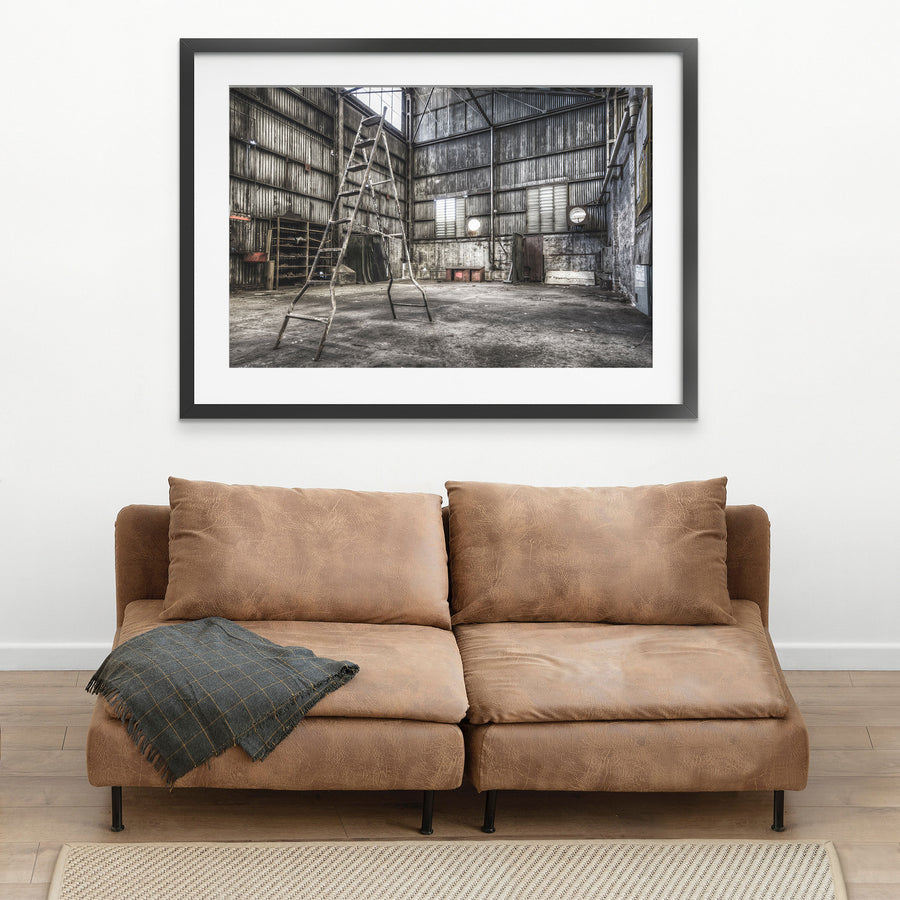
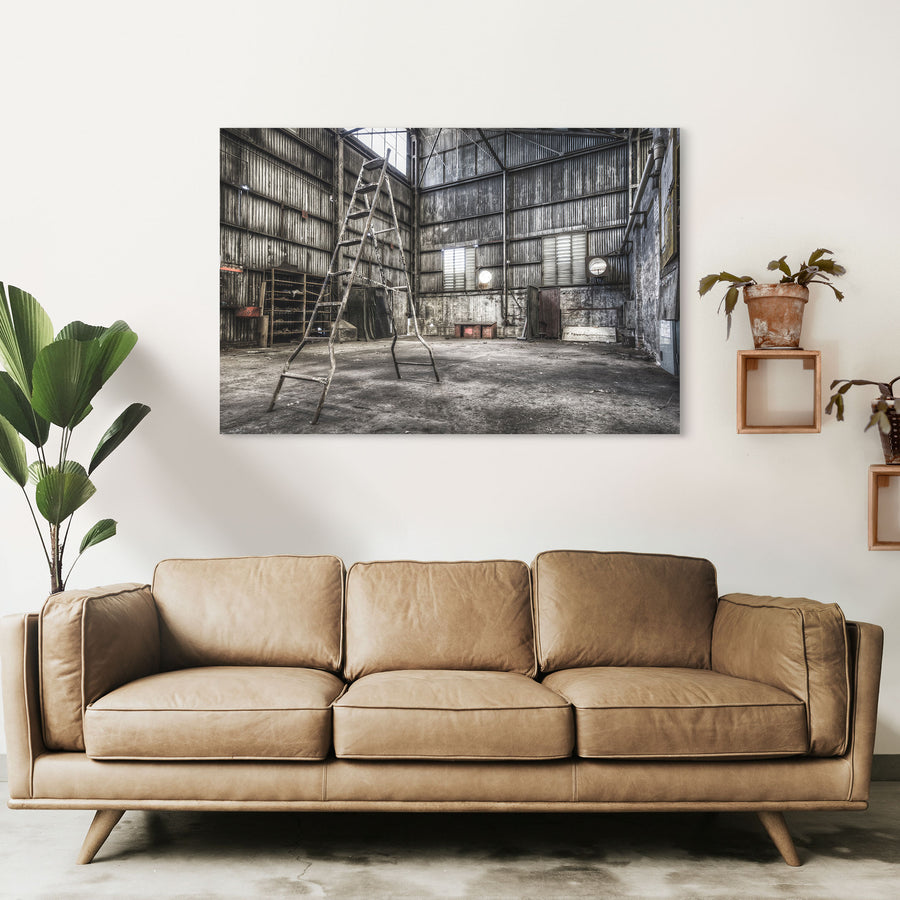
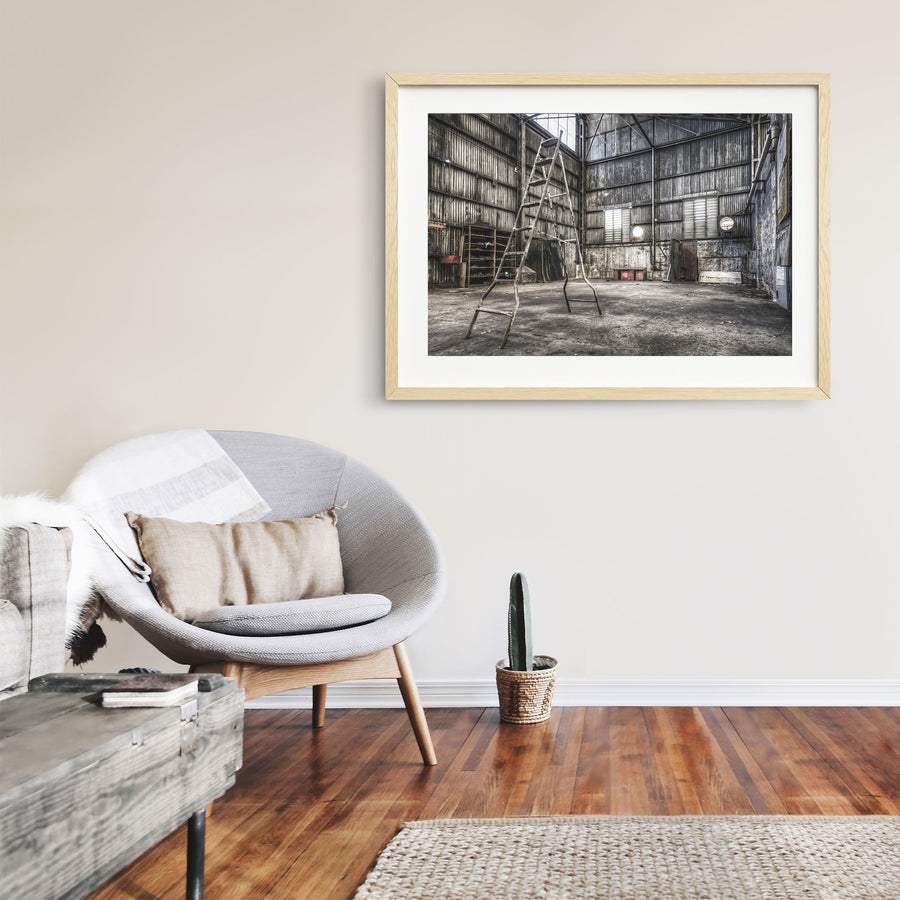
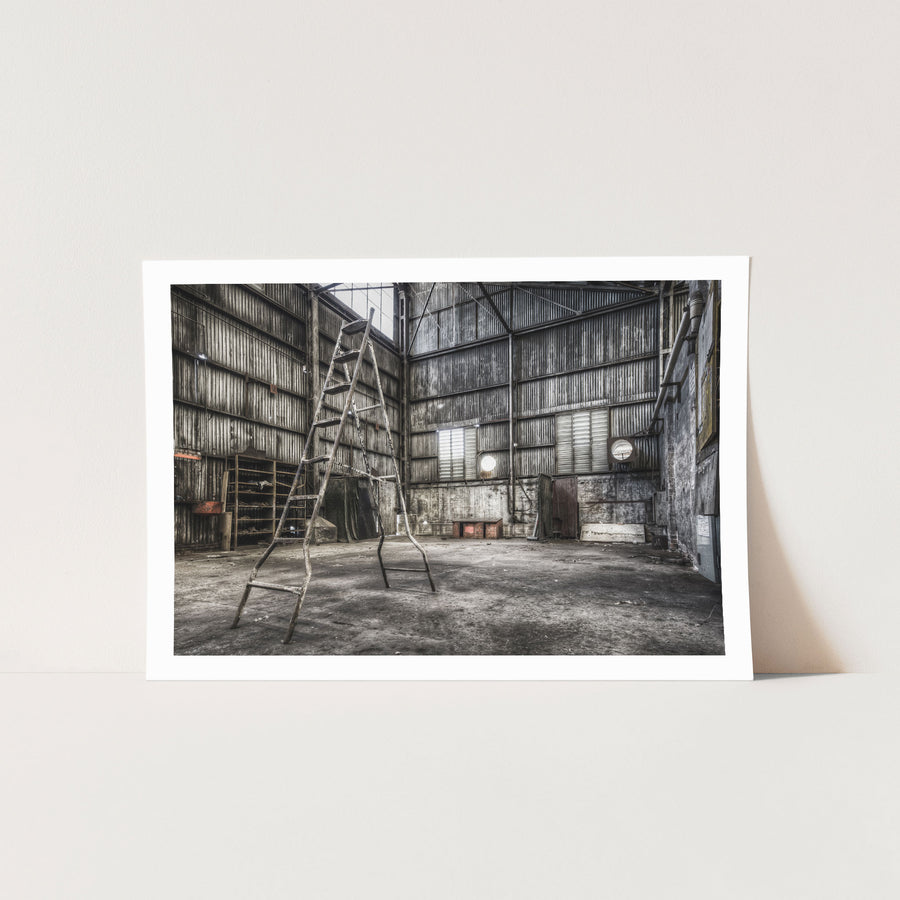
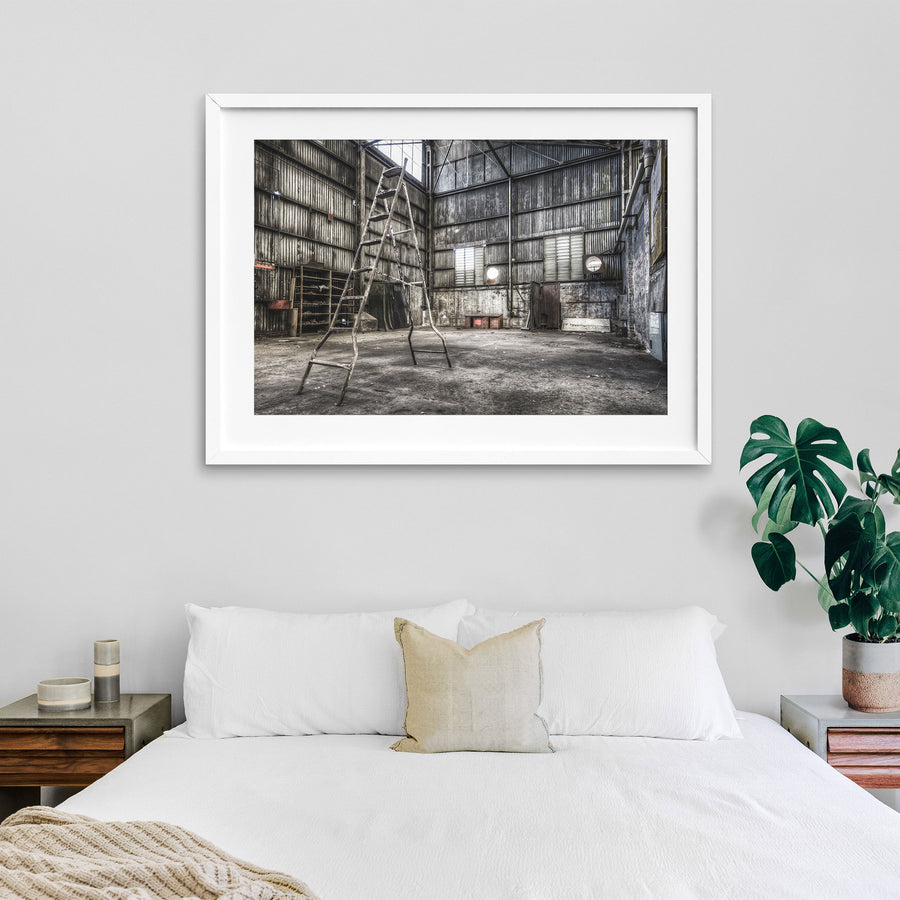
A rusted A-frame ladder, paint worn to bare metal, stands upright on a concrete floor. Red objects are visible behind it. A wooden shelving unit lines the left wall. A sign partially reads "Grind across" and "Emery wheel." A single louvred window high on the back wall admits the only natural light.
Edition
Open edition
Open edition Printed to order, no fixed quantity. Each print is hand-signed by the photographer.
Limited edition A fixed number of prints exist. Once sold, the edition closes permanently. Each print is individually numbered and signed.
$100.00 AUD
Size
Type
Colour
✓
Signed, numbered, with COA. Made to order in 5 to 10 business days (unframed). Shipped in protective packaging with edition certificate, paper-stock reference and a printed care guide.
The ladder is an A-frame, steel, paint worn to bare metal across most of its length. It stands upright near the centre of the workshop floor at Awaba Colliery as if someone set it down mid-job and never came back. Behind it, red objects rest on the concrete. To the left, a wooden shelving unit runs along the wall beside a sign that partially reads "Grind across" and "Emery wheel." A single louvred window high on the back wall is the room's only source of natural light. Awaba State Coal Mine began development in 1947, built specifically to supply thermal coal to Wangi Power Station for state-wide electricity generation. The NSW Government reserved 8,500 acres in the Awaba district by gazette in June that year, and Premier James McGirr formally opened the mine on 14 July 1948. The operation sat on Awabakal Country in the City of Lake Macquarie, with underground workings reaching from the western edge of the lake toward the Watagan Mountains foothills. It was a drift mine, not a shaft mine, meaning miners and materials descended via an inclined drift cut into the hillside rather than a vertical shaft. There was no headframe. Surface infrastructure included administration offices, workshops, a bathhouse, a lamp room, and a coal handling and crushing plant. Raw coal requiring washing was conveyed to the adjacent Newstan Colliery washery. The mine changed hands several times across its working life. The State Coal Mines Control Board governed it from opening; the State Mines Control Authority succeeded in March 1950; ownership transferred to the Electricity Commission of New South Wales on 1 July 1973 under the Electricity Commission (State Coal Mines) Act 1973, with day-to-day management through Elcom Collieries Pty Ltd. Pacific Power and its subsidiary PowerCoal Pty Ltd held it from the early 1990s until August 2002, when Centennial Coal Company Ltd acquired the PowerCoal portfolio for $331 million. Centennial itself was acquired by Thai group Banpu Public Company Ltd in 2011. By the end, the operation employed around 85 workers and produced approximately 800,000 to 900,000 tonnes of thermal coal per year, recovering coal from pillars left in earlier workings. The last shift ran on 23 December 2011. Final mining ceased in March 2012 when the Great Northern Seam reserves were exhausted. Over sixty-five years, the mine had produced more than 35 million tonnes of coal. This photograph was made in 2015.
04·FROM THE FIELD NOTES
A workshop interior at Awaba Colliery, photographed in 2015, three years after the last shift. An A-frame ladder stands near the centre of the room, its paint reduced to bare metal by years of use. A wooden shelving unit lines the left wall beside a sign referencing a grinder and emery wheel. Red objects sit on the concrete floor. A single louvred window high on the back wall is the room's only source of natural light. The mine operated from 1947 until coal reserves in the Great Northern Seam were exhausted in March 2012.
Brett Patman
The series
Awaba Colliery
2015 · 24
photographs
Awaba Colliery worked the Great Northern Seam at Awaba, on the western side of Lake Macquarie in New South Wales, from 1947 until 2012. The state opened the mine to supply thermal coal to Wangi Power Station, and from 1954 a branch railway carried the coal there. It was a drift mine, entered by an inclined tunnel rather than a vertical shaft, so it never carried a headframe. Mining ended in March 2012 when the workable coal in the seam ran out, and the entries were sealed that year.
The anatomy view shows what this finish is as a physical object: paper margin, mat band, frame depth, acrylic profile. The comparison strip shows how each size sits relative to the others at true scale. Click a size or a finish to update both.