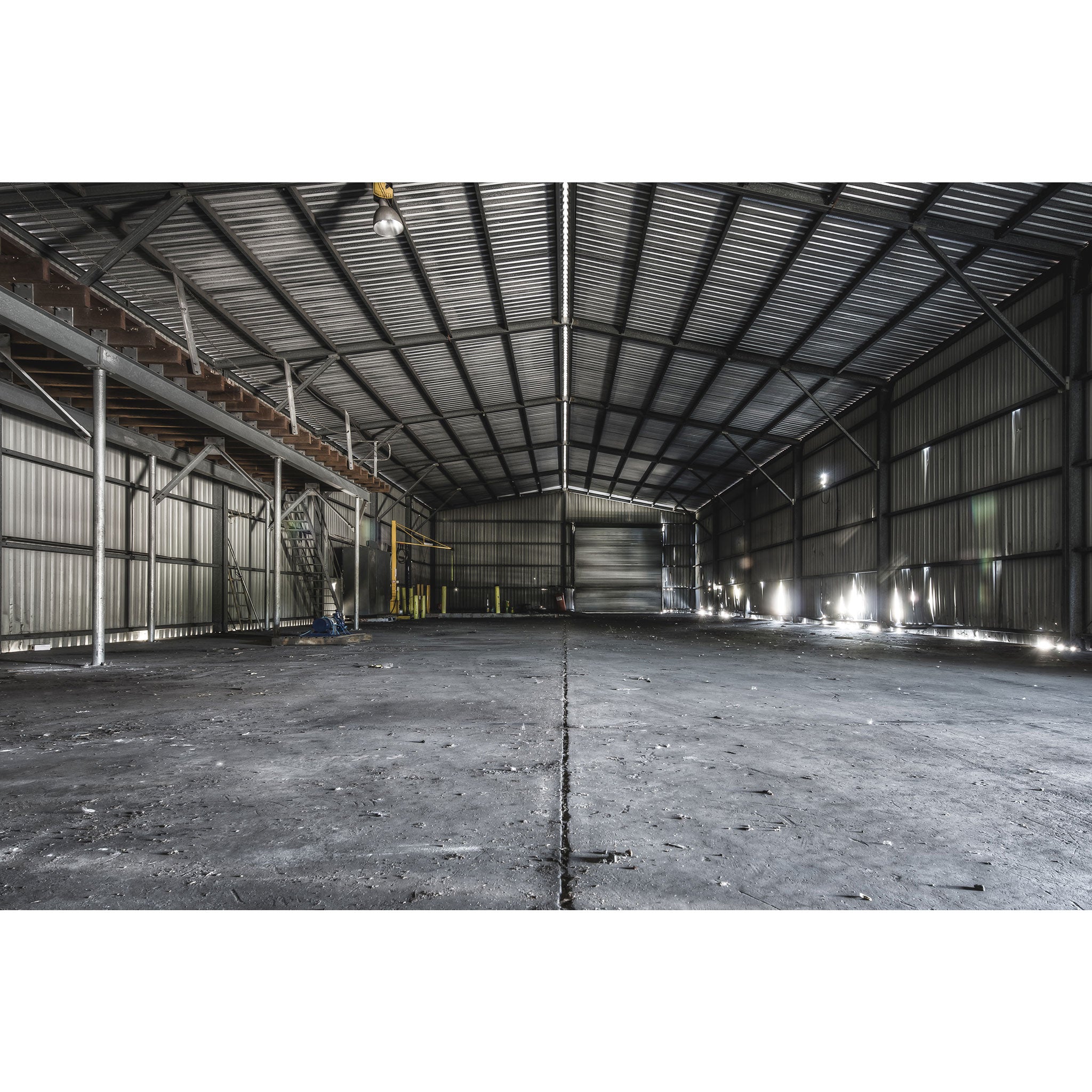
Interior of the storage shed at Awaba Colliery, showing buckled corrugated metal walls, a metal walkway with timber steps along the left side, a yellow gantry in the mid-ground, and bright window light cutting across a concrete floor.

01 Awaba CollieryAwaba2015

ISO 10015.0 secf/8.014mm

Series · 2 prints

Awaba Colliery

Photographed 2015
Frames 2
Camera NIKON D7000
Location Awaba
Status Underground sealed 2012; surface pit top retained as a service yard for Newstan Colliery
Years 1947 to 2012
Heritage No listing identified (Heritage NSW HMS, 2026)
Specs Seam: Great Northern · Access: drift mine, no headframe · Worked: 1947 to 2012 · Output: over 35 million tonnes · Supplied: Wangi Power Station
01 ABOUT THIS SERIES

Series story

Map · Mapbox · OpenStreetMap

Awaba Colliery worked the Great Northern Seam at Awaba, on the western side of Lake Macquarie in New South Wales, from 1947 until 2012. The state opened the mine to supply thermal coal to Wangi Power Station, and from 1954 a branch railway carried the coal there. It was a drift mine, entered by an inclined tunnel rather than a vertical shaft, so it never carried a headframe. Mining ended in March 2012 when the workable coal in the seam ran out, and the entries were sealed that year.

Awaba was a state enterprise from the start. In June 1947 the government reserved 8,500 acres in the district for state mining, and small-scale production was expected within months. The mine was run first by the State Coal Mines Control Board, then from 1950 by the State Mines Control Authority, and it passed to the Electricity Commission of New South Wales in 1973. Its purpose was fixed throughout: coal for the state's power stations, and for Wangi above all.

The coal came out by bord and pillar, cut by continuous miners, and in the later years by working back through the pillars left in the first passes. Forty pit horses worked underground in the early decades, and the last of them were still in service in 1965. Over its life the mine produced more than 35 million tonnes, though by the end it was a small operation, about 85 workers raising some 800,000 tonnes a year.

In 2002 the state sold its Powercoal mines to Centennial Coal, and in 2011 Centennial was bought by the Thai company Banpu. The last shift at Awaba was on 23 December 2011, and underground work ceased in March 2012 with the seam worked out. The drifts and shafts were sealed the same year. The surface pit top was kept on as a service yard for the neighbouring Newstan mine, and a proposal to flood the sealed workings as a pumped hydro reservoir reached a feasibility report in August 2022.

Centennial Coal, Awaba Colliery Annual Review 2017, Awaba colliery to close, Newcastle Herald, 2011 and Premier Opens New Coal Mine At Awaba, Newcastle Sun, 14 July 1948, via Trove
02 TIMELINE

Chronology

1947
1948
1954
1965
1973
2002
2011
2012
03 PRINTS

Prints in this series

Hand-signed limited editions, printed from the original RAW file. Editions run from 100 down to 25 and are not reissued once they sell through.

03 STATEMENT OF SIGNIFICANCE

Our last shift at Awaba is on 23 December

Ross Smith, Awaba miner, quoted in Australian Mining, 17 November 2011

04 ABOUT THE PRINTS

How they’re made

Made to order by Brett in Sydney, from the original RAW file. Each print is hand-signed and numbered before it ships.

Paper

Ilford Galerie cotton rag, 310 gsm. Acrylic on metallic gloss, 260 gsm.

Editions

Open in XS and S. Limited in M (100), L (50), XL (25). From $100.

Print tiers →

Lead time

Unframed: 5 to 10 business days. Framed and acrylic: 10 to 20.

06 PRESS

In the press

Holding a solo exhibition in one of the spaces I've photographed would also be a dream, particularly at a site with a strong community connection - so the images can be enjoyed by the people who made it matter.

The Guardian

Brett Patman·2019

theguardian.com

On the LC archive.

I'm not trying to make out like I'm some kind of mysterious urbex badass. Lost Collective isn't about me. It's about the places I shoot and even more about the connection that the people have to the sites.

Broadsheet

Brett Patman·2016

lostcollective.com

On the LC archive.

Often I'd find myself looking at the machines and architecture and challenging myself to find one single object designed purely for aesthetics. Craftsmanship made way for efficiency in engineering long before I'd even left school.

The Guardian

Brett Patman·2019

theguardian.com

On the LC archive.

08 REFERENCES

Sources and further reading

  1. 01 T1
  2. 02
    Awaba colliery to close, Newcastle HeraldNewcastle Herald · 2011newcastleherald.com.au/story/439121/awaba-colliery-to-close/
    T2
  3. 03
    Premier Opens New Coal Mine At Awaba, Newcastle SunNewcastle Sun via Trove, National Library of Australia · 1948nla.gov.au/nla.news-article158268175
    T1
  4. 04
    Awaba Coal Land Vested In State Board, Newcastle Morning HeraldNewcastle Morning Herald via Trove, National Library of Australia · 1947trove.nla.gov.au/newspaper/article/140325049
    T1
  5. 05
    Awaba Colliery, Resource Assessment, Hunter SubregionBioregional Assessments, Commonwealth of Australia · 2015bioregionalassessments.gov.au/assessments/12-resource-assessment-hunter-subregion/12211-awaba-colliery
    T1
  6. 06
    Awaba Colliery Mining Project, Director-General's Environmental Assessment ReportNSW Department of Planning · 2011majorprojects.planningportal.nsw.gov.au/prweb/PRRestService/mp/01/getContent?AttachRef=MP10_0038%2120191018T005627.051%20GMT
    T1
  7. 07
    Awaba Colliery, Lake Mac HistoryLake Macquarie Librarieshistory.lakemac.com.au/narrative/3957
    T2
  8. 08
    Centennial Coal's Awaba colliery to closeAustralian Mining · 2011australianmining.com.au/centennial-coals-awaba-colliery-to-close/
    T2
  9. 09
    Last steam hauled coal train from Awaba State Mine to Wangi Power StationHarold J Wright, Buckland collection, National Library of Australia · 1973nla.gov.au/nla.obj-155329902/view
    T2
  10. 10
    Wangi Power Station Branchnswrail.netnswrail.net/lines/show.php?name=NSW:wangi
    T3
08 BY POST · NO SPAM

Read the full story

Articles when they're published. The history behind a place. The day of a shoot. The work between prints. No marketing, no schedule.

You're subscribed.