Lifiting Gear Rack

Provenance

Camera
NIKON D7000
Lens
14.0-24.0 mm f/2.8
Settings
14mm · f/8.0 · 0.8 sec · ISO 100
Paper
Ilford Galerie Smooth Cotton Rag 310 gsm

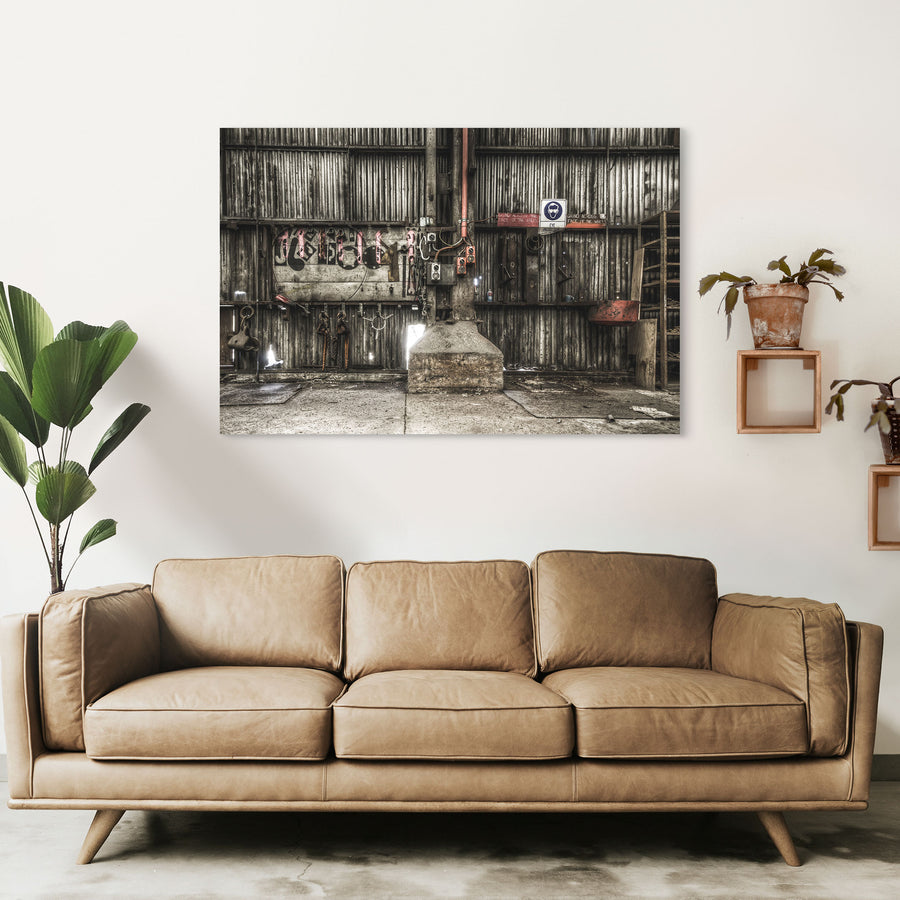
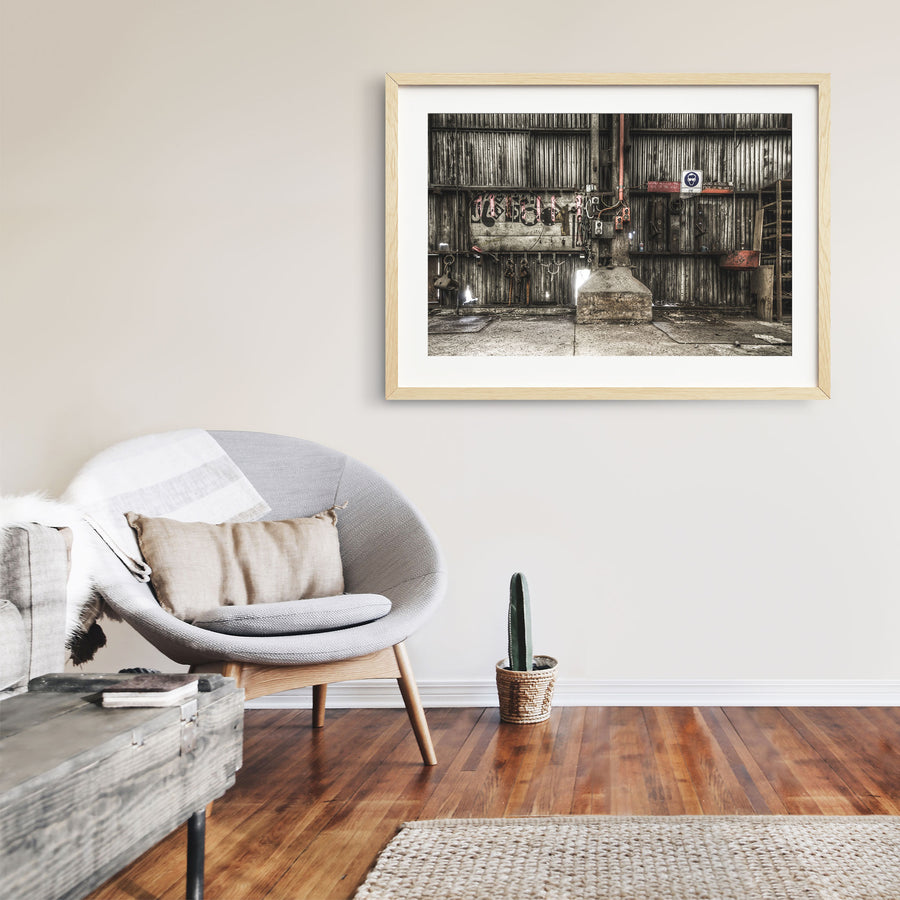
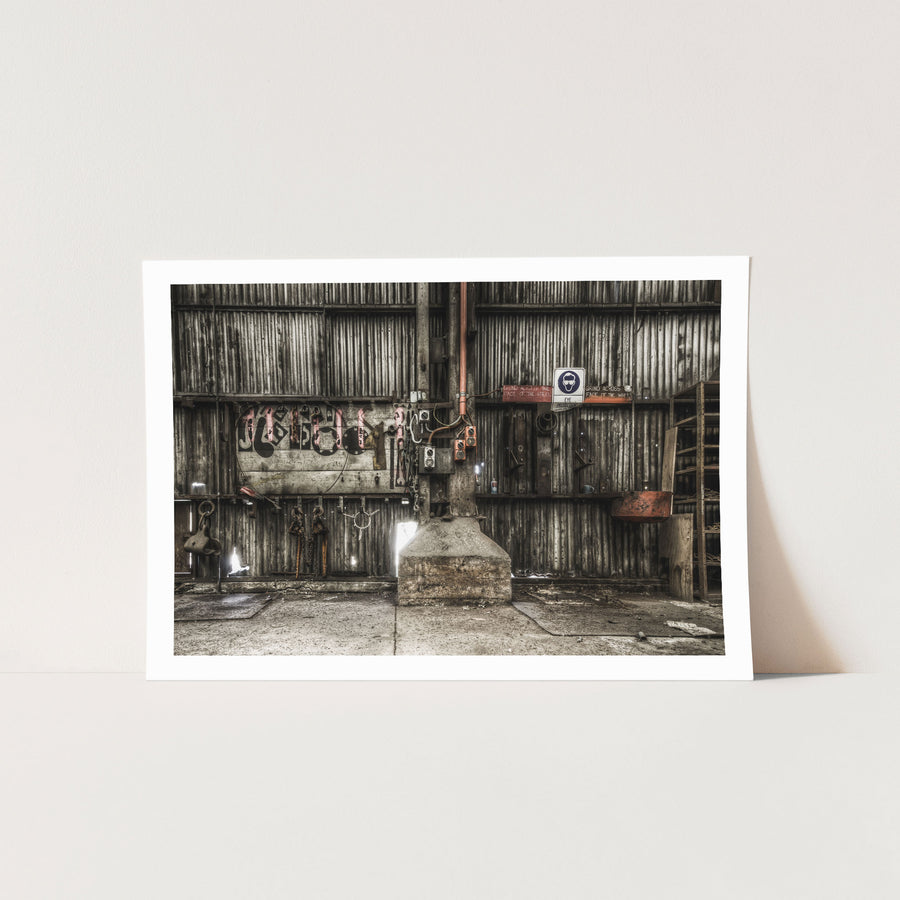
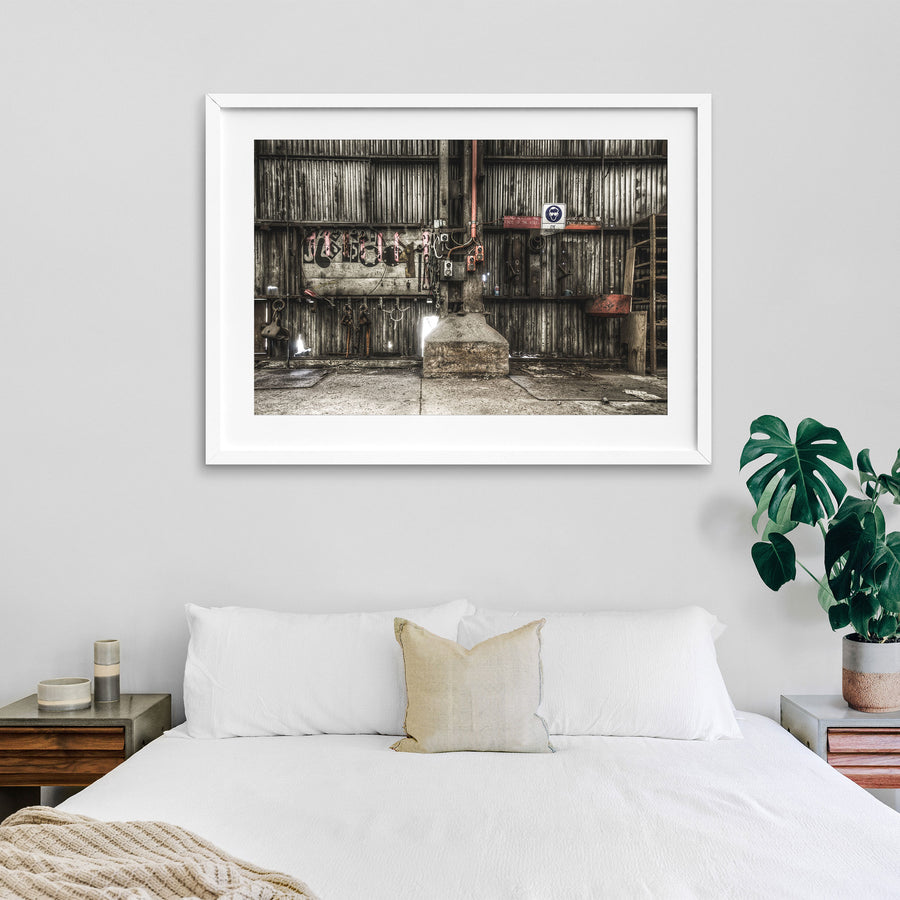
Pegboard on the left wall with hook outlines and remaining lifting gear below. Empty pedestal grinder base to the right. Two red safety signs fixed to wooden planking above, one for grinding technique, one for eye protection. Graffiti reading "Jehovah" across the planking. Exposed conduit and junction boxes on the central support post.

Edition
Open edition

Open edition
Printed to order, no fixed quantity. Each print is hand-signed by the photographer.

Limited edition
A fixed number of prints exist. Once sold, the edition closes permanently. Each print is individually numbered and signed.

$100.00 AUD
Size
Type
Colour
Signed, numbered, with COA. Made to order in 10 to 20 business days (framed). Shipped in protective packaging with edition certificate, paper-stock reference and a printed care guide.
See certificate sample →

Shipping Free shipping over $250. Ships worldwide, rates calculated at checkout.

Returns Damaged in transit? We replace it. Full policy →

Ships within 10 business days · signed & numbered

In situ
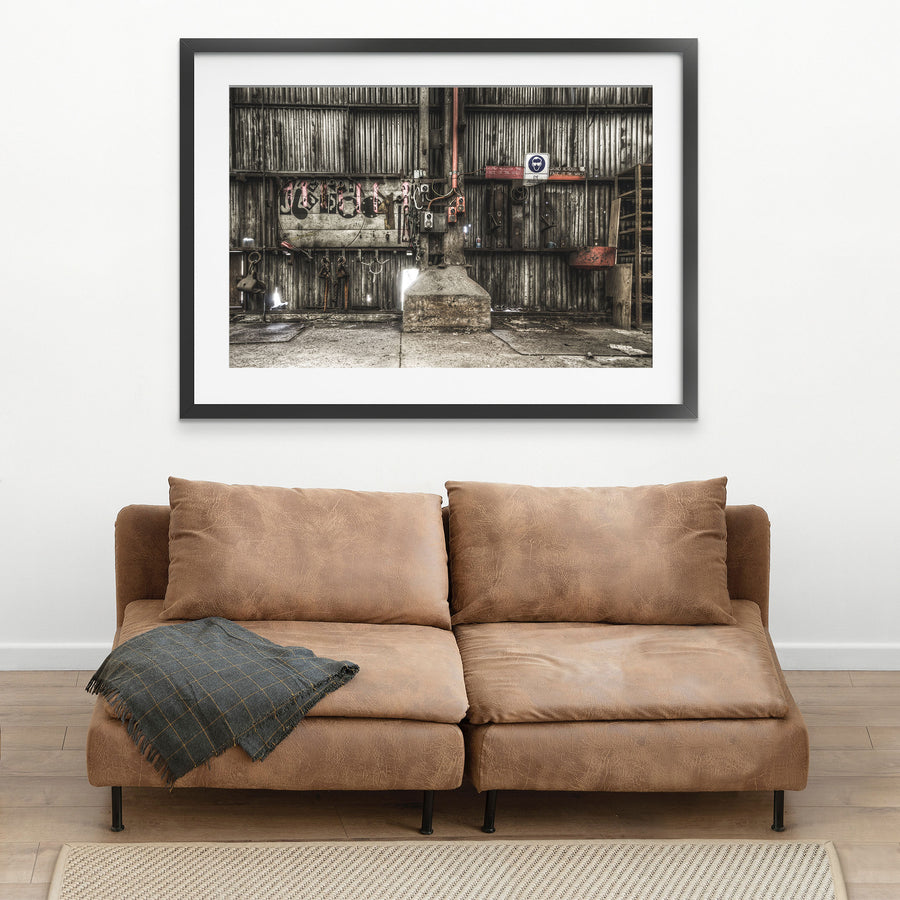
Workshop wall at Awaba Colliery showing a pegboard with remaining lifting gear, an empty grinder base, red safety signs, and graffiti on wooden planking.Workshop wall at Awaba Colliery showing a pegboard with remaining lifting gear, an empty grinder base, red safety signs, and graffiti on wooden planking.Workshop wall at Awaba Colliery showing a pegboard with remaining lifting gear, an empty grinder base, red safety signs, and graffiti on wooden planking.Workshop wall at Awaba Colliery showing a pegboard with remaining lifting gear, an empty grinder base, red safety signs, and graffiti on wooden planking.Workshop wall at Awaba Colliery showing a pegboard with remaining lifting gear, an empty grinder base, red safety signs, and graffiti on wooden planking.
01 PROVENANCE

Print datasheet

Title
Lifiting Gear Rack
Series
Awaba Colliery
Catalogue
AWB-015
Process
Giclée
Captured
20 December 2015
Camera
NIKON D7000
Lens
14.0-24.0 mm f/2.8
Aperture
f/8.0
Shutter
0.8 sec s
ISO
100
Focal length
14 mm
Paper
Ilford Galerie Smooth Cotton Rag 310 gsm
Location
Awaba
Recognised by
Highly Commended in Multimedia at the 2016 National Trust of Australia (NSW) Heritage Awards
02 LOCATION

Awaba

Map · Mapbox · OpenStreetMap

03 THE STORY

About this print

The left wall of this workshop at Awaba Colliery carries the record of what was once organised there. A pegboard still holds the outline of hooks and a few pieces of lifting gear that remained when the site went quiet. To the right, a pedestal grinder base sits stripped of its machine, two red safety signs fixed to the wooden planking above it: one detailing how to grind across the face of the wheel, the other mandating eye protection. Graffiti spelling "Jehovah" runs across the same planking in red and black. Exposed conduit and junction boxes climb the central support post between the two stations. Awaba Colliery, formally known as Awaba State Coal Mine, was established in 1947 on Wilton Road, approximately 1 kilometre south of the Awaba township in the City of Lake Macquarie. Development and first coal commenced that year, and the mine was formally opened by NSW Premier James McGirr on 14 July 1948. It was built expressly to supply thermal coal to Wangi Power Station, with a dedicated railway branch line constructed to carry the coal there, opening on 25 May 1954. The mine worked the Great Northern Seam by bord-and-pillar method using continuous miners, later returning to mined areas for pillar extraction, pillar quartering, and pillar stripping. Over 35 million tonnes of thermal coal were produced across its operational life. The mine passed from the State Coal Mines Control Board to the State Mines Control Authority in March 1950, then to the Electricity Commission of New South Wales on 1 July 1973, then through the Pacific Power and PowerCoal restructure, before Centennial Coal Company acquired the Powercoal portfolio in August 2002 for $331 million. Centennial Coal was itself acquired by Thai group Banpu Public Company Ltd in 2011. By November 2011, Centennial Coal announced the closure, with approximately 85 workers at the site. The last shift ran on 23 December 2011, with final cessation of all underground mining in March 2012 when coal reserves in the Great Northern Seam were exhausted. The surface buildings, including this workshop, were photographed at Awaba in 2015.

04 FROM THE FIELD NOTES

The workshop wall at Awaba Colliery still holds the ghost of its inventory. A pegboard keeps the outline of hooks and a handful of lifting gear that never made it out; beside it, a pedestal grinder base sits stripped and empty. Two red safety signs remain fixed to the wooden planking, one instructing how to grind across the face of the wheel, the other for eye protection. Graffiti spelling "Jehovah" crosses the same planking in red and black. The mine ran from 1947 until the Great Northern Seam gave out in 2012.

Brett Patman

Awaba Colliery

The series

Awaba Colliery

1947 to 2012 · 24 photographs

Awaba Colliery worked the Great Northern Seam at Awaba, on the western side of Lake Macquarie in New South Wales, from 1947 until 2012. The state opened the mine to supply thermal coal to Wangi Power Station, and from 1954 a branch railway carried the coal there. It was a drift mine, entered by an inclined tunnel rather than a vertical shaft, so it never carried a headframe. Mining ended in March 2012 when the workable coal in the seam ran out, and the entries were sealed that year.

View all in this series →

05 SIZE GUIDE

Print sizes

The anatomy view shows what this finish is as a physical object: paper margin, mat band, frame depth, acrylic profile. The comparison strip shows how each size sits relative to the others at true scale. Click a size or a finish to update both.

Anatomy · true ratio
TypeSizeWidthHeight
08 BY POST · NO SPAM

Read the full story

Articles when they're published. The history behind a place. The day of a shoot. The work between prints. No marketing, no schedule.

You're subscribed.