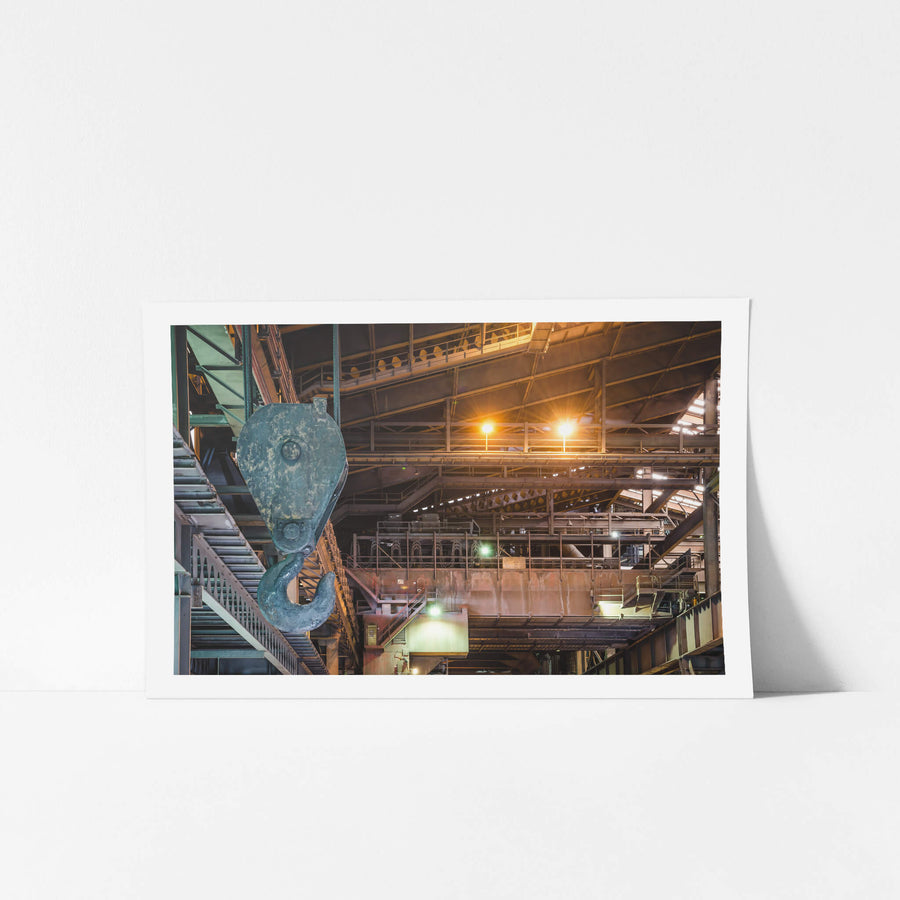
Charge Crane Hook

Provenance

Camera
NIKON D7000
Lens
24.0-70.0 mm f/2.8
Settings
66mm · f/8.0 · 13s · ISO 100
Paper
Ilford Galerie Smooth Cotton Rag 310 gsm

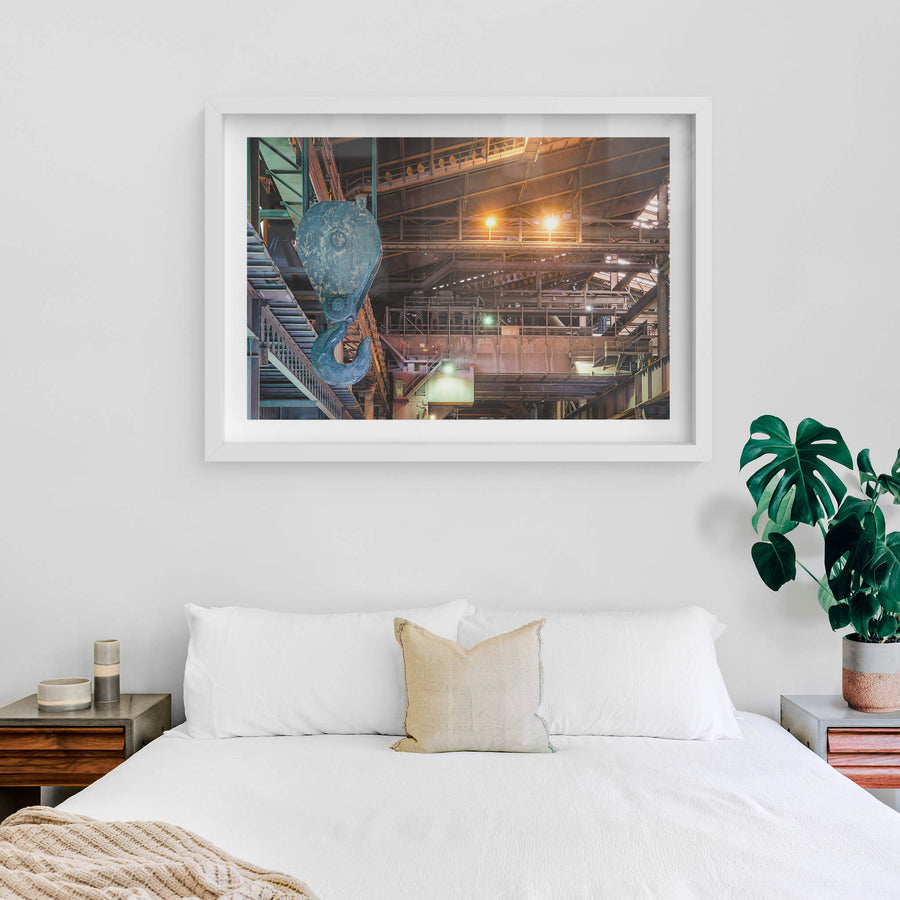
The hook block of a charge crane at BlueScope's Port Kembla steelworks, a single steel hook worn and pitted by long service and about the size of a person. Charge cranes handled the heavy loads of the steelmaking floor. Port Kembla has made steel since 1928.

Edition
Open edition

Open edition
Printed to order, no fixed quantity. Each print is hand-signed by the photographer.

Limited edition
A fixed number of prints exist. Once sold, the edition closes permanently. Each print is individually numbered and signed.

$100.00 AUD
Size
Type
Colour
Signed, numbered, with COA. Made to order in 5 to 10 business days (unframed). Shipped in protective packaging with edition certificate, paper-stock reference and a printed care guide.
See certificate sample →

Shipping Free shipping over $250. Ships worldwide, rates calculated at checkout.

Returns Damaged in transit? We replace it. Full policy →

Ships within 10 business days · signed & numbered

In situ
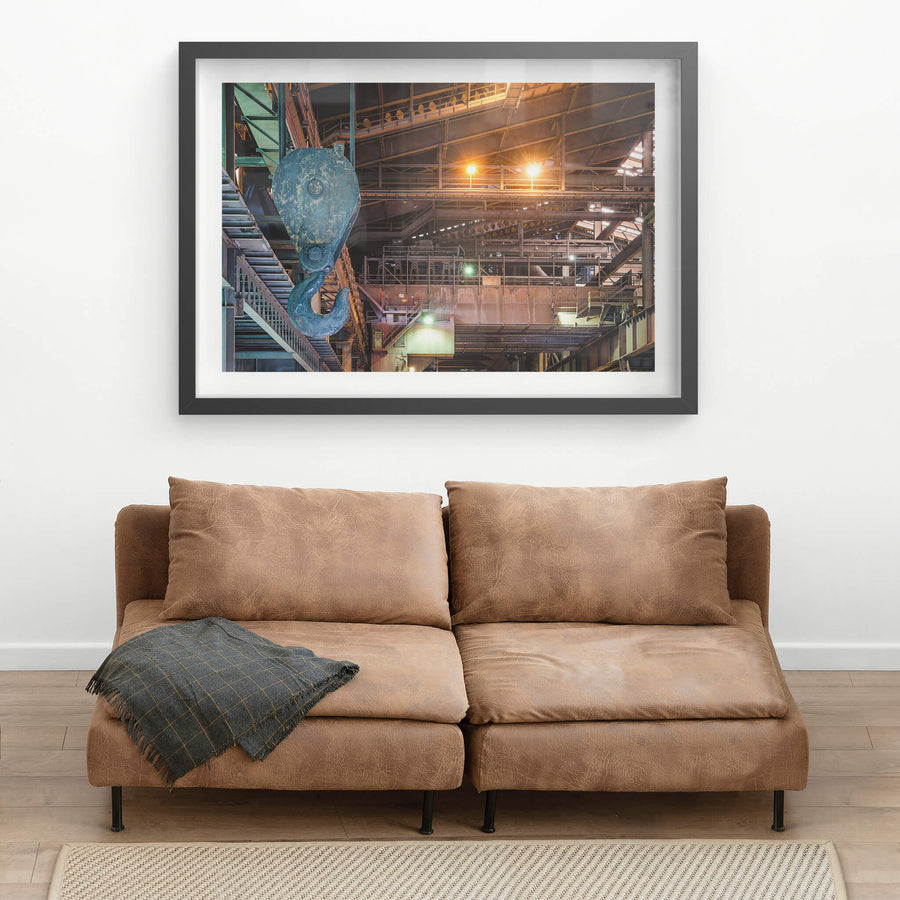
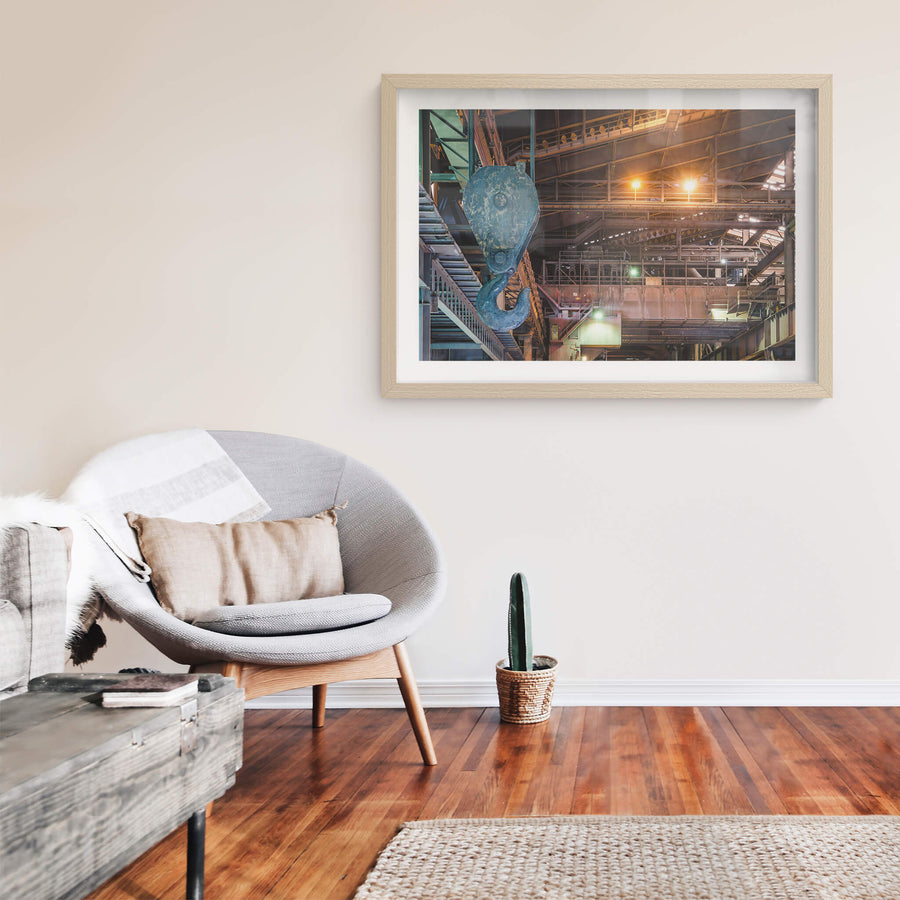
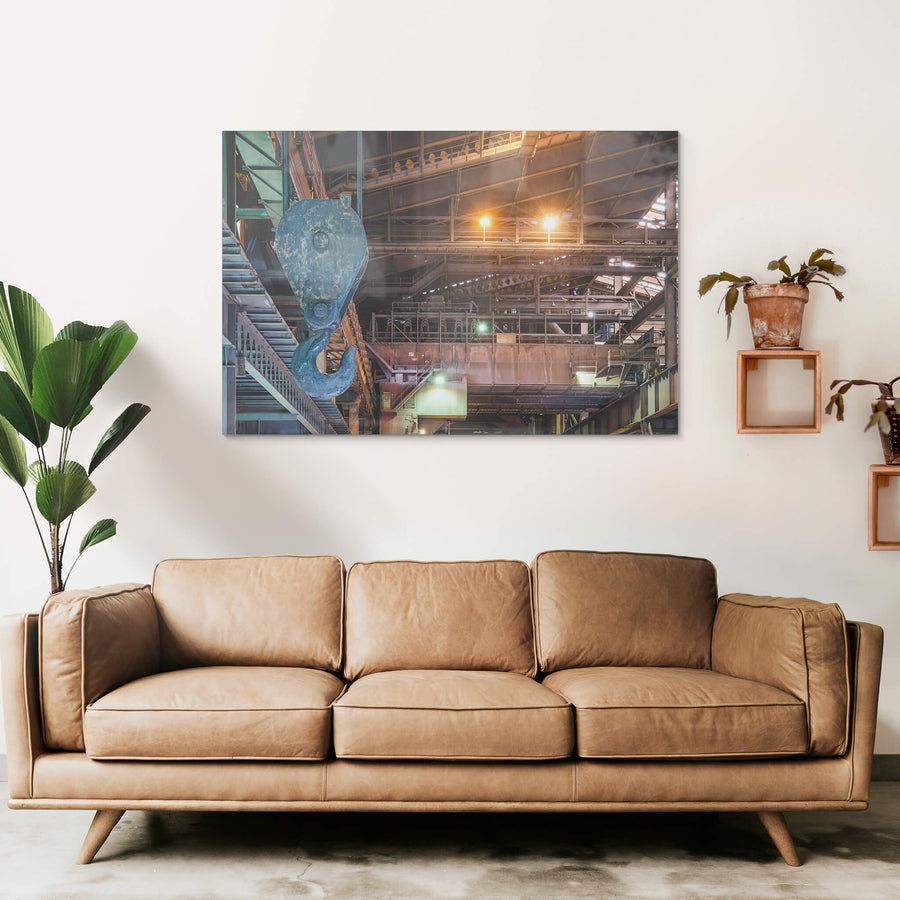
Charge Crane Hook at BlueScope Port Kembla, unframed print displayed in situ on a wall.Charge Crane Hook at BlueScope Port Kembla, white-framed print displayed in situ on a wall.Charge Crane Hook at BlueScope Port Kembla, black-framed print displayed in situ on a wall.Charge Crane Hook at BlueScope Port Kembla, raw timber-framed print displayed in situ on a wall.Charge Crane Hook at BlueScope Port Kembla, glass print displayed in situ on a wall.
01 PROVENANCE

Print datasheet

Title
Charge Crane Hook
Series
BlueScope Port Kembla
Catalogue
BPK-006
Process
Giclée
Captured
18 March 2016
Camera
NIKON D7000
Lens
24.0-70.0 mm f/2.8
Aperture
f/8.0
Shutter
13s s
ISO
100
Focal length
66 mm
Paper
Ilford Galerie Smooth Cotton Rag 310 gsm
Paper size
290 × 200 mm
Location
Port Kembla, New South Wales, Australia
Recognised by
Highly Commended in Multimedia at the 2016 National Trust of Australia (NSW) Heritage Awards
02 LOCATION

Port Kembla, New South Wales, Australia

Map · Mapbox · OpenStreetMap

03 THE STORY

About this print

The charge crane hook is a piece of working steel, shaped entirely by function. Photographed in 2016, it shows the cumulative wear of heavy industrial service: a surface pitted and marked by decades of load, heat, and mechanical stress. Nothing about it is decorative. Everything about it was necessary. Crane equipment of this kind operated throughout Port Kembla Steelworks, moving material through production areas spanning the full length of the site's 760-hectare footprint. The hook in this photograph carries no load. What it carries instead is the physical evidence of how many times it did. Port Kembla Steelworks was constructed by Hoskins Iron and Steel Co. Ltd from 1926, with the first blast furnace designed by Freyn Engineering of Chicago to a capacity of 800 tonnes per day. No. 1 blast furnace was blown in on 29 August 1928 by Emily Hoskins, widow of company founder Charles Hoskins, who had died in February 1926 before the works were completed. The furnace was subsequently named Emily in her honour. The commissioning ceremony was, by contemporary account, of the most practical character. The works passed to Australian Iron and Steel Ltd in 1928 and became a BHP subsidiary in 1935. Through the following decades, five further blast furnaces were added. Open hearth steelmaking ran from 1931 until the last furnace closed in 1982, replaced by basic oxygen steelmaking introduced in 1972. At the workforce peak in 1973, steelmaking exceeded 4,000,000 tonnes per year and more than 20,000 people worked on site. BlueScope Steel took over Port Kembla operations in 2002. The steelworks remains active. No. 5 blast furnace is currently operating, with retirement scheduled for 2030. No. 6 blast furnace, mothballed in 2011, is under a $1.15 billion reline expected to extend its operational life by 20 years. The hook in this photograph predates all of that redevelopment. It records a steelworks still in full industrial use, its equipment worn to the shape of the work it was built to do.

04 FROM THE FIELD NOTES

The charge crane hook at Port Kembla Steelworks carries the physical record of its working life in every worn surface and scored edge. Crane equipment of this kind was integral to steelmaking operations across the site, moving material through production areas that have run continuously since 29 August 1928, when Emily Hoskins lit No. 1 blast furnace and Port Kembla's first iron began to flow. The steelworks, now operated by BlueScope Steel, remains Australia's largest crude steel production plant.

Brett Patman

BlueScope Port Kembla

The series

BlueScope Port Kembla

2019 · 12 photographs

The BlueScope Port Kembla steelworks is the largest crude-steel production plant in Australia and the largest single industrial operation in the Illawarra. The site began in 1928 as Australian Iron & Steel, taking over Charles Hoskins's iron operation from Lithgow. First steel was made in 1931. BHP merged with AIS in 1935 and the works ran as BHP Steel until 2002, when BlueScope was demerged from BHP. The No.6 Blast Furnace was decommissioned in 2011 when BlueScope withdrew from the export market and stood dormant for over a decade before reline work was approved in 2021 at an estimated $1.15 billion. The No.5 Blast Furnace is approaching end of life. The Lost Collective photographs document the dormant sections of the works during the period after the 2011 shutdown.

View all in this series →

05 SIZE GUIDE

Print sizes

The anatomy view shows what this finish is as a physical object: paper margin, mat band, frame depth, acrylic profile. The comparison strip shows how each size sits relative to the others at true scale. Click a size or a finish to update both.

Anatomy · true ratio
TypeSizeWidthHeight
08 BY POST · NO SPAM

Read the full story

Articles when they're published. The history behind a place. The day of a shoot. The work between prints. No marketing, no schedule.

You're subscribed.