On the Catwalk

Provenance

Camera
NIKON D850
Lens
14.0-24.0 mm f/2.8
Settings
24mm · f/8.0 · 1/50 · ISO 100
Paper
Ilford Galerie Smooth Cotton Rag 310 gsm

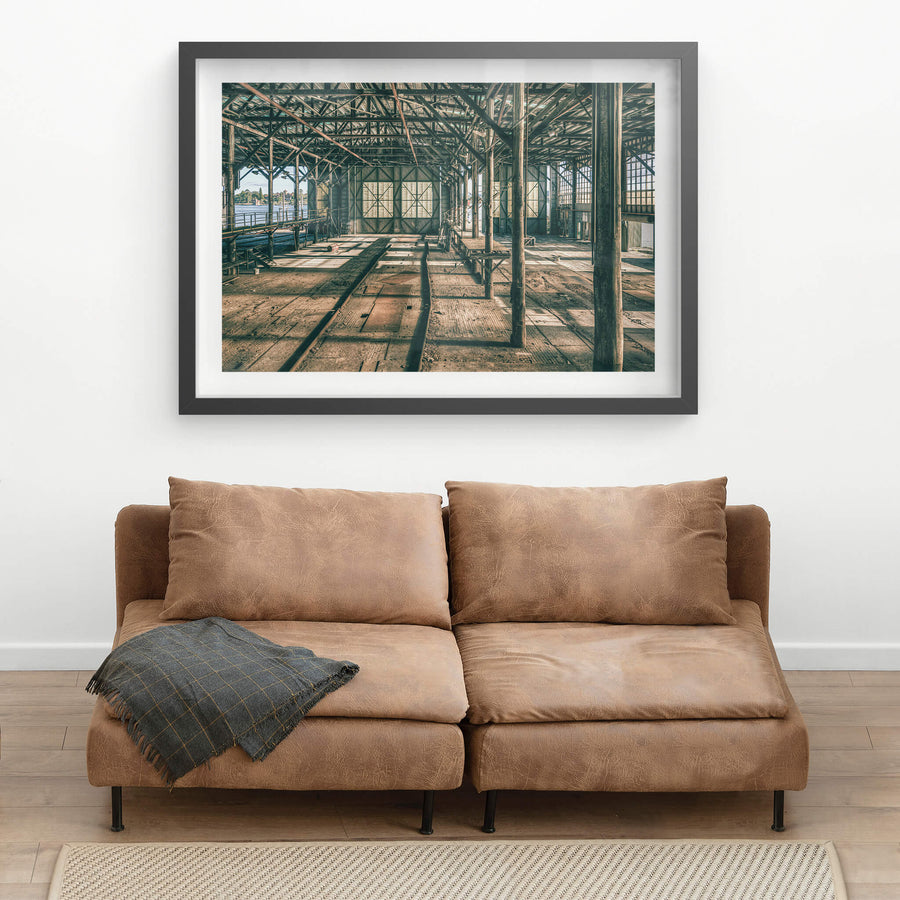
Steel columns rise at regular intervals through the interior of the main boatshed. Rail tracks are set into a timber floor and run the length of the shed toward the water. The roof structure is open above a slipway bay, letting daylight into the vacant space. No vessels or equipment remain on the floor.

Edition
Open edition

Open edition
Printed to order, no fixed quantity. Each print is hand-signed by the photographer.

Limited edition
A fixed number of prints exist. Once sold, the edition closes permanently. Each print is individually numbered and signed.

$100.00 AUD
Size
Type
Colour
Signed, numbered, with COA. Made to order in 5 to 10 business days (unframed). Shipped in protective packaging with edition certificate, paper-stock reference and a printed care guide.
See certificate sample →

Shipping Free shipping over $250. Ships worldwide, rates calculated at checkout.

Returns Damaged in transit? We replace it. Full policy →

Ships within 10 business days · signed & numbered

In situ

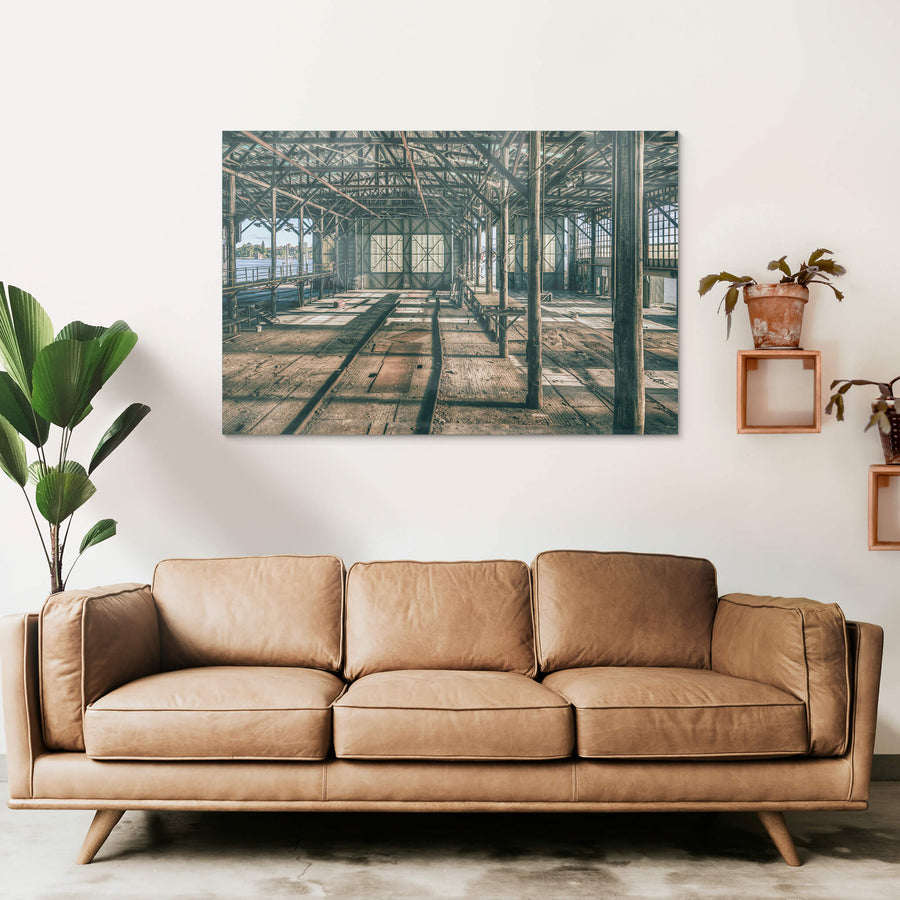
On the Catwalk at Halvorsens Boat Yard, unframed print displayed in situ on a wall.On the Catwalk at Halvorsens Boat Yard, white-framed print displayed in situ on a wall.On the Catwalk at Halvorsens Boat Yard, black-framed print displayed in situ on a wall.On the Catwalk at Halvorsens Boat Yard, raw timber-framed print displayed in situ on a wall.On the Catwalk at Halvorsens Boat Yard, glass print displayed in situ on a wall.
01 PROVENANCE

Print datasheet

Title
On the Catwalk
Series
Halvorsens Boat Yard
Catalogue
HBY-010
Process
Giclée
Captured
24 June 2018
Camera
NIKON D850
Lens
14.0-24.0 mm f/2.8
Aperture
f/8.0
Shutter
1/50 s
ISO
100
Focal length
24 mm
Paper
Ilford Galerie Smooth Cotton Rag 310 gsm
Paper size
290 × 200 mm
Location
Putney, New South Wales, Australia
Recognised by
Highly Commended in Multimedia at the 2016 National Trust of Australia (NSW) Heritage Awards
02 LOCATION

Putney, New South Wales, Australia

Map · Mapbox · OpenStreetMap

03 THE STORY

About this print

The rail tracks run from somewhere near the back of the shed all the way to the river. They are set into the timber floor of the main boatshed at Halvorsens Boat Yard in Putney, and their purpose is straightforward: move the hull to the water. Everything in the shed was built around that logic. The steel columns, the timber roof trusses above the slipway bay open to sky, the long clear span of the floor. The building was designed for launching, not for looking at. Lars Halvorsen Sons Pty Ltd constructed the Putney complex from 1939, completing the boatshed, concrete slipways, timber wharf, and associated buildings in the early 1940s. The yard operated five slipways on the Parramatta River, capable of handling vessels up to 90 feet and 100 tons. At its wartime peak the workforce reached approximately 350 people, producing Fairmile motor launches, fast supply vessels, and air-sea rescue boats for the Royal Australian Navy, the United States Navy, the Royal Netherlands Navy, and the RAAF. The combined value of wartime contracts exceeded £1,000,000. After the war the yard returned to leisure craft and racing yacht construction. The 1949 Daily Telegraph described it as the most modern facility of its kind in the British Empire. In 1962 the yard launched Gretel, designed by naval architect Alan Payne and commissioned by Sir Frank Packer, Australia's first America's Cup challenger. Between 1925 and 1976, across the Drummoyne, Neutral Bay, and Putney yards, Lars Halvorsen Sons built 1,299 craft. The boatyard closed around 1980. The Commonwealth of Australia subsequently converted the site to a Royal Australian Navy repair facility. By 2018, when this photograph was made, the shed stood empty. The columns held the roof up. The tracks went nowhere. The slipway bay was open to the sky above a floor that hadn't carried a hull in decades.

04 FROM THE FIELD NOTES

Steel columns carry the roof of the main boatshed at Halvorsens Boat Yard in Putney, where rail tracks still run the length of the timber floor toward the Parramatta River. The tracks were laid to move hulls from the workshop to the water, a practical detail in a yard that built 1,299 craft between 1925 and 1976. The boatshed, a timber-framed structure built over the river in the early 1940s, sat above five concrete slipways capable of handling vessels up to 90 feet and 100 tons. By the time this photograph was made in 2018, the yard had long closed; the roof was open to sky above a slipway bay that hadn't seen a hull in decades.

Brett Patman

Halvorsens Boat Yard

The series

Halvorsens Boat Yard

2018 · 17 photographs

Halvorsens Boat Yard ran on the Parramatta River at Ryde from 1939 to 1980, on a five-acre site that had once been part of James Squire's colonial brewery wharf. The yard was Lars Halvorsen Sons' main works, with engineering, blacksmith, lumber, machine, plumbing, and sheet metal shops, plus five slipways for craft up to 90 feet and 100 tons. The Halvorsen family enterprise built 1,299 vessels between 1925 and 1976; over 200 of those went to the Australian, United States, and Dutch forces during the Second World War, including 178 38-foot air-sea rescue boats and 16 112-foot Fairmile motor launches. In 1962 the yard built Gretel, Australia's first America's Cup challenger. Production at Ryde wound down through 1979 and the site was sold to the Royal Australian Navy in 1980.

View all in this series →

05 SIZE GUIDE

Print sizes

The anatomy view shows what this finish is as a physical object: paper margin, mat band, frame depth, acrylic profile. The comparison strip shows how each size sits relative to the others at true scale. Click a size or a finish to update both.

Anatomy · true ratio
TypeSizeWidthHeight
08 BY POST · NO SPAM

Read the full story

Articles when they're published. The history behind a place. The day of a shoot. The work between prints. No marketing, no schedule.

You're subscribed.