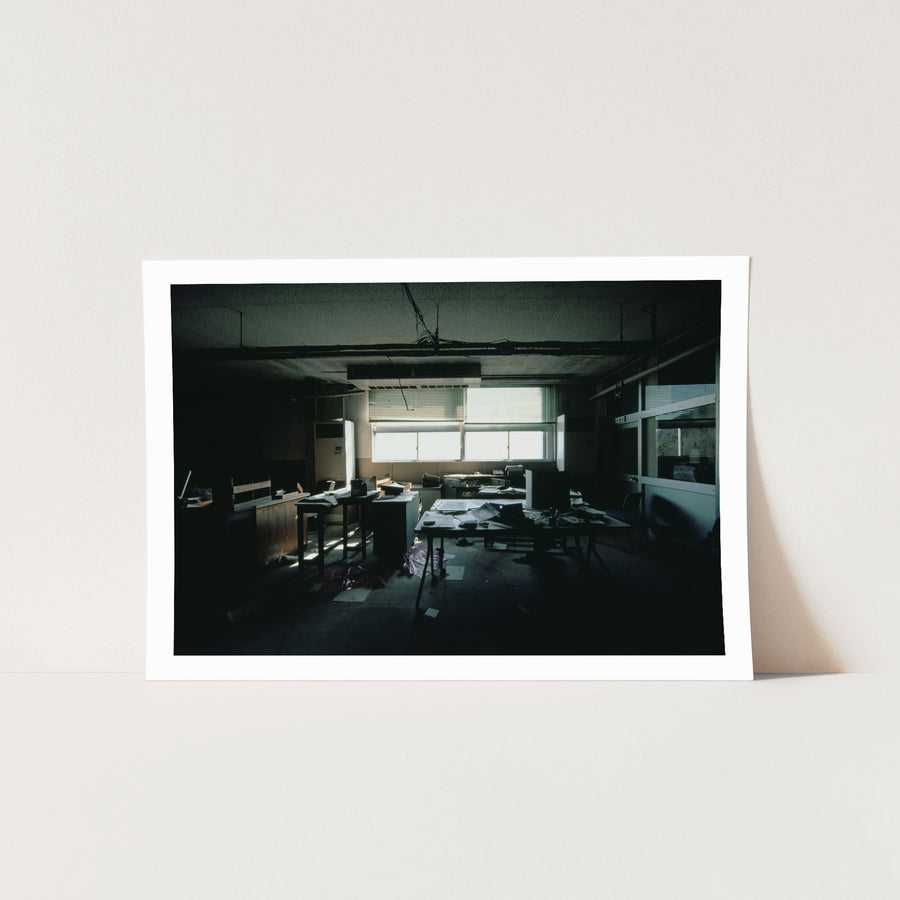
Scattered Desks

Provenance

Camera
Nikon F100
Film
Fujifilm Velvia 50 · 35mm · ISO 50
Paper
Ilford Galerie Smooth Cotton Rag 310 gsm

Two large windows with horizontal blinds cast banded light across desks covered in papers and debris. A tall white air conditioning unit stands left of the windows beside a dark wooden desk. A large dark monitor sits on a desk to the right. Electrical conduits hang loose from a sagging, water-stained ceiling.

Edition
Open edition

Open edition
Printed to order, no fixed quantity. Each print is hand-signed by the photographer.

Limited edition
A fixed number of prints exist. Once sold, the edition closes permanently. Each print is individually numbered and signed.

$100.00 AUD
Size
Type
Colour
Signed, numbered, with COA. Made to order in 5 to 10 business days (unframed). Shipped in protective packaging with edition certificate, paper-stock reference and a printed care guide.
See certificate sample →

Shipping Free shipping over $250. Ships worldwide, rates calculated at checkout.

Returns Damaged in transit? We replace it. Full policy →

Ships within 10 business days · signed & numbered

In situ
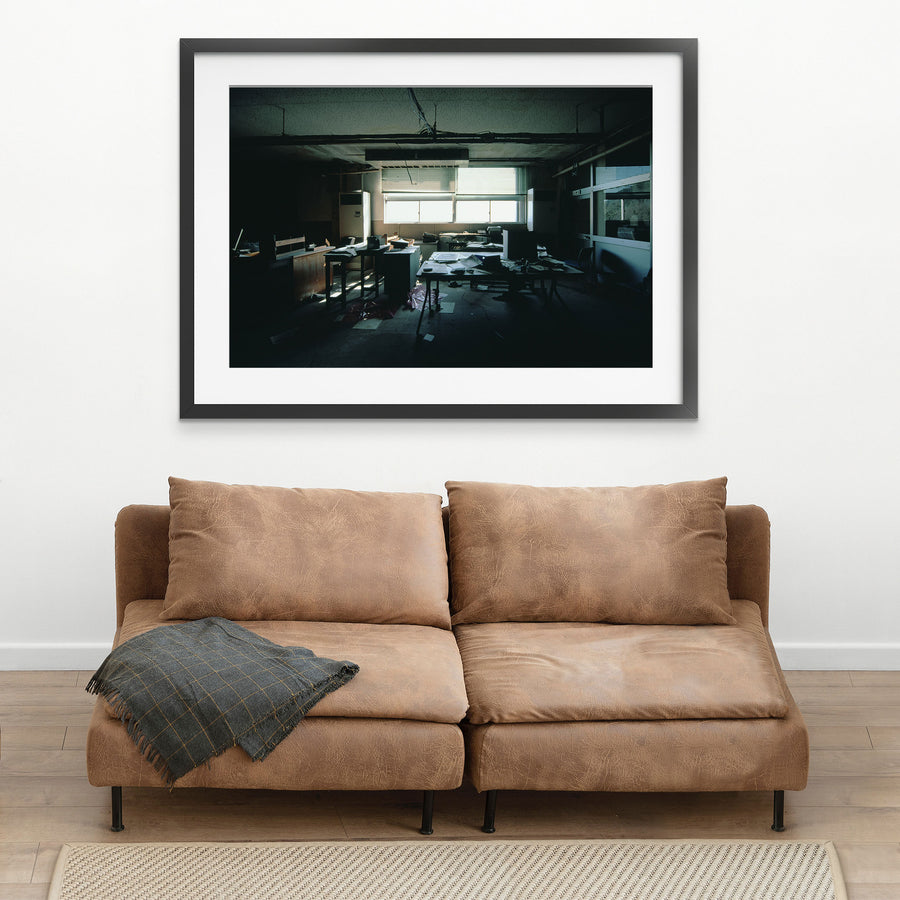
Interior of a derelict office at Ikeshima Coal Mine, with horizontal blinds casting banded light across paper-strewn desks, a large dark monitor, a white air conditioning unit, and a sagging ceiling with visible water damage.Interior of a derelict office at Ikeshima Coal Mine, with horizontal blinds casting banded light across paper-strewn desks, a large dark monitor, a white air conditioning unit, and a sagging ceiling with visible water damage.Interior of a derelict office at Ikeshima Coal Mine, with horizontal blinds casting banded light across paper-strewn desks, a large dark monitor, a white air conditioning unit, and a sagging ceiling with visible water damage.Interior of a derelict office at Ikeshima Coal Mine, with horizontal blinds casting banded light across paper-strewn desks, a large dark monitor, a white air conditioning unit, and a sagging ceiling with visible water damage.Interior of a derelict office at Ikeshima Coal Mine, with horizontal blinds casting banded light across paper-strewn desks, a large dark monitor, a white air conditioning unit, and a sagging ceiling with visible water damage.
01 PROVENANCE

Print datasheet

Title
Scattered Desks
Series
Ikeshima
Catalogue
IKE-044
Process
Giclée
Captured
17 January 2026
Camera
Nikon F100
Film
Fujifilm Velvia 50
Format
35mm
Film ISO
50
Paper
Ilford Galerie Smooth Cotton Rag 310 gsm
Location
Nagasaki, Nagasaki, Japan
Recognised by
Highly Commended in Multimedia at the 2016 National Trust of Australia (NSW) Heritage Awards
02 LOCATION

Nagasaki, Nagasaki, Japan

Map · Mapbox · OpenStreetMap

03 THE STORY

About this print

The safety offices occupy a room on an upper floor of the main building at Ikeshima Coal Mine, and in 2026 they look largely as they were left. Papers and debris cover the desks. A large dark monitor sits on a desk to the right of centre. A tall white air conditioning unit stands beside the rear windows, next to a dark wooden desk with a low partition. Horizontal blinds on the two large windows slice the room into hard bands of light and shadow. Overhead, electrical conduits hang loose from a ceiling that has been giving way to water for years, the damage most visible above the left window. Ikeshima Coal Mine operated on and beneath a small island in Nagasaki Prefecture, about 7 km off the west coast of the Nishi-Sonogi Peninsula in the Gotō Sea. The island itself covers about 1.08 km²; the worked coalfield lay entirely under the seabed, the deepest workings reaching about 650 m below sea level. Commercial output began in 1959, making Ikeshima the last new coal mine to open in Japan, and the mine produced approximately 44.5 million tonnes of clean coal over its operating life. At its 1970 peak, around 7,770 people lived on the island, housed in reinforced-concrete apartment blocks because there was no room to spread. To supply them, Matsushima Coal Mining commissioned an on-island coal-fired power station and a seawater-desalination plant in 1967. The mine produced more than 1.5 million tonnes of coal in its peak year of 1985, and maintained output of around 1.2 million tonnes a year into the 1990s. The end came on 29 November 2001. The last descent was made the day before; about 2,500 employees were dismissed. A closure ceremony followed on 23 March 2002. The offices, the desks, the papers, the monitor: what the photograph records is what the closure left behind.

04 FROM THE FIELD NOTES

The safety offices of Ikeshima Coal Mine sit inside the main building of a submarine coal operation that ran from 1959 until 29 November 2001, when the last descent was made and about 2,500 employees were dismissed. Papers and debris still cover the desks. Horizontal blinds slice the room into bands of light and shadow, a tall white air conditioning unit stands beside the windows, and the ceiling above shows the long work of water damage.

Brett Patman

Ikeshima

The series

Ikeshima

1959 to 2001 · 55 photographs

Ikeshima Coal Mine operated beneath the seabed off Nagasaki from 1959 until 29 November 2001, making it the last new coal mine to open in Japan and the last large-scale underground colliery to close. At its 1970 peak the island held 7,770 residents on a 1.08 km² rock in the Gotō Sea, housed in company-built concrete towers above a mine that reached 650 m below sea level.

View all in this series →

05 SIZE GUIDE

Print sizes

The anatomy view shows what this finish is as a physical object: paper margin, mat band, frame depth, acrylic profile. The comparison strip shows how each size sits relative to the others at true scale. Click a size or a finish to update both.

Anatomy · true ratio
TypeSizeWidthHeight
08 BY POST · NO SPAM

Read the full story

Articles when they're published. The history behind a place. The day of a shoot. The work between prints. No marketing, no schedule.

You're subscribed.