Ikeshima : You can go, but you can't come back
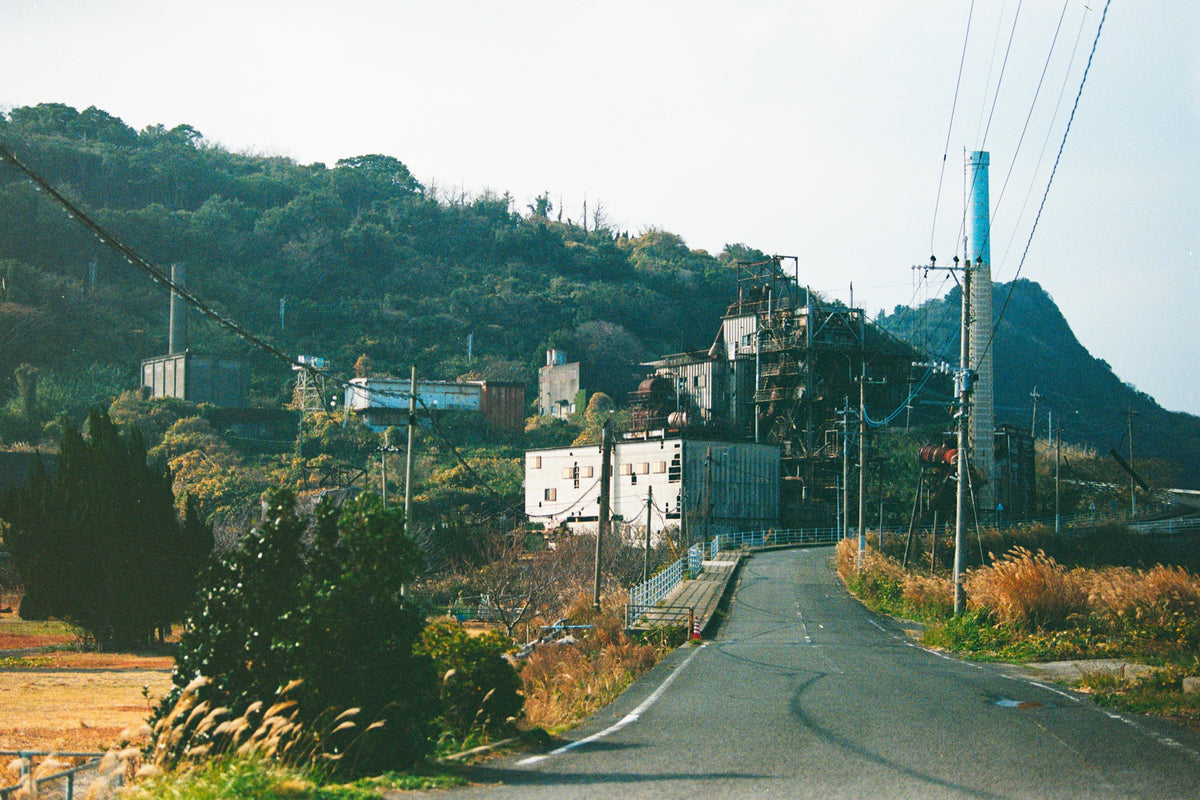
One day on Ikeshima, the last large-scale coal mine in Japan, with a stranger called Yu, from the ticket queue at Kōnoura to the 5 PM ferry off the island. Shot on a Nikon F100.
Read the noteYour cart
Nothing saved yet. Start with the current series or browse the full archive.

01 Ikeshima2026
Series · 54 prints
Map · Mapbox · OpenStreetMap
Ikeshima Coal Mine operated beneath the seabed off Nagasaki from 1959 until 29 November 2001, making it the last new coal mine to open in Japan and the last large-scale underground colliery to close. At its 1970 peak the island held 7,770 residents on a 0.86 km² rock in the Gotō Sea, housed in company-built concrete towers above a mine that reached 650 m below sea level.
Ikeshima Coal Mine grew from offshore boring begun in 1948 that confirmed coal seams under and around a small island in the Gotō Sea, roughly 7 km off the Nishi-Sonogi Peninsula west of Nagasaki. Commercial output started in 1959 under Matsushima Coal Mining, a Mitsui group subsidiary, and ran for 42 years. The mine was entirely submarine: the worked seams sat beneath the seabed, reaching about 650 m below sea level, and from 1974 extended a further 4 to 5 km west to a second working area off the islet of Hikishima. German-built high-speed personnel trains carried miners to faces far out under the water. Peak production in 1985 exceeded 1.5 million tonnes; lifetime output was approximately 44.5 million tonnes of clean coal.
The island sustained nearly 7,800 residents at its 1970 peak, housed in reinforced-concrete apartment towers with communal bathhouses and a rent of about 400 yen, served by the island's own coal-fired power station and seawater-desalination plant. When the mine closed on 29 November 2001, about 2,500 employees were dismissed and most residents left. Rather than being sealed, the workings were kept usable: from 2002 the site ran a government-backed overseas coal-technology transfer programme, and Ikeshima now operates what is described as Japan's only underground coal-mine experience tour, with former miners as guides. By 2021 the resident population had fallen to 111.
Hand-signed and numbered, printed from a scan of the original negative. Open editions in the two smallest sizes; limited editions of 100, 50 and 25 in the three larger, never reissued once they sell through.
Made to order by Brett in Sydney, from a scan of the original negative. Each print is hand-signed and numbered before it ships.
Paper
Ilford Galerie cotton rag, 310 gsm. Acrylic on metallic gloss, 260 gsm.
Lead time
Unframed: 5 to 10 business days. Framed and acrylic: 10 to 20.
One day on Ikeshima, the last large-scale coal mine in Japan, with a stranger called Yu, from the ticket queue at Kōnoura to the 5 PM ferry off the island. Shot on a Nikon F100.
Read the noteAt the 1970 peak, 7,770 people lived on an island barely a kilometre across. Matsushima Coal Mining built reinforced-concrete apartment towers with communal bathhouses and shared laundries, hot water supplied, rent about 400 yen. Mainland coal towns spread across paddocks in low timber rows; Ikeshima had no room for that, so it went up instead.
While still producing coal, Ikeshima trained around 500 people from 28 countries in deep-mining methods. After closure in 2001 the workings were kept open for a government-backed technology transfer programme, sending Japanese undersea mining expertise to Indonesia, Vietnam and elsewhere. The mine's afterlife was as useful as its working life.
Reaching the coal faces required travelling more than 5 km underground at up to 50 km/h aboard German-built high-speed personnel trains. The engineering record names two sets, the Megami-go and Jikai. After closure, one trainset was kept on the island; the other went to the Omuta Coal Industry and Science Museum in Fukuoka.