Approach and Sign

Provenance

Camera
NIKON D850
Lens
14.0-24.0 mm f/2.8
Settings
24mm · f/9.0 · 1/250 sec · ISO 100
Paper
Ilford Galerie Smooth Cotton Rag 310 gsm

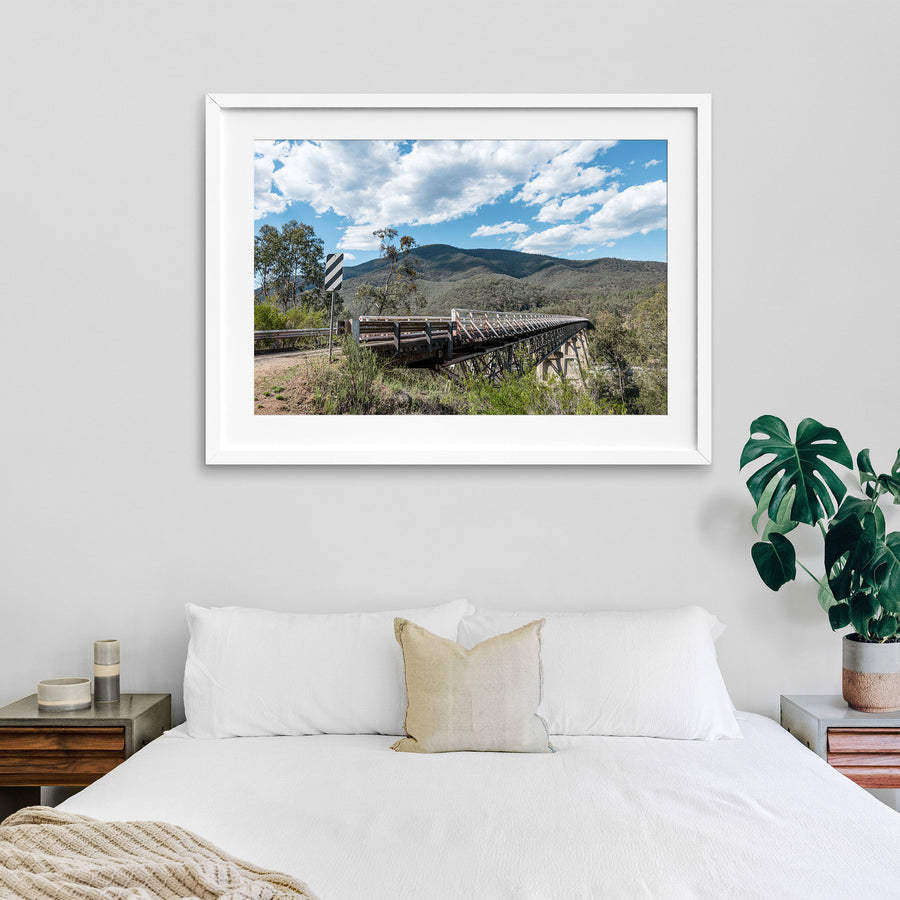
Road approach to McKillops Bridge viewed from the western side. A black and white chevron warning sign stands at left. Steel Warren trusses and concrete piers carry a single-lane timber deck across the Snowy River. Forested hills rise on both banks. Overcast sky above the treeline. No vehicles or people in the frame.

Edition
Open edition

Open edition
Printed to order, no fixed quantity. Each print is hand-signed by the photographer.

Limited edition
A fixed number of prints exist. Once sold, the edition closes permanently. Each print is individually numbered and signed.

$100.00 AUD
Size
Type
Colour
Signed, numbered, with COA. Made to order in 10 to 20 business days (framed). Shipped in protective packaging with edition certificate, paper-stock reference and a printed care guide.
See certificate sample →

Shipping Free shipping over $250. Ships worldwide, rates calculated at checkout.

Returns Damaged in transit? We replace it. Full policy →

Ships within 10 business days · signed & numbered

In situ
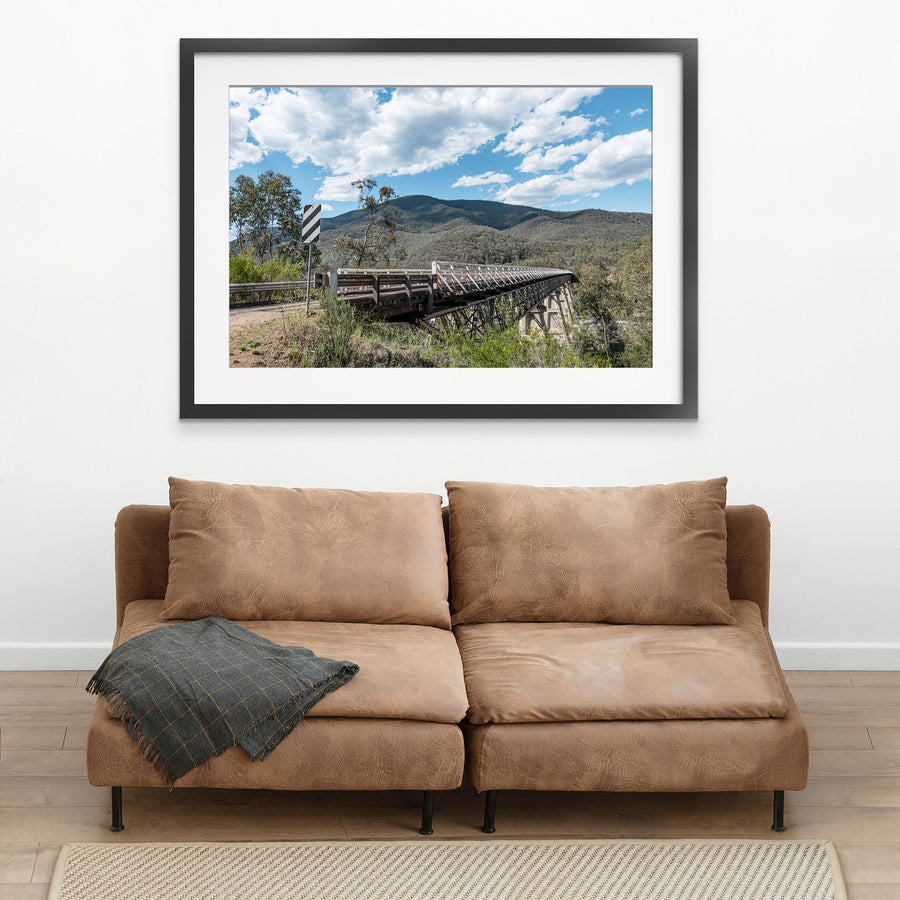
View along the road approach to McKillops Bridge in Deddick Valley, with a black and white chevron sign at left and the single-lane timber-decked steel truss bridge spanning the Snowy River, forested hills rising beyond under an overcast sky.View along the road approach to McKillops Bridge in Deddick Valley, with a black and white chevron sign at left and the single-lane timber-decked steel truss bridge spanning the Snowy River, forested hills rising beyond under an overcast sky.View along the road approach to McKillops Bridge in Deddick Valley, with a black and white chevron sign at left and the single-lane timber-decked steel truss bridge spanning the Snowy River, forested hills rising beyond under an overcast sky.View along the road approach to McKillops Bridge in Deddick Valley, with a black and white chevron sign at left and the single-lane timber-decked steel truss bridge spanning the Snowy River, forested hills rising beyond under an overcast sky.View along the road approach to McKillops Bridge in Deddick Valley, with a black and white chevron sign at left and the single-lane timber-decked steel truss bridge spanning the Snowy River, forested hills rising beyond under an overcast sky.
01 PROVENANCE

Print datasheet

Title
Approach and Sign
Series
McKillops Bridge
Catalogue
MCK-002
Process
Giclée
Captured
26 December 2018
Camera
NIKON D850
Lens
14.0-24.0 mm f/2.8
Aperture
f/9.0
Shutter
1/250 sec s
ISO
100
Focal length
24 mm
Paper
Ilford Galerie Smooth Cotton Rag 310 gsm
Location
Deddick Valley
Recognised by
Highly Commended in Multimedia at the 2016 National Trust of Australia (NSW) Heritage Awards
02 LOCATION

Deddick Valley

Map · Mapbox · OpenStreetMap

03 THE STORY

About this print

The road approach to McKillops Bridge offers the clearest measure of what the Country Roads Board achieved here. A single lane of timber decking, 255 metres of it, runs out across the Snowy River on welded steel Warren trusses carried by five reinforced-concrete A-frame piers. A black and white chevron sign at the entry is the only signal that anything significant is ahead. Forested hills rise on both banks, and the sky above the gorge holds cloud. The crossing at this point on the Snowy had been worked by a punt since 1889, when the Victorian Government funded the service and employed a Scottish-born ferryman named Duncan McKellar at £75 a year. The site became known as McKellar's Crossing. The bridge itself takes a different name: George McKillop, who brought cattle through here in 1835 on the stock route down from the Monaro toward the Omeo plains. The Country Roads Board first proposed a crossing in 1928. A low-level design was set aside once flash floods were recognised as the governing risk, and a high-level structure was chosen. The contract was let to Gardener Constructions of Melbourne in 1931 for £11,950. The first bridge was completed but never opened. On 8 January 1934, a flash flood lifted the structure off its piers and carried the superstructure downstream; part of the wreck reached Orbost. The river was reported 16 feet above any previously recorded height. The CRB rebuilt. The piers were raised 15 feet, the open A-frames filled in to shed debris, the original abutments turned into additional piers, the trusses cantilevered back to the higher approaches. The replacement opened on 20 December 1935, with about 250 people present. A contemporary press report put the cost of the replacement at about £12,000. The bridge was listed on the Victorian Heritage Register as H1849 and received an Engineering Heritage Marker from Engineers Australia in November 2019. It has stood through every flood since 1935 without damage, none reaching the height of the trusses. This photograph was made in 2018.

04 FROM THE FIELD NOTES

Seen from the road approach, McKillops Bridge presents itself as it has since 1935: a single lane of timber decking on welded steel trusses, carried across the Snowy River on five concrete piers above a deep gorge in what is now Snowy River National Park. A black and white chevron sign at the entry is the only formal instruction. The Country Roads Board built the bridge in two stages after the first structure, completed but never opened, was torn from its piers by a flash flood on 8 January 1934 and swept downstream. The replacement opened on 20 December 1935.

Brett Patman

McKillops Bridge

The series

McKillops Bridge

1931 to 2025 · 7 photographs

McKillops Bridge carries a single lane across the Snowy River in East Gippsland's Deddick Valley, 255 metres of timber decking on electric-arc-welded steel trusses and five tall concrete piers. The Country Roads Board built it in two attempts between 1931 and 1935. The first bridge was torn off its piers by a flash flood in January 1934, days before its planned opening. The replacement, set 15 feet higher, opened 20 December 1935 and has stood through every flood since.

View all in this series →

05 SIZE GUIDE

Print sizes

The anatomy view shows what this finish is as a physical object: paper margin, mat band, frame depth, acrylic profile. The comparison strip shows how each size sits relative to the others at true scale. Click a size or a finish to update both.

Anatomy · true ratio
TypeSizeWidthHeight
08 BY POST · NO SPAM

Read the full story

Articles when they're published. The history behind a place. The day of a shoot. The work between prints. No marketing, no schedule.

You're subscribed.