
Railing Line
Provenance
- Camera
- NIKON Z 7
- Lens
- 250.0-560.0 mm f/5.6
- Settings
- 550mm · f/8.0 · 1/640 sec · ISO 140
- Paper
- Ilford Galerie Smooth Cotton Rag 310 gsm
A diamond-set top rail over four intermediate rails runs the full 255 metres of the McKillops Bridge handrail, the white-painted timber throwing hard repeating shadows across the wire mesh infill in strong afternoon light. The geometry tightens into a dense lattice before the bush swallows the far end of the deck above the Snowy River.
Open edition
Printed to order, no fixed quantity. Each print is hand-signed by the photographer.
Limited edition
A fixed number of prints exist. Once sold, the edition closes permanently. Each print is individually numbered and signed.
Shipping Free shipping over $250. Ships worldwide, rates calculated at checkout.
Returns Damaged in transit? We replace it. Full policy →
Ships within 10 business days · signed & numbered
In situ
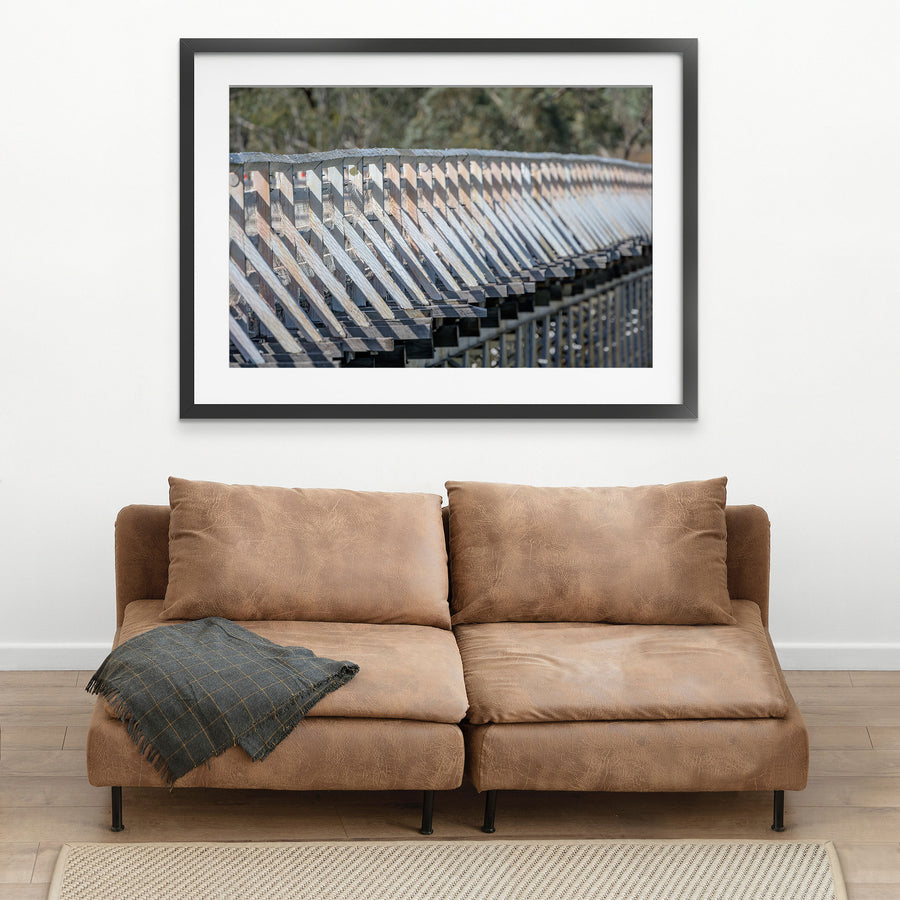
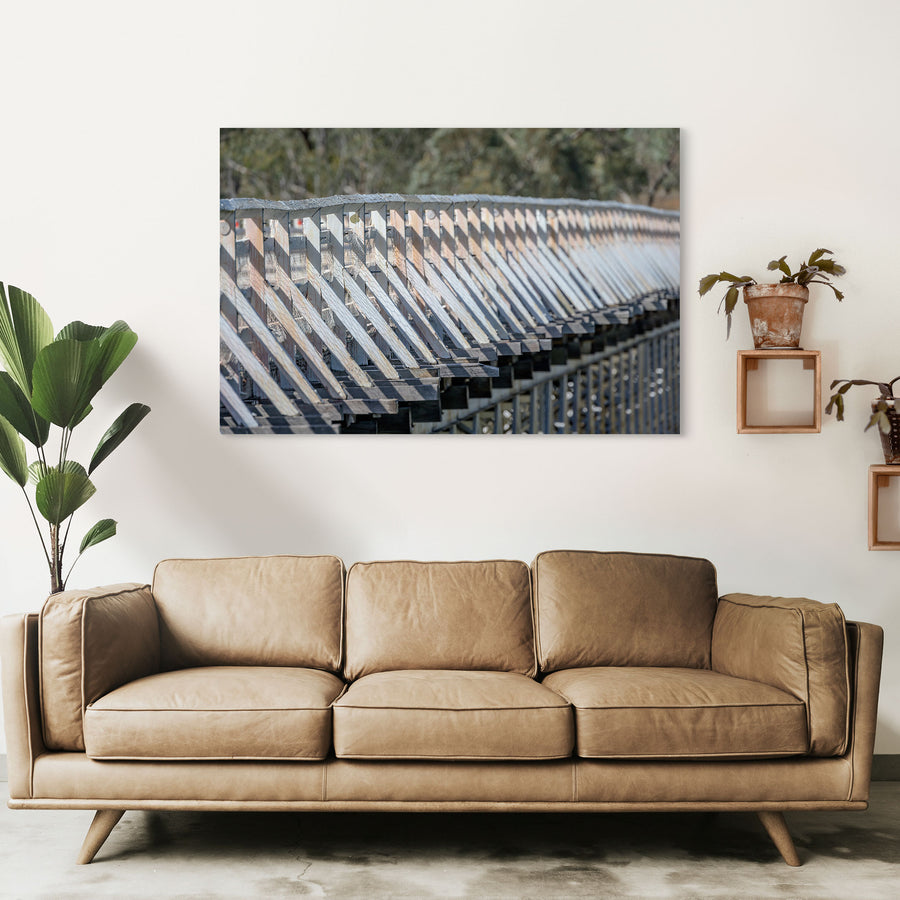

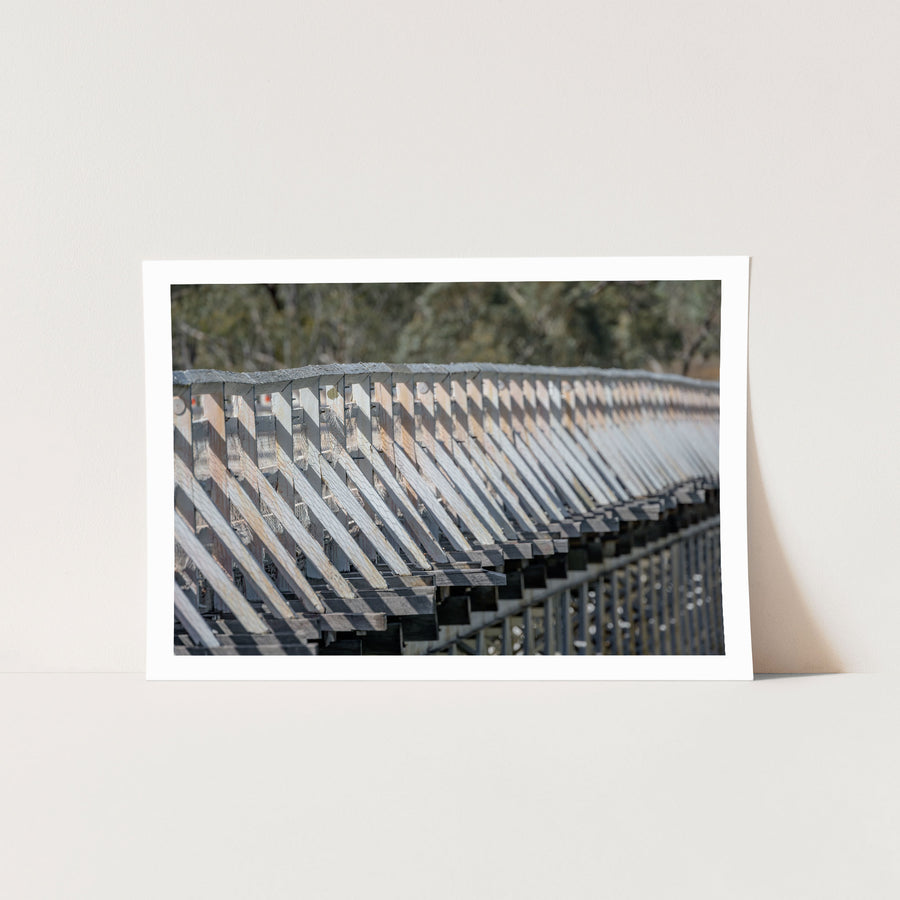

Print datasheet
- Title
- Railing Line
- Series
- McKillops Bridge
- Catalogue
- MCK-006
- Process
- Giclée
- Captured
- 26 December 2018
- Camera
- NIKON Z 7
- Lens
- 250.0-560.0 mm f/5.6
- Aperture
- f/8.0
- Shutter
- 1/640 sec s
- ISO
- 140
- Focal length
- 550 mm
- Paper
- Ilford Galerie Smooth Cotton Rag 310 gsm
- Paper size
- 297 × 210 mm
- Location
- Deddick Valley
- Authenticity
- C2PA verified provenance →
- Recognised by
- Highly Commended in Multimedia at the 2016 National Trust of Australia (NSW) Heritage Awards
Deddick Valley
Map · Mapbox · OpenStreetMap
About this print
The railing along McKillops Bridge was built with purpose: a substantial timber barrier, braced and angled, designed to keep runaway cattle on a 255-metre crossing over the Snowy River in East Gippsland. The Country Roads Board opened the bridge on 20 December 1935, after a first structure was torn off its piers by a flash flood on 8 January 1934. The replacement deck was set fifteen feet higher. Painted white, the timber stands out clearly against the deep gorge and surrounding bush of Snowy River National Park.
Brett Patman

The series
McKillops Bridge
McKillops Bridge carries a single lane across the Snowy River in East Gippsland's Deddick Valley, 255 metres of timber decking on electric-arc-welded steel trusses and five tall concrete piers. The Country Roads Board built it in two attempts between 1931 and 1935. The first bridge was torn off its piers by a flash flood in January 1934, days before its planned opening. The replacement, set 15 feet higher, opened 20 December 1935 and has stood through every flood since.
Print sizes
The anatomy view shows what this finish is as a physical object: paper margin, mat band, frame depth, acrylic profile. The comparison strip shows how each size sits relative to the others at true scale. Click a size or a finish to update both.
| Type | Size | Width | Height |
|---|


